
Spectral-MPQS: Harmonizing Time and Space in Spatial Crowdsourcing
Mixed Priority Queue Scheduling Based on Spectral Clustering in Spatial Crowdsourcing
The paper introduces Spectral-MPQS, a novel spatial crowdsourcing framework that optimizes task assignment by maximizing accomplishment rates and minimizing travel time. It uniquely combines an enhanced Spectral Clustering algorithm for domain partitioning with a Mixed Priority Queue Scheduling mechanism for effective task sequencing.
TL;DR
The paper presents Spectral-MPQS, a sophisticated task-assignment framework designed for spatial crowdsourcing. By combining Spectral Clustering for intelligent network partitioning and a Mixed Priority Queue for task scheduling, it effectively solves the conflict between maximizing task completion and minimizing worker travel costs, outperforming traditional nearest-neighbor heuristics.
Background & Motivation: The Limitations of "Local Thinking"
In the booming sharing economy (Uber, Meituan, product auditing), spatial crowdsourcing handles massive location-sensitive tasks. However, two major hurdles persist:
- Spatio-Temporal Rigidity: Workers must finish tasks before individual deadlines and return to their origins before their own work shift ends.
- Clustering Phenomena: Tasks are rarely uniform; they cluster in hubs.
Previous methods like the Nearest-Neighbor Heuristic (NNH) suffer from "short-sightedness"—choosing the closest task now might lead to missing three urgent tasks later. The authors argue that a global partitioning strategy combined with a dynamic priority metric is the only way to achieve true efficiency.
Methodology: The Spectral-MPQS Architecture
The solution is divided into two distinct phases: spatial partitioning and task-level scheduling.
1. Spectral Clustering with KNN Affinity
Instead of simple K-means, the authors use Spectral Clustering. By constructing an affinity matrix using K-Nearest Neighbors (KNN), the model captures the underlying manifold of task distributions. This ensures that subdomains are not just circular blobs but reflect the actual density and connectivity of urban tasks.
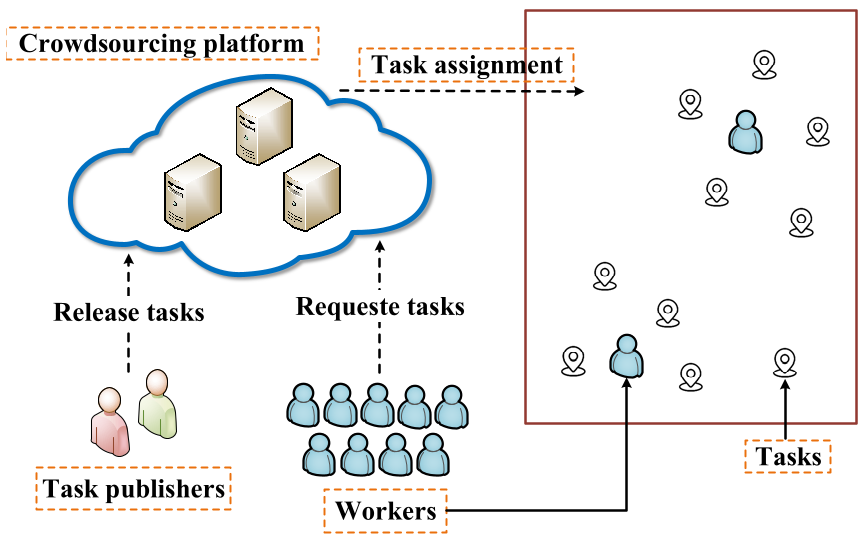 Fig 1: The general framework showing the interaction between platform, workers, and publishers.
2. Mixed Priority Queue Scheduling (MPQS)
Once assigned to a subdomain, workers don't just pick the closest task. They use a Mixed Priority Index:
- : Normalized spatial distance.
- : Normalized temporal emergency (time left until deadline).
- : A balancing weight found to be optimal at 0.6 (favoring temporal urgency slightly more than distance).
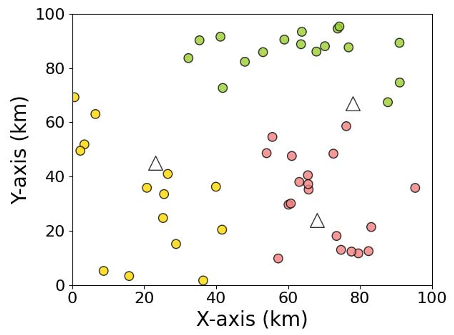 Fig 2: The step-by-step process: (a) Initialization, (b) Spectral partitioning, (c) Assigning workers to specific subdomains.
Experiments: Real-World Performance on Gowalla
The researchers tested their algorithm using the Gowalla dataset (a location-based social network).
Key Findings:
- Task Accomplishment (): Spectral-MPQS consistently stayed ahead of K-MPQS and NNH. As the number of workers increased, Spectral-MPQS was able to reach global task completion saturation much faster.
- Travel Cost (): While NNH is naturally fast by being greedy, Spectral-MPQS maintained a competitive travel cost while achieving a significantly higher total completed task count.
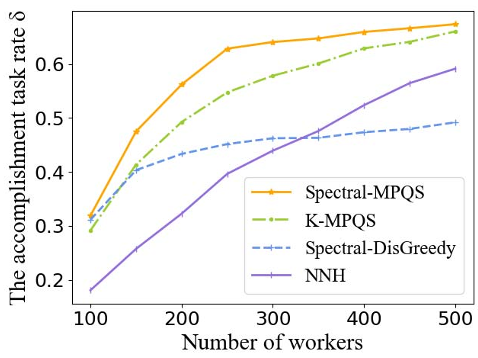 Fig 3: Comparison of accomplishment rate (δ) and travel cost (τ) on the Gowalla dataset showing Spectral-MPQS's superior scalability.
Critical Insight & Conclusion
The genius of this paper lies in its recognition that time is often more "expensive" than distance in crowdsourcing. By assigning , the system acknowledges that while saving gas (distance) is good, preventing a task from expiring (time) provides better utility for the platform.
Limitations: The current model assumes a constant travel speed and fixed processing times. In real-world urban environments, traffic congestion and variable task complexity (e.g., a "large" delivery vs. a "small" one) would require more dynamic modeling.
Future Outlook: Integrating Real-Time Traffic APIs and Reinforcement Learning to dynamically adjust the parameter as worker density shifts throughout the day could be the next frontier for this research.