
MixedEmotions: Bridging the Gap Between Affective Research and Industrial Multimodality
Mixedemotions: An open-source toolbox for multimodal emotion analysis
MixedEmotions is a comprehensive open-source toolbox for multimodal emotion analysis, supporting text, audio, video, and linked data. It achieves SOTA performance by integrating diverse modules like LSTM-based text analysis and Bag-of-Audio-Words (BoAW) via a scalable microservice architecture.
TL;DR
MixedEmotions is a game-changing open-source platform designed to handle the messy reality of human emotion across text, audio, and video. By moving away from monolithic designs toward a Docker-powered microservice architecture, it provides a "plug-and-play" solution that scales for big data. It’s not just about detecting a "happy face"; it's about linking that emotion to social network graphs and knowledge bases like DBpedia to understand why the user is happy.
The Problem: The "Variety" Bottleneck in Affective Computing
Most prior works in emotion AI were "silos"—specializing in either facial expressions (Video) or tone of voice (Audio), but rarely both, and almost never at scale.
- Integration Hell: Each tool came with its own API and data format.
- Language Barriers: Most tools were English-centric, leaving global datasets unanalyzed.
- Context Blindness: Systems recognized a "negative" sentiment but lacked the semantic context to know if it was directed at a brand, a person, or a specific product feature.
Methodology: The "Polyglot" Architecture
The MixedEmotions Toolbox solves these by introducing a Linked Data approach. By using JSON-LD, the system treats an emotion detected in a video and a sentiment found in a tweet as comparable semantic objects.
1. Robust Core Modules
- Text: Uses LSTMs for sentiment and suggestion mining. The authors notably created a Polylingual WordNet for 23 languages using Statistical Machine Translation (SMT) with sense disambiguation.
- Audio: Employs a Bag-of-Audio-Words (BoAW) approach, utilizing the openSMILE and openXBOW toolkits to map raw acoustic features to Arousal and Valence dimensions.
- Video: A sophisticated pipeline involving DPM (Deformable Part Models) for tracking and CNNs fine-tuned on the Megaface dataset for high-accuracy facial alignment.
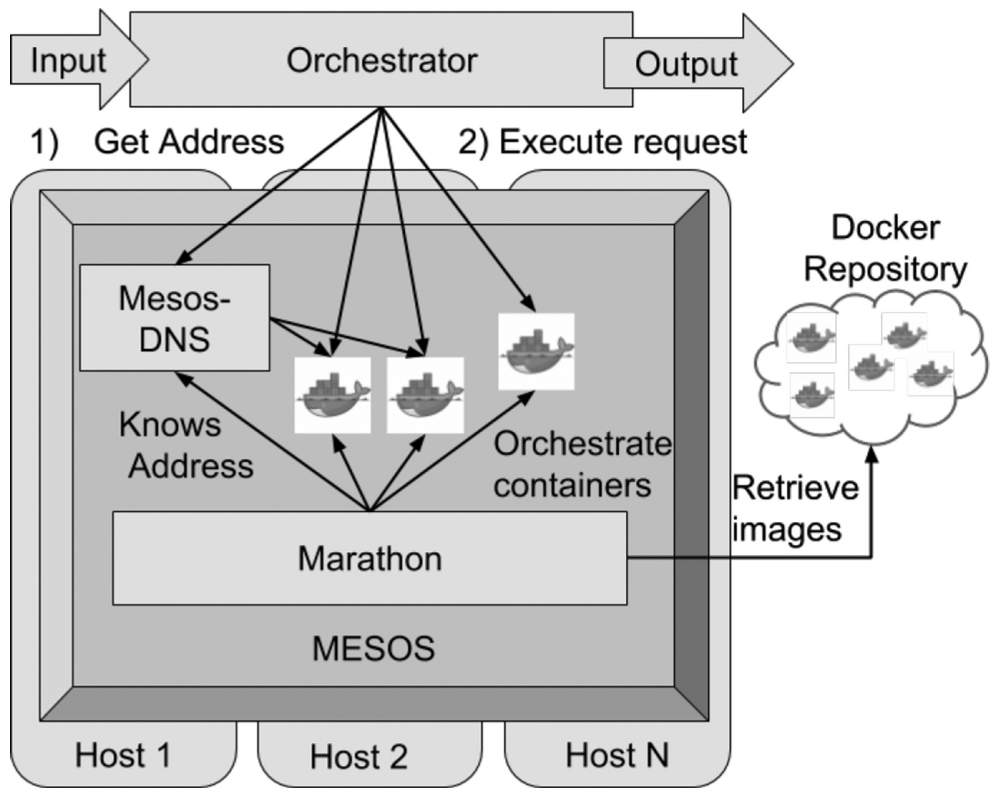 Fig 1: The Orchestrator allows for distributed processing using Mesos and Docker, ensuring the system can handle high-volume data streams like Twitter or Call Center traffic.
2. Semantic Fusion
Instead of simple feature concatenation, MixedEmotions uses Decision Fusion. Different modalities provide estimates (e.g., Video provides Valence, Audio provides Arousal), which are combined using weighted averages. These are then visualized via Kibi dashboards, allowing users to explore relationships between entities and emotions in a Knowledge Graph (KG).
Experiments: Real-World Validity
The authors didn't just test on lab datasets (like RECOLA); they deployed into three industrial scenarios:
- Smart TV (Deutsche Welle): They used emotions to categorize content as Hedonic (joyful) or Eudaimonic (challenging). Users were significantly more likely to watch a video to completion if the recommendation engine factored in these emotional profiles.
- Call Centers: They proved that sentiment analysis on translated text (Czech to English) actually provided more reliable customer satisfaction metrics than analyzing the Czech audio alone.
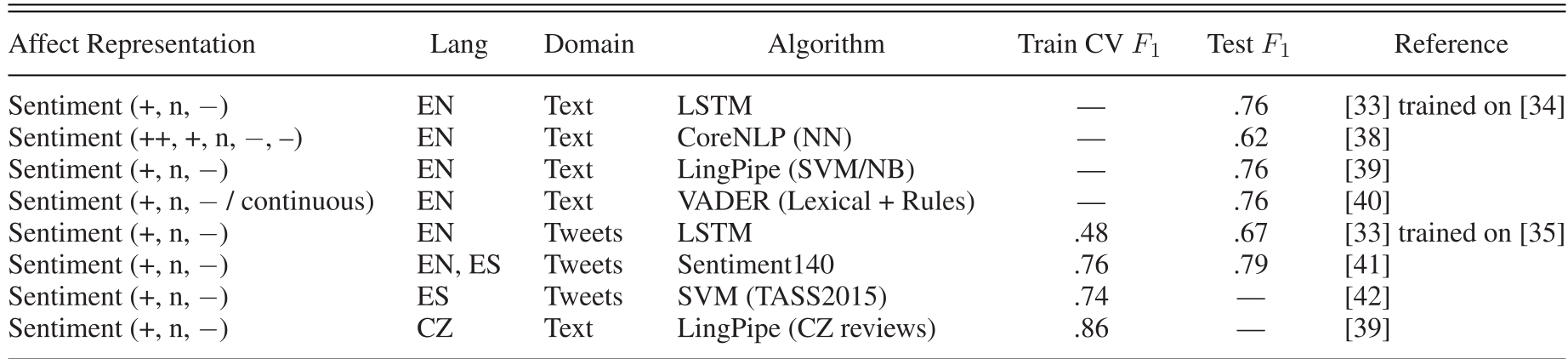 Fig 2: Comparison of different text-based sentiment algorithms across English, Spanish, and Czech.
Critical Insight & Future Outlook
MixedEmotions was a pioneer in treating emotion as Structured Knowledge rather than just a classification label.
The Takeaway: While modern LLMs (like GPT-4o) now dominate text-based sentiment, the architectural lesson of MixedEmotions remains relevant: to build a production-grade AI system, you must decouple the analysis modules (Microservices) from the data representation (Linked Data).
Limitations: The system relies heavily on SVR (Support Vector Regression) and standard LSTMs, which have since been surpassed by Transformer-based architectures. However, the toolbox's modularity means these containers could theoretically be swapped for "BERT-servicing" or "Whisper-servicing" Docker nodes without breaking the pipeline.
Conclusion
MixedEmotions remains a foundational blueprint for anyone looking to build a large-scale multimodal analytics pipeline. Its open-source nature and commitment to "Linked Data" principles make it a rare example of academic research that is truly "production-ready."