
MixGroup: Leveraging Sparse Social Interactions for Robust Vehicular Location Privacy
MixGroup: Accumulative Pseudonym Exchanging for Location Privacy Enhancement in Vehicular Social Networks
This paper introduces MixGroup, a novel location privacy-preserving scheme for Vehicular Social Networks (VSNs) that leverages "group-regions" and group signatures to facilitate accumulative pseudonym exchanging. Unlike traditional mix-zones, MixGroup allows vehicles to exchange pseudonyms during sparse meeting opportunities, significantly increasing the uncertainty for tracking adversaries and achieving SOTA performance in low-traffic conditions.
TL;DR
MixGroup is a location privacy framework for Vehicular Social Networks (VSNs) that moves beyond the limitation of "crowded intersections." By constructing extended "group-regions" and using group signatures, it allows vehicles to accumulatively swap pseudonyms across multiple meeting points. This approach significantly boosts pseudonym entropy, outperforming traditional Mix-zones by up to 500% in certain scenarios.
The "Crowd" Fallacy in Vehicular Privacy
In the world of Intelligent Transportation Systems (ITS), the standard way to hide a vehicle's identity is to use a pseudonym. To prevent tracking, vehicles must change these pseudonyms. Traditional wisdom suggests doing this at "Mix-zones"—busy intersections where many cars meet.
However, the authors point out a glaring reality: 87% of vehicles navigate sparsely, meeting others sporadically rather than in large crowds. In low-traffic areas, a Mix-zone with only two cars provides almost zero protection; an adversary can easily guess who is who after the swap.
The MixGroup Insight: Accumulation is Key
The core intuition of MixGroup is that while you might not meet 20 cars at once, you will likely meet 20 cars over the course of your journey.
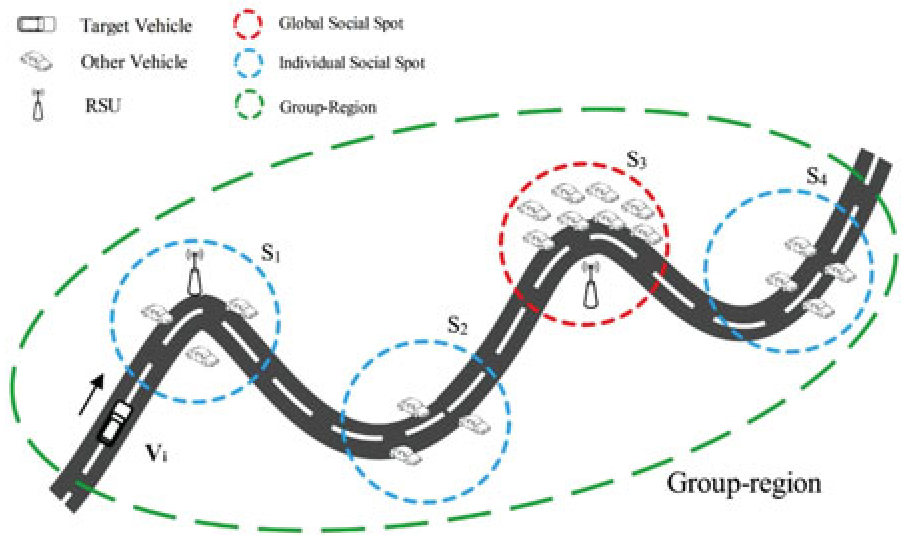
1. Extended Group-Regions
Instead of a single point, MixGroup defines a group-region covering multiple intersections. When a vehicle enters, it joins a group and uses a Group Signature. To any observer (even a Global Passive Adversary), all vehicles in the group look identical because they share the same Group ID (GID).
2. Accumulative Exchanging
Inside this region, whenever two vehicles pass each other, they perform a "handshake" to exchange their underlying pseudonyms. These swapped pseudonyms aren't used yet—they are stored and "activated" only when leaving the region. By the time a car exits, it may have swapped IDs multiple times, making it mathematically impossible for an observer to trace the origin.
Methodology: The Entropy-Optimal Negotiation
Swapping pseudonyms isn't always safe. Internal adversaries (Internal Betrayal Adversaries) might swap "dirty" or tracked IDs with you. To combat this, the authors introduce a decision-making formula based on Pseudonym Entropy:
A vehicle only agrees to a swap if the benefit (increased uncertainty for the attacker) outweighs the risk (the probability that the peer is a malicious node).
The Protocol Flow:
- Group Join: Authenticate with a Roadside Unit (RSU) and receive a Temporary In-group ID (TID).
- Exchange Handshake: Mutually evaluate entropy benefits.
- Pseudonym Exchange: Encrypted transfer of pseudonym sets using dual signatures for accountability.
- Activation: The RSU verifies the exchange record to ensure no "tricking" occurred.
Experimental Results: Dominating Sparse Traffic
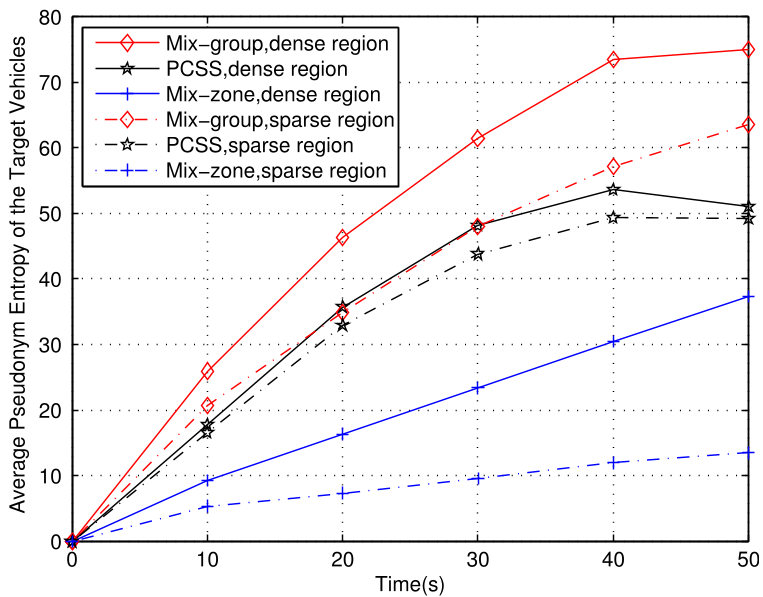
The researchers tested MixGroup against Mix-zone and PCSS (Pseudonym Changing at Social Spots).
- Global Entropy: MixGroup achieved a 56% lead over PCSS.
- Low Traffic Robustness: While traditional Mix-zones saw performance tank as traffic decreased, MixGroup’s accumulative nature kept privacy levels high.
Critical Analysis & Takeaways
The brilliance of MixGroup lies in its Inductive Bias toward social regularity. It acknowledges that vehicle movement is predictable but uses that very regularity to "harvest" meeting opportunities that were previously ignored.
Limitations:
- Computational Overhead: Group signatures and multiple encryptions for every exchange place a higher load on the Onboard Unit (OBU).
- RSU Dependency: While exchanges are peer-to-peer, the system still requires RSUs at region boundaries for "activation" and revocation.
Conclusion: MixGroup demonstrates that in decentralized networks, time can substitute for density. By spreading the "mixture" process across a trajectory, we can provide high-tier privacy even in the quietest suburbs.