
Directed Social Graphs: The Hidden Security Cost of Simple Modeling
On the mixing time of directed social graphs and security implications
This paper investigates the mixing time of directed social graphs and its impact on security applications. By applying fixed-point theory to estimate stationary distributions, the authors compare four benchmarking datasets (Slashdot, Epinion, Wiki-vote, Gnutella) in both directed and undirected forms, revealing that edge directionality significantly influences random walk convergence and subsequent security guarantees.
TL;DR
In the world of decentralized security, the "fast-mixing" property of social graphs is the holy grail. It powers everything from Sybil defense to anonymous routing. However, most researchers take a shortcut: they treat directed relationships (I follow you) as undirected ones (we are friends). This paper reveals that this shortcut isn't just a simplification—it's a security risk. By analyzing directed graphs using fixed-point theory, the authors prove that ignoring edge direction leads to a massive overestimation of security, sometimes allowing three times as many Sybil attackers as previously thought.
The "Undirected" Illusion
Most social network security protocols—like SybilLimit or Whanau—rely on random walks to sample the network. If a graph is "fast-mixing," a short random walk quickly reaches a state where it could be at any node with a probability proportional to that node's degree.
The industry standard has been to convert directed datasets into undirected ones by either:
- Symmetrizing: Adding an edge if exists.
- Omitting Labels: Simply treating every arrow as a two-way street.
The motivation for this paper was simple: Does this change the math? If the mixing time changes when we respect the arrows, then every security claim made on undirected models is potentially invalid.
Methodology: Measuring the "Unmeasurable"
Measuring mixing time in undirected graphs is straightforward because we know the stationary distribution () in closed form based on node degrees. In directed graphs, has no such formula.
The authors solved this by leveraging Fixed Point Theory. They treated the transition matrix as a contraction mapping. By iteratively multiplying an initial distribution by , the system eventually converges to the stationary distribution.
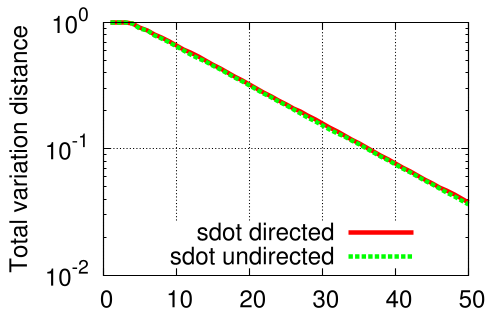 Figure 1: Comparison of mean mixing times () across different datasets (Slashdot, Epinion, etc.). Note how the undirected versions (red lines) generally plummet toward convergence faster than the directed versions (blue lines).
Key Insights from the Results
The researchers tested four major datasets: Slashdot, Epinion, Wiki-vote, and Gnutella. Their findings challenge several common assumptions:
- Consistency of Slower Mixing: In almost every social scenario, directed graphs are slower mixing than their undirected counterparts. This means random walks take longer to "lose" their starting position, making it harder to sample the network uniformly.
- The Gnutella Anomaly: Interestingly, in the P2P network Gnutella, the directed graph actually mixed faster in very long walks. However, for the short walks (length < 10) actually used in security applications, the undirected version still appeared falsely superior.
- Structural Hubs: Graphs like Wiki-vote, which contain clear "social hubs," mix significantly faster than more distributed networks like Slashdot, regardless of directionality.
Security Implications: Sybils and Anonymity
Sybil Defense (SybilLimit)
When the authors ran the SybilLimit protocol on the original directed graphs, the performance degraded.
- Honest Acceptance Rate: In Gnutella, using a walk length of 4, the undirected model accepted 95% of honest nodes. The directed model? Only 75%.
- Attacker Success: For a fixed number of "attack edges," the directed graph allowed significantly more Sybil identities to infiltrate the network.
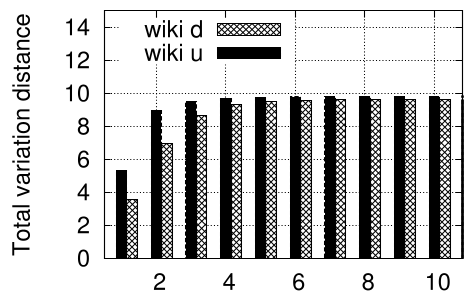 Figure 2: The acceptance rate of Sybil nodes. Notice that directed graphs (blue) consistently allow more attackers into the system than the undirected versions (red) across all datasets.
Anonymous Communication
In systems where you route traffic through social friends for anonymity, the size of the "Anonymity Set" is determined by the entropy of the walk's final location. The paper shows that entropy is lower in directed graphs. For Epinion, the anonymity set dropped from 6,013 (undirected) to just 2,411 (directed)—a 60% reduction in privacy protection!
Critical Analysis & Conclusion
The takeaway for the academic community is stark: Stop "massaging" your data.
While it is tempting to simplify graphs to use well-known undirected algorithms, this paper proves that doing so creates a "What-If" scenario that bears little resemblance to reality. If a Sybil defense needs to perform a walk of length to be secure, but that walk takes twice as long to mix in a directed graph, the protocol isn't just slower—it's broken.
Future Work: This study opens the door for designing "Direction-Aware" Sybil defenses. Rather than trying to force directed graphs to act like undirected ones, we need protocols that utilize the asymmetric nature of trust to provide even stronger security guarantees.