
ML-Driven Sustainable Precision Agriculture: Architecting the Future of Farming
ML based sustainable precision agriculture: A future generation perspective
The paper "ML based sustainable precision agriculture: A future generation perspective" provides a comprehensive architectural framework for precision agriculture. It integrates Machine Learning (ML), Big Data, and IoT to optimize various agricultural dimensions, achieving significant resource savings such as a 20.5% reduction in fertilizer use through advanced clustering techniques.
TL;DR
Agriculture is evolving from a labor-intensive tradition into a data-driven science. This paper outlines a robust architectural framework for Precision Agriculture (PA) powered by Machine Learning and Big Data. By moving beyond human limitations and simple statistics, the proposed model addresses critical issues like soil fertility, pest detection, and climate fluctuation, ultimately demonstrating that technology can reduce resource waste (like fertilizer) by over 20%.
1. The Motivation: Why Move Beyond Traditional Intuition?
Agricultural ecosystems are notoriously complex. With global temperatures rising (nearly 0.89°C in the last century) and rainfall patterns becoming increasingly erratic, traditional "rule of thumb" farming is no longer sustainable.
The authors identify a major bottleneck in current systems: human intelligence cannot precisely process the conglomerate behavior of massive, non-linear environmental datasets. Most prior work failed because it couldn't handle the "noise" of multi-source data or didn't provide an interactive interface for the people who need it most—the farmers.
2. Methodology: A Multi-Layered AI Architecture
The paper proposes a systematic approach to digitizing the farm. The workflow is divided into three distinct phases:
Phase A: Data Acquisition & Categorization
Using Wireless Sensor Networks (WSN), drones (UAVs), and satellite data, the system monitors:
- Soil Parameters: pH, nutrients (N-P-K), and moisture.
- Climatic Factors: Humidity, wind speed, and solar radiation.
- Crop Health: Pest presence and growth stages.
Phase B: The ML Engine
The authors categorize the "toolbox" of algorithms based on the specific agricultural problem:
- Supervised Learning: Used for Yield Prediction and Disease Detection. For instance, Random Forest (RF) is highlighted for its ability to handle high-dimensional big data with less preprocessing than SVM.
- Unsupervised Learning: Used for Management Zone Identification. Techniques like DBSCAN and K-means identify patterns in soil fertility without needing pre-labeled data.
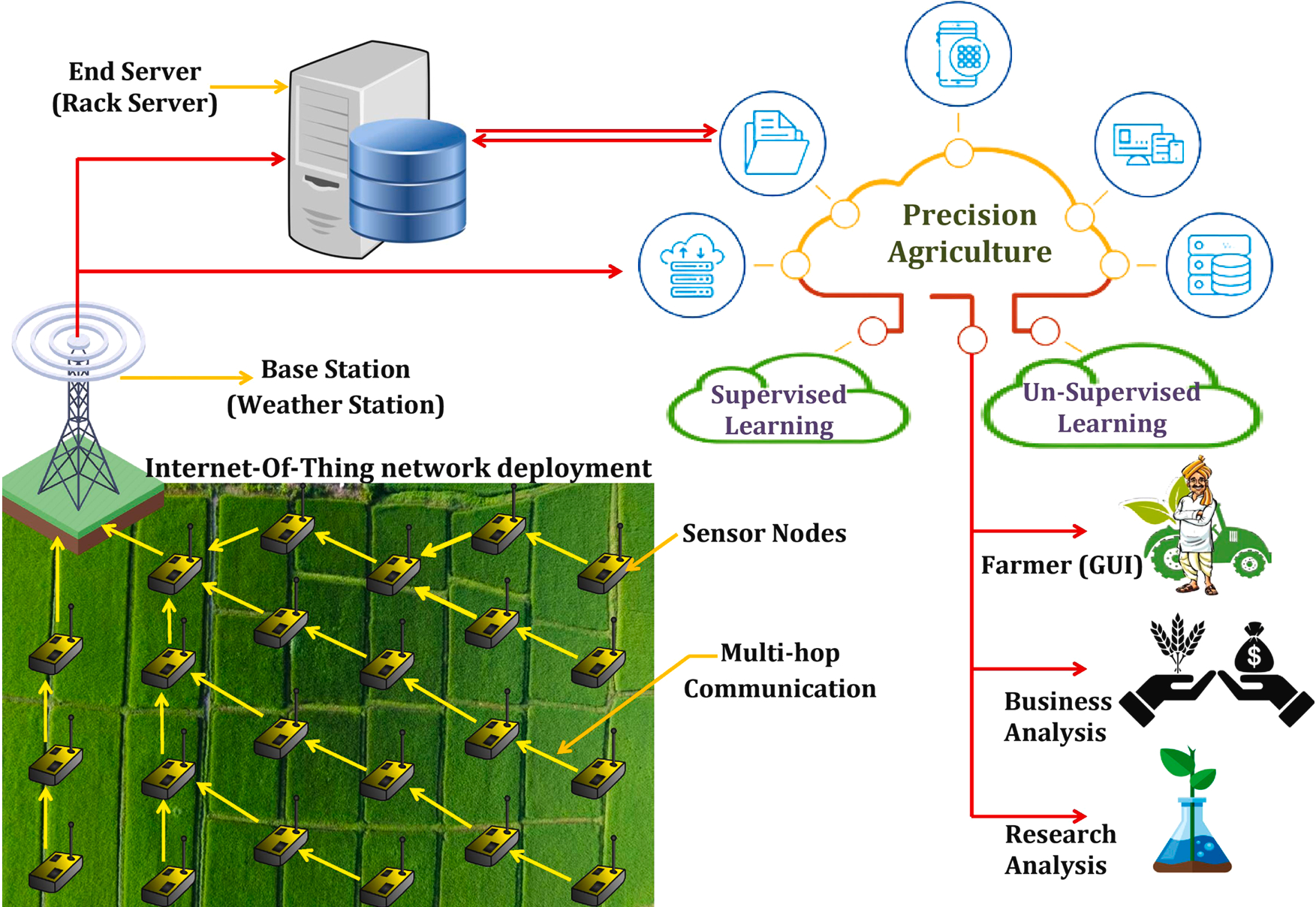 Figure 1: Overview of major components in the Precision Agriculture model, from sensors to decision support.
3. Key Findings: Algorithms in Action
The paper synthesizes several case studies to prove the efficacy of ML in the field:
- Precision Fertilization: By using the OPTIC clustering algorithm, researchers achieved a 20.5% saving in fertilizer for corn crops compared to traditional blanket application methods.
- Pest Control: Unsupervised varying vector quantization combined with vegetation indices allowed for precise discrimination between crops and weeds, even in high-density fields.
- Probability Modelling: Bayesian Networks are suggested as the go-to for Decision Support Systems (DSS) because they can effectively model the causal relationships between climate variables and crop survival rates under uncertainty.
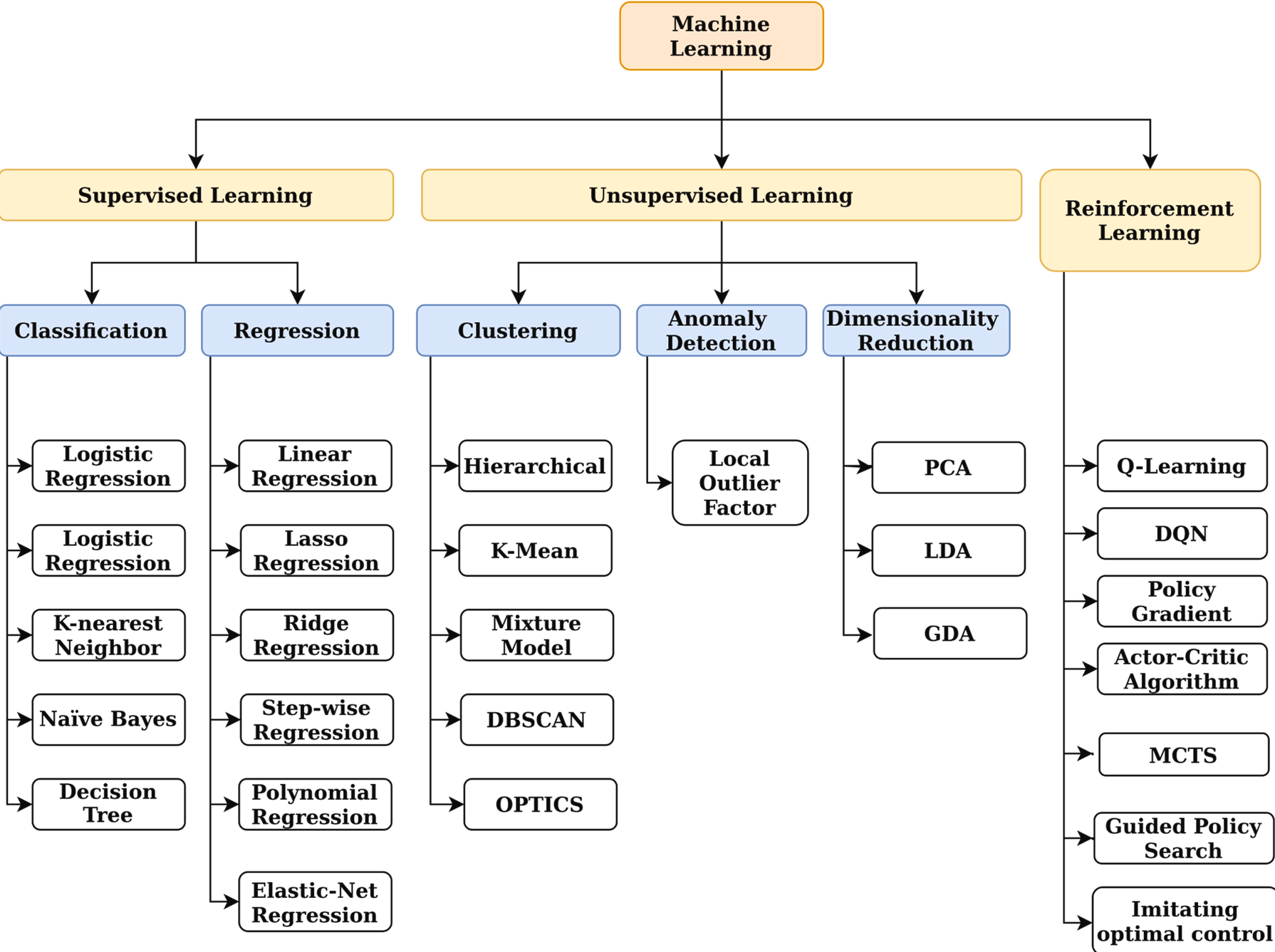 Figure 2: Taxonomy of ML algorithms discussed, categorizing techniques into Supervised, Unsupervised, and Reinforcement learning.
4. Academic Insight: Strengths and Limitations
The study provides a nuanced comparison of the most popular algorithms in the agro-sector:
- ANN (Artificial Neural Networks): Excellent for non-linear time series but "expensive" in terms of training time and computational power.
- SVM (Support Vector Machine): Ideal for small, high-dimensional datasets but falls short when dealing with outliers (noise).
- RF (Random Forest): The most balanced choice for modern Big Data applications in agriculture due to its parallel processing and ability to handle missing values.
The Barrier: The "last mile" problem remains a concern. Most models are built by computer scientists from an academic perspective. The authors argue that for these tools to be successful, they must be integrated into user-friendly GUIs that farmers can use without a PhD in statistics.
5. Conclusion & Future Outlook
The fusion of ML and Big Data isn't just about "better yields"—it's about sustainability. By precisely identifying the water retention capacity of soil and predicting pest outbreaks early, we can reduce the environmental footprint of farming (e.g., lower pesticide and chemical fertilizer use).
Future Work will likely focus on Hybrid Models (Meta-heuristics) that combine the predictive power of Supervised Learning with the pattern-discovery strengths of Unsupervised Learning to create more generalized, globally applicable agricultural models.