
Unified Identity: Decoding the ML-Model for Multi-Layer Social Networks
The ML-Model for Multi-layer Social Networks
The paper introduces the ML Model (Multi Layer Model), a formal framework for representing interconnected social networks where the same users operate across multiple platforms (layers). It extends traditional Social Network Analysis (SNA) metrics, specifically degree and closeness centrality, to account for cross-platform interactions and identity mappings.
Executive Summary
TL;DR: This paper proposes the ML Model, a mathematical framework designed to treat multiple social media platforms as a single, interconnected system. By mapping a user’s "identity pillars" across platforms like Twitter and FriendFeed, the authors redefine centrality metrics, proving that an individual's true social influence is often invisible when looking at one network in isolation.
Academic Positioning: This work serves as a foundational bridge between sociological theories of "online self-presentation" and the mathematical rigor of Network Science. It shifts the focus from monoplex (single-layer) analysis to multiplex (multi-layer) dynamics.
Problem & Motivation: The Silo Trap
In the modern digital landscape, our social identities are fragmented. You might be a professional on LinkedIn, a photographer on Instagram, and an observer on Twitter. Existing research often falls into the "Silo Trap"—analyzing Twitter or Facebook as independent graphs.
The authors argue this is fundamentally flawed for two reasons:
- Context Collapse: Information doesn't stay in one place; a YouTube video goes viral because it is shared on Twitter, which then drives engagement back on YouTube.
- Strategic Identity: Users choose specific "layers" for specific audiences. Ignoring these connections masks the true path of information diffusion and the actual reach of a user.
Methodology: Building the "Pillar" Model
The core of the ML Model is the concept of a Pillar. If a user exists on Layer A (Twitter) and Layer B (FriendFeed), they are represented as a pillar traversing these "floors."
1. Identity Mapping and Node Equivalence
The authors define a mapping function that identifies if account on one network is the same entity as account on another. This allows the creation of a "flattened" graph where paths can jump between layers.
2. Redefining Centrality
The paper extends the classical In-Degree Centrality. In a single network, your degree is just your follower count. In a Multi-Layer network, the formula is:
This ensures that if the same person follows you on both Twitter and FriendFeed, they are only counted as one unique member of your audience.
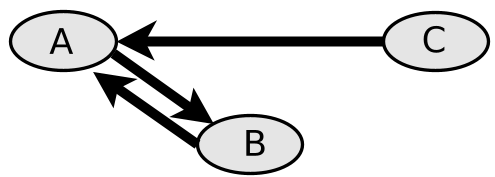 Figure 1: The general MLN structure where a single user can have multiple accounts across various social layers.
Experiments: Real-World Evidence
The researchers tested their model on a massive dataset of ~155,000 users active on both FriendFeed and Twitter.
Key Findings:
- The Correlation Gap: There is surprisingly little linear correlation between a user's rank on a single platform and their rank in the Multi-Layer system. A "nobody" on Twitter might be a central hub when their combined cross-platform influence is measured.
- Reachability: In the Twitter network, "islands" of nodes that seemed disconnected were actually linked through FriendFeed accounts. By adding the second layer, thousands of nodes moved into the "Giant Component," making them reachable for information flows.
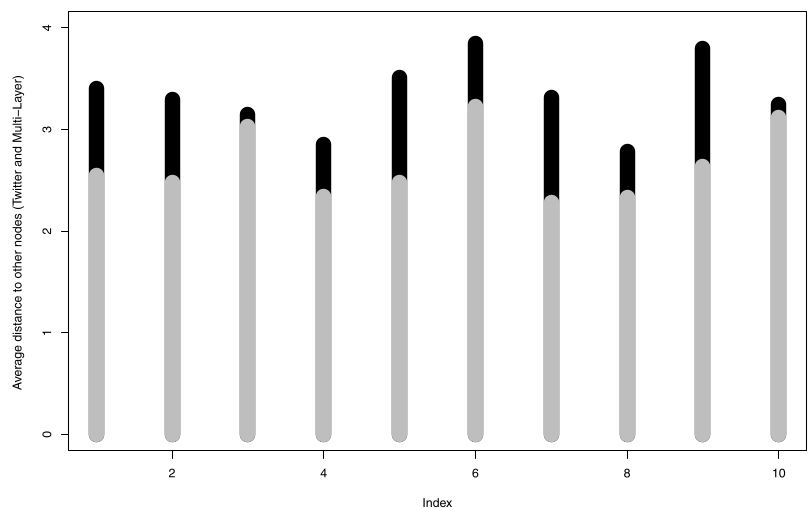 Figure 2: Closeness centrality shifts when moving from a single network (black) to a Multi-Layer network (gray), showing significantly reduced "distances" between users.
Critical Insight & Conclusion
The ML Model provides a vital "reality check" for social media marketing and sociological research. Its main takeaway is that redundancy and complementarity between networks are key. Some networks are redundant (same audience), while others are complementary (extending reach to new groups).
Limitations: The current model focuses on static snapshots. Future iterations must address the temporal dynamics—how a post on Twitter leads to a post on Facebook over minutes or hours. Furthermore, calculating these metrics on billion-node graphs remains a significant computational challenge.
Future Outlook: As platforms become increasingly fragmented and privacy-conscious, the ability to integrate distributed data into a unified "Pillar" profile will be the holy grail for both personalized services and the study of global information hygiene.