
Mlogger: Bridging Pervasive Sensing and Social Computing via Automatic Blogging
Mlogger: An Automatic Blogging System by Mobile Sensing User Behaviors
This paper introduces Mlogger, an automated blogging system that leverages mobile sensing to capture and transform raw behavioral data into social blog entries. Using Sun SPOT sensor nodes and a dedicated back-end processing engine, the system autonomously recognizes user activities and context to generate "p pervasive social computing" updates.
TL;DR
Mlogger is an early-stage pervasive computing system that automates the process of blogging. By wearing small "Sun SPOT" sensors, a user's physical activities (running, driving), social environment (who they are with), and location (home, office) are detected and automatically published as blog entries, transforming raw sensor data into a digital life-log.
Background & Motivation: Moving Beyond Geotagging
In the era of Web 2.0, blogs became the cornerstone of social computing. However, keeping a blog active requires constant manual input. While Geoblogging introduced the idea of "tagging" places, it is one-dimensional. The authors of Mlogger argue that a true digital diary needs more context:
- What are you doing? (Activity)
- With whom are you spending time? (Social Context)
- How is the environment changing? (Ambient Sensing)
The challenge lies in the "Pervasive" part—sensing these nuances without requiring the user to carry a laptop or manually check in.
Methodology: From Raw Bits to Human Activity
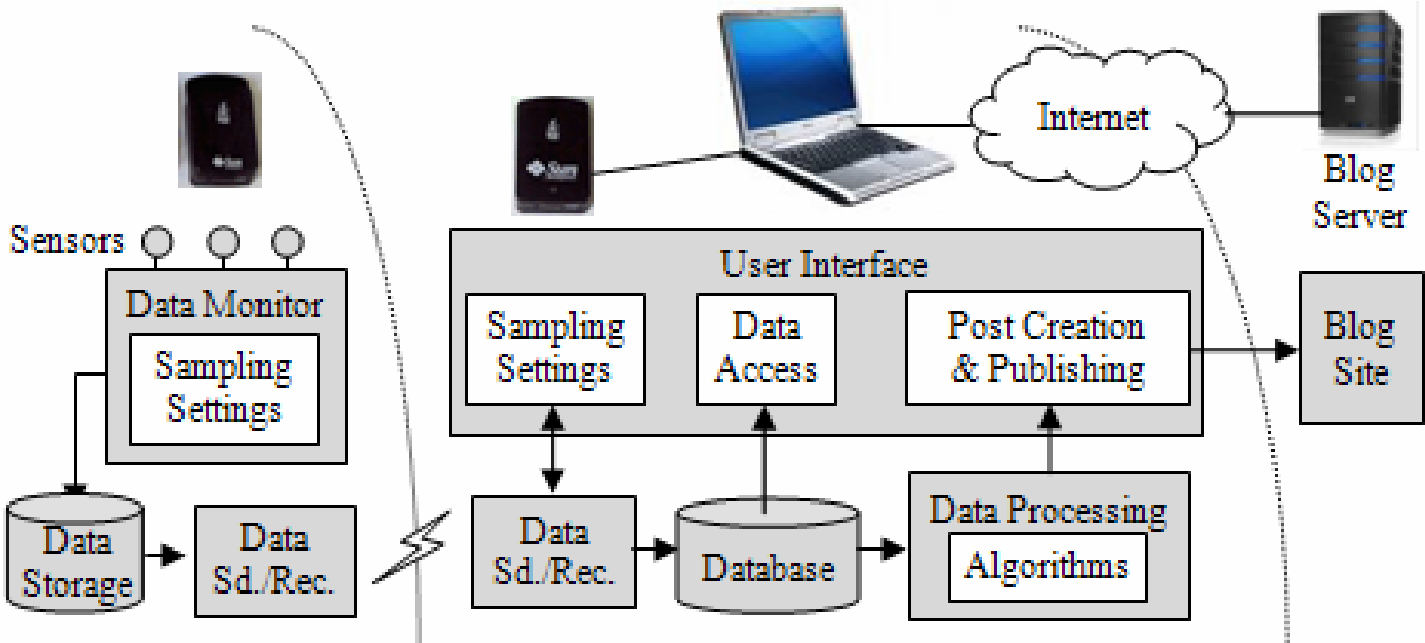
The Mlogger architecture is split into a Front-End (Wearable) and a Back-End (Processing).
1. The Hardware: Sun SPOTs
The system uses Sun Small Programmable Object Technology (Sun SPOTs), which include:
- 3-axis Accelerometers
- Temperature and Light sensors
- IEEE 802.15.4 radio for mesh networking
2. Behavioral Inference Engine
This is the "brain" of Mlogger. Instead of just showing raw G-force values, the system uses a Fuzzy Logic Classifier to determine motion.
The motion magnitude is calculated as: This value is then mapped to linguistic terms like "Low," "Medium," or "Extreme" to identify if the user is biking, walking, or running.
3. Context Awareness: The Finite State Machine (FSM)
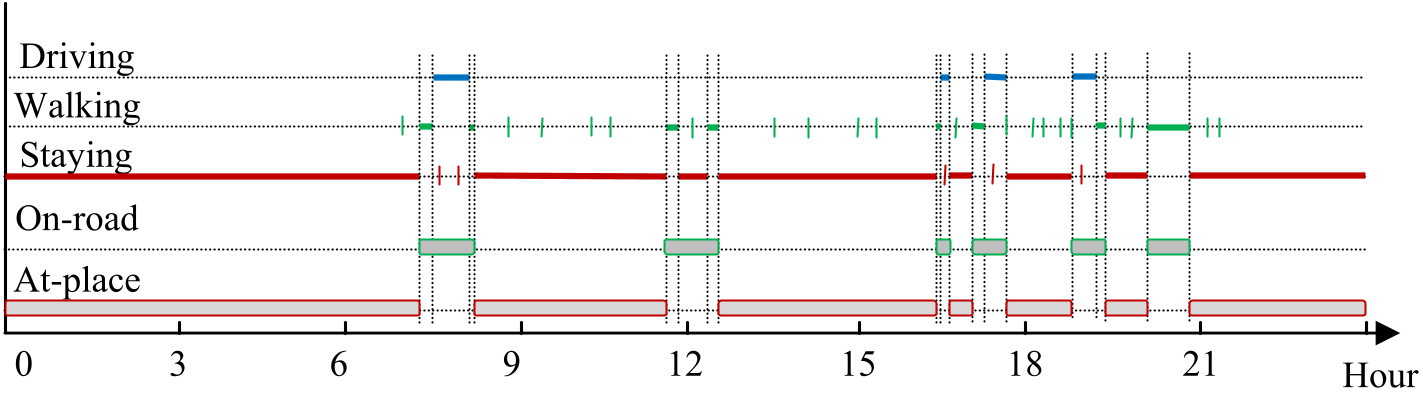
To determine "Where" a user is without GPS, Mlogger uses an FSM to track transitions between At-place (Home, Office) and On-road (Commuting). By detecting the IEEE addresses of nearby "Base-station" SPOTs or other people's sensors, the system can infer location. For instance, seeing "Boss" + "Office PC" between 9:00 AM and 5:00 PM creates a high-probability inference that the user is at work.

Experiments and Results
The authors validated the classifier by defining membership functions for motion. The system proved efficient at "absorbing" short fluctuations—for example, a car stopping at a red light (temporary "Staying" motion) does not trigger an "At-place" state unless it lasts longer than 90 seconds.
Key Recognition Metrics:
- Social Grouping: Successfully categorized contacts into Home, Family, Friends, and Strangers.
- Event Triggering: Blogging isn't just a timer; it's event-driven. A new entry is generated only when the "Situation" changes (e.g., entering a new location or a temperature shift > 2°C).
Deep Insight & Perspective
Mlogger represents a transition point in wearable tech. While the methodology is compared to today's AI-driven activity recognition, its brilliance lies in Context Fusion.
The Takeaway: You don't need 99.9% accuracy in motion detection to create a useful blog. You need a system that understands the intersection of time, social proximity, and movement.
Limitations: The reliance on Sun SPOTs (which aren't common) and the lack of GPS limit its use in the "wild." However, the logic presented here—offloading heavy processing to a back-end and using social "beacons" for location—is exactly how modern IoT ecosystems operate.
Future Outlook
The authors predict a shift toward smartphones (iPhone/Android) as the primary sensing hub. As we move forward, the Mlogger philosophy of "automatic digital life-recording" will likely integrate with LLMs to transform these raw logs into beautifully written, narrative-driven stories.