
MobiSoft: Bridging Digital Proximity and Social Interaction via Mobile Agents
MobiSoft: An Agent-Based Middleware for Social-Mobile Applications
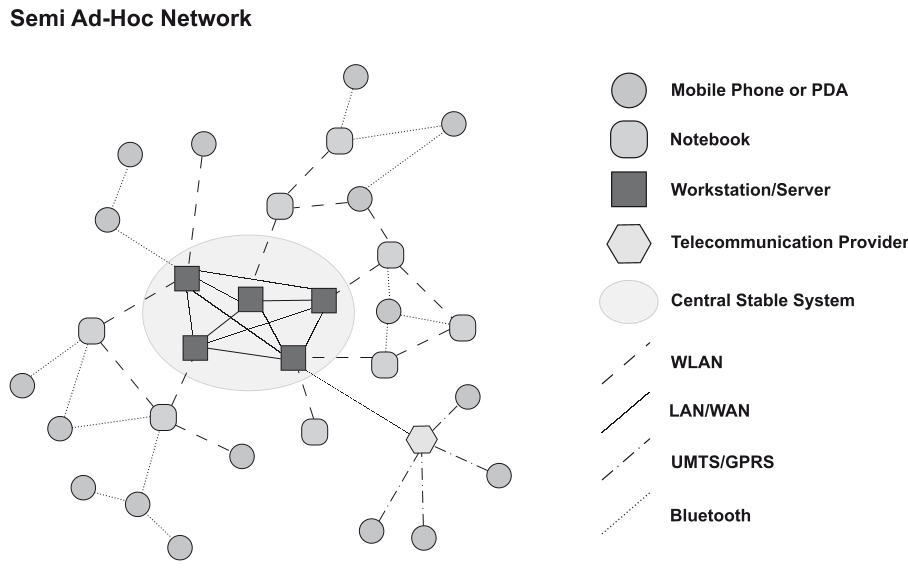
MobiSoft is an agent-based middleware designed for social-mobile applications in MANETs (Mobile Ad-hoc Networks). It utilizes the Tracy2 agent toolkit and JXTA to enable autonomous software agents to act as personal representatives for decentralized profile matching and service discovery on mobile devices.
TL;DR
MobiSoft is an ambitious middleware framework that turns your mobile phone into a proactive social scout. By deploying autonomous mobile agents that hop between devices in a Peer-to-Peer (P2P) fashion, the system identifies shared interests and potential social connections (like sharing a taxi or professional networking) without requiring a central server or manual user intervention.
Strategic Context: This work sits at the intersection of Multi-Agent Systems (MAS) and Mobile Ad-hoc Networks (MANETs). It moves beyond simple routing to create a semantic application layer for spontaneous "face-to-face" digital encounters.
Problem & Motivation: The "Inhibition" Barrier
Human social interaction often suffers from social barriers or a lack of immediate information about strangers in proximity. While services like Dodgeball existed at the time of writing, they were hampered by:
- Centralization: Dependency on a central server and SMS.
- Manual Overhead: Users had to manually broadcast locations.
- Lack of Semantics: Matching was restricted to basic keywords rather than deep interests.
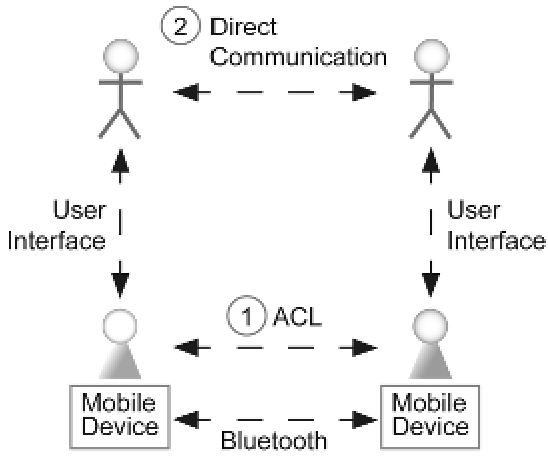
The authors' insight was to create a "digital space" around each person. If two people’s digital spaces overlap via Bluetooth or WiFi, their digital assistants (agents) should "talk" first to find common ground, only alerting the humans if a high-value match is found.
Methodology: The Core Architecture
The MobiSoft middleware is built on a layered approach to handle the volatility of mobile environments.
1. The Three-Layer Stack
- Micro Kernel (Tracy2): Manages the lifecycle of agents and thread scheduling.
- Plugin Layer: Includes the JXTA-based P2P overlay for service discovery and network management.
- Business Logic Layer: Where the Social-Mobile Assistants reside.
2. Overcoming Java ME Constraints
Standard Java for mobile (J2ME) lacked object serialization and class loading—essential for moving agents. The authors solved this by implementing a proprietary Virtual Machine that interprets code represented as Abstract Syntax Trees (AST). In essence, they converted Code into Data, allowing logic to travel across the network as byte streams.
3. Epidemic Dissemination
Instead of expensive multi-hop routing, MobiSoft uses Epidemic (Gossip) Protocols. Agents carry information units to a random group of nodes, ensuring rapid propagation and high robustness against frequent network disconnections.
Experiments & Results: The CeBIT Reality Check
The authors moved from theory to a formal prototype deployed at the CeBIT exhibition. The goal was to help business attendees find partners with similar interests.
- The Approach: Users defined interests via an exhibition catalog. Stationary agents acted as "gatekeepers" to protect privacy, only surfacing relevant matches.
- The Conflict: While the software logic was sound, the physical layer failed. In the crowded exhibition environment, Bluetooth discovery was overwhelmed by the sheer volume of "noise" from laptops, headsets, and other peripherals.
Critical Analysis & Conclusion
Takeaway
MobiSoft correctly identified the future of ubiquitous social computing. Their use of Semantic Web standards (RDF/FOAF) for profile matching was ahead of its time, providing a much higher "signal-to-noise" ratio than simple keyword tagging.
Limitations
- Hardware Fragility: The reliance on legacy Bluetooth protocols proved to be a single point of failure in dense environments.
- Privacy/Spam: While the paper mentions stationary agents as "gatekeepers," the epidemic dissemination of data raises significant privacy concerns in a post-GDPR world.
Future Outlook
Today, the spirit of MobiSoft lives on in technologies like Apple’s AirDrop and distributed social protocols (Nostr/ActivityPub). The next step for this research lineage is integrating Zero-Knowledge Proofs (ZKP) to allow profile matching without ever revealing the underlying sensitive data to the "roaming agents" of strangers.