
MobiFuzzyTrust: Bridging the Gap Between Binary Logic and Social Intuition in MSNs
MobiFuzzyTrust: An Efficient Fuzzy Trust Inference Mechanism in Mobile Social Networks
This paper introduces MobiFuzzyTrust, a semantic trust inference mechanism for Mobile Social Networks (MSNs) that combines multi-dimensional mobile contexts with fuzzy logic. By utilizing a "Computing with Words" approach, it transforms numerical interaction data into human-understandable linguistic terms like "High Trust" or "Medium Trust."
TL;DR
MobiFuzzyTrust is an efficient trust inference framework designed for Mobile Social Networks (MSNs). It moves beyond "0 or 1" connectivity by integrating mobile contexts—reputation, familiarity, and spatiotemporal similarity—into a fuzzy logic system. The result? A model that doesn't just calculate a "score," but understands trust semantically through linguistic terms like "Highly Trusted" or "Low Trust," while explicitly accounting for the risks of social transitivity.
Problem & Motivation: The Contextual Void of Trust
Trust is inherently "fuzzy." When you ask a friend for a restaurant recommendation, your trust isn't a hard number like 0.762; it’s a subjective feeling shaped by how long you've known them, where you are, and the time of day.
Standard trust models in social networks suffer from three major flaws:
- Lack of Semantics: They output raw floating-point numbers that mean little to a human user.
- Context Ignorance: They ignore the "Mobile Context"—the fact that meeting someone at "Home" at 9:00 PM implies a different social bond than meeting a stranger at an "Airport" at 3:00 AM.
- Linear Risk Assessment: They often fail to model the non-linear "decay" of trust as it passes through multiple intermediaries (friend-of-a-friend).
Methodology: The Four Pillars of Mobile Trust
The core of MobiFuzzyTrust lies in its Mobile Context Awareness. The authors define the trust value as a weighted aggregation of four distinct components:
- Prestige (): A degree-based measure of how central a user is in the network (reputation).
- Familiarity (): Calculated via a communication interaction graph. It follows the intuition: "The more we talk, the more I know you."
- Similarity (): A dual-layered metric covering External Similarity (overlapping locations like "Office" vs "Home" and time slots) and Internal Similarity (shared interests or even phone models).
- Risk of Trust (): Modeled using a Logistic S-Curve. As the number of "hops" between two people increases, the risk grows exponentially before plateauing, reflecting the natural skepticism we feel toward distant connections.
System Architecture
The framework processes raw MSN data into semantic labels through a dedicated pipeline:
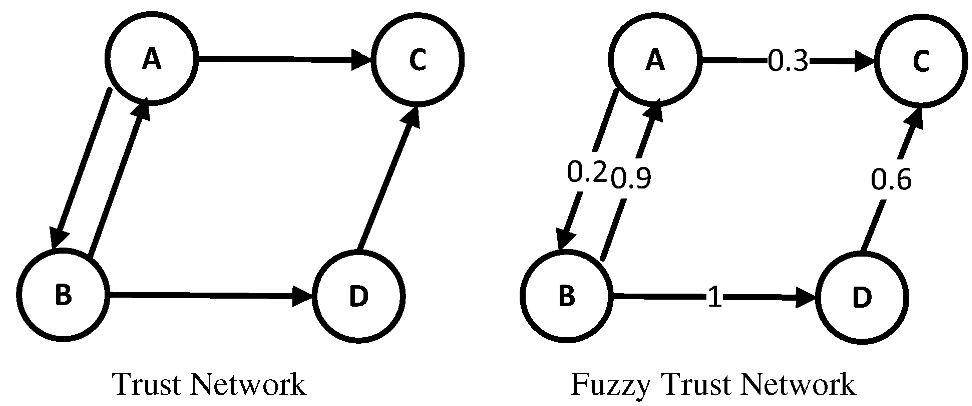
The Fuzzy Inference Engine
To convert these complex numbers into human-readable labels, the paper employs Triangular Membership Functions. These functions define the overlapping boundaries between labels like Medium Low, Medium, and Medium High. By applying the "Maximum Membership" principle, the system chooses the label that best fits the calculated numerical trust.

Experiments: Real-World Validation
Using the MIT Reality Mining Dataset (which includes 330,000 hours of behavioral data from Nokia 100 users), the authors tested how well the model predicts trust across "hops."
Key Findings:
- Location Matters: Social interactions at "Home" or "Apartments" were found to be much stronger predictors of trust than public hubs like "Airports."
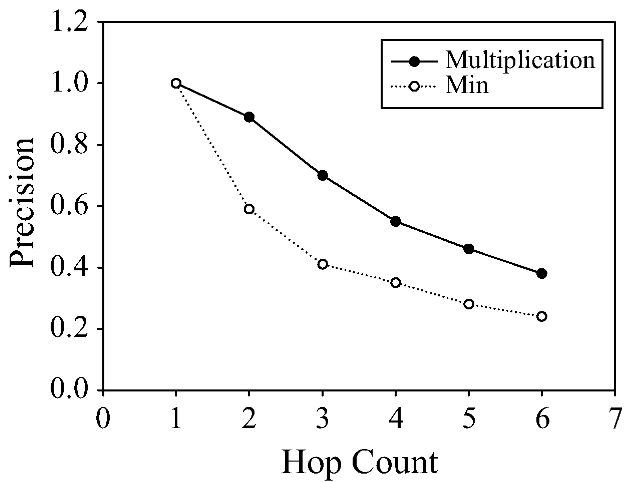
- Transitivity Operators: When calculating trust from User A to User C via User B, the Multiplication operator proved significantly more accurate than the Min operator.
- Precision vs. Distance: While precision naturally decreases as social distance (hops) increases, the MobiFuzzyTrust model maintained a stable lead over baseline methods by incorporating the S-curve risk factor.
Critical Analysis & Conclusion
MobiFuzzyTrust is a significant step toward Human-Centric AI in social computing. Its strength lies in its "Computing with Words" approach, which respects the inherent vagueness of social relations.
Takeaway: Effective trust management in mobile environments cannot rely on network topology alone. It must integrate the "when" and "where" of human behavior.
Limitations: The membership functions and weights () are currently set empirically. Future work could benefit from Adaptive Fuzzy Systems that use machine learning to tune these parameters automatically based on individual user behavior patterns.
Looking Ahead: As we move toward the edge-computing era, lightweight semantic trust models like this will be vital for verifying interactions between autonomous devices and people in Smart Cities.