
Scalable soundscapes: Revolutionizing Crowdsourced Audio Collection through UI Innovation
Development of a Mobile Application for Crowdsourcing the Data Collection of Environmental Sounds
The paper presents a mobile navigation and data collection system designed to crowdsource environmental sounds using Android devices. By integrating a novel dual-mode annotation interface (hierarchical and list-view), the authors aim to build a robust database for high-performance sound recognition using Hidden Markov Models (HMMs) and AdaBoost.
TL;DR
Training high-performance environmental sound recognition systems requires massive, accurately labeled datasets. This paper introduces an Android-based crowdsourcing framework that simplifies the arduous task of audio annotation. By moving away from frustrating text-based labels to a switchable Hierarchical/List-view interface, the researchers successfully engaged over 400 users to map 92 distinct sound categories in the wild.
The Motivating Crisis: The Annotation Bottleneck
In the realm of AI, data is the fuel. For environmental sound recognition—helping a navigation system detect a siren or a water leak—statistical models like Hidden Markov Models (HMMs) and AdaBoost require thousands of samples.
However, collecting these samples faces a "UI Wall." Users recording sounds on the go hate typing on tiny software keyboards. If the annotation process is "depressing" or "troublesome" (see the negative descriptors in the paper's survey), user motivation evaporates, and the data pipeline dries up. The authors realized that the success of the system depended not on the recognition engine, but on the User Experience (UX) of the labeler.
Methodology: Reimagining the Annotation Task
The core contribution of this work lies in its server-client architecture and the specialized annotation UI. The system captures one-minute audio clips along with GPS and OS metadata, then asks the user to label the source immediately.
Two Paths to Accuracy
The researchers pitted two UI philosophies against each other:
- Hierarchical Type: A 4-layer tree structure. It reduces cognitive load by showing only a few categories at a time (e.g., Transport -> Rail -> Train).
- List View Type: A traditional scrolling list. It provides a "flat" view for users who already know exactly what they are looking for.
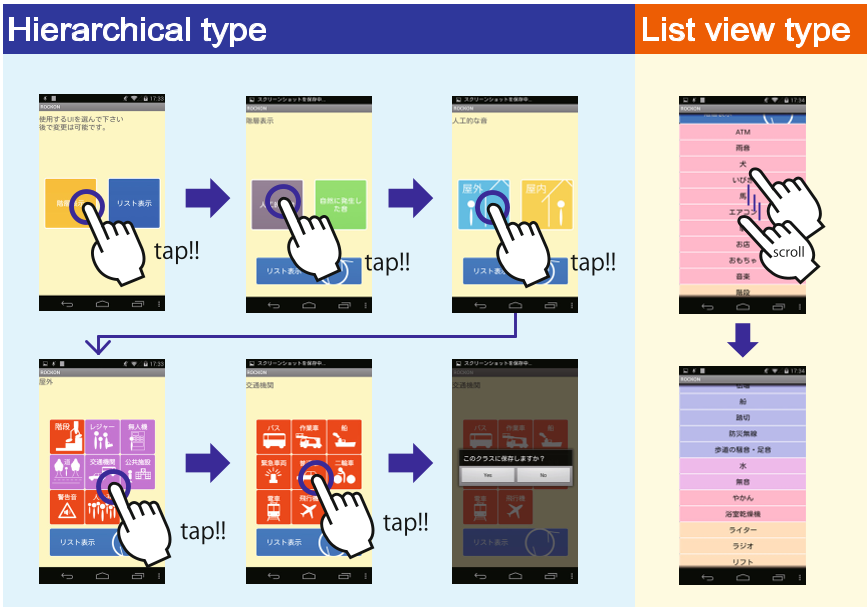 Fig. 6: The transition from frustrating text-input to streamlined touch-selection.
By offering both, the system caters to both "explorers" (who need step-by-step guidance) and "experts" (who want to scroll quickly to a known category).
Experiments & Results: Real-World Deployment
The team deployed the app to 863 users via a Japanese crowdsourcing provider (Rakuten). The results were striking:
- Scale: 428 active participants provided 841 datasets totaling over 10 hours of labeled audio.
- Performance: In comparative testing, the Hierarchical UI was faster for "Large-number classes" (13.64s vs 17.49s for List view), proving that structured navigation helps users process common sounds more efficiently.
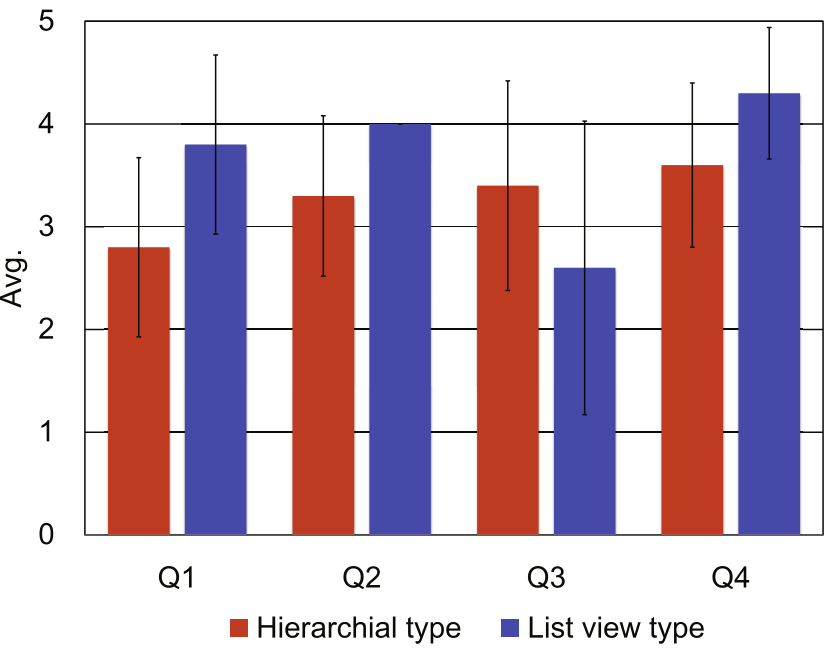 Fig. 7: User evaluation across five metrics. Note the high visibility (Q3) of the Hierarchical approach.
Interestingly, the study found a "Gap of Intent." Users were much better at labeling sounds they recorded themselves (where they had visual context) than sounds they were asked to listen to and "guess." This highlights the importance of real-time annotation in crowdsourcing workflows.
Critical Analysis & Conclusion
The value of this study extends beyond its database. It provides a blueprint for "Human-Centric Data Engineering."
Strengths:
- Recognizes that incentives (Rakuten points) and UI fluidity are dual pillars of crowdsourcing.
- Data diversity: Collecting 92 classes of sounds from varying hardware (Android fragmentation) provides a more robust dataset for real-world deployment than lab-recorded audio.
Limitations:
- The recognition algorithms used (HMM/AdaBoost) are somewhat dated compared to modern Transformer-based audio models.
- GPS data loss occurred in nearly 30% of samples due to network/sensor latency, indicating a need for better offline metadata caching.
Future Outlook: As we move toward "Ambient Intelligence," the ability to pull high-quality, labeled data from the pockets of thousands of citizens will be the differentiator for SOTA models. This paper proves that if you make the UI "enjoyable" and "novel," the crowd will build the database for you.