
Vanilla: Elevating Mobile App Recommendation through Social Ties and Contextual Intelligence
Recommendation of Mobile Applications based on social and contextual user information
The paper introduces Vanilla, a Context-Aware Recommender System (CARS) for mobile applications that integrates social network data with 11 multi-dimensional contextual factors. It employs a Social-Contextual Recommendation (V-SCR) approach to outperform traditional and purely contextual collaborative filtering methods.
TL;DR
With millions of apps in the marketplace, discovery is a burden. Vanilla is a new recommender system that moves beyond simple collaborative filtering by injecting two critical signals: who you know (Social) and where you are/what you are doing (Context). By monitoring 11 distinct contextual dimensions and weighing the influence of "social experts," Vanilla significantly reduces recommendation error (MAE) from 0.67 to 0.47 compared to traditional methods.
The "Context" Gap in App Discovery
Most app stores recommend apps based on "People who installed X also installed Y." However, mobile app usage is hyper-fragmented and situation-dependent. You don't need a navigation app at 11 PM in bed, even if it's popular. Existing systems either focus on social popularity or basic location context, but rarely both. The authors identify that user influence and environmental states (like orientation, lighting, and movement) are the missing links to truly personalized suggestions.
Methodology: The Vanilla Architecture
The Vanilla system operates through a sophisticated pipeline that transforms raw device sensor data into actionable ratings.
1. Hybrid App Rating (V-FPR)
Instead of just "Installed vs. Not Installed," Vanilla tracks the app lifecycle (open, close, stay, update). It calculates the V-FPR (Vanilla Frequent Prolonged Rating), which balances how often you open an app with how long you stay in it.
2. The 11 Dimensions of Context
The system monitors 11 dimensions to define the user state .
- Physical: Time, Lighting, Weather, Movement, Orientation.
- Cognitive: Frame of Mind (User-provided).
- Social: Relative Location (User-provided).
3. Social-Contextual Prediction (V-SCR)
This is the core innovation. Unlike standard neighborhood-based methods, Vanilla calculates a Social Proximity score. It identifies "Expert Users" (contacts with high app counts) and uses their consumption patterns, weighted by their social closeness to the user, to predict what the user would like in a specific context.
 Figure 1: The overarching architecture of Vanilla, showing data collection from the smartphone to the Social-Contextual Recommendation branch.
Experiments and Performance
The researchers conducted "on-line" and "off-line" evaluations with 50 volunteers.
- Rating Integrity: The V-FPR metric showed a 0.91 correlation with frequent consumption, proving it accurately captures user preference.
- Accuracy Boost: The Social-Contextual (V-SCR) approach achieved a much lower MAE (0.4772) than the traditional Collaborative Filtering (0.6784).
- Effectiveness: During live testing, users were more likely to select apps recommended via the V-SCR branch than those from traditional or purely contextual branches.
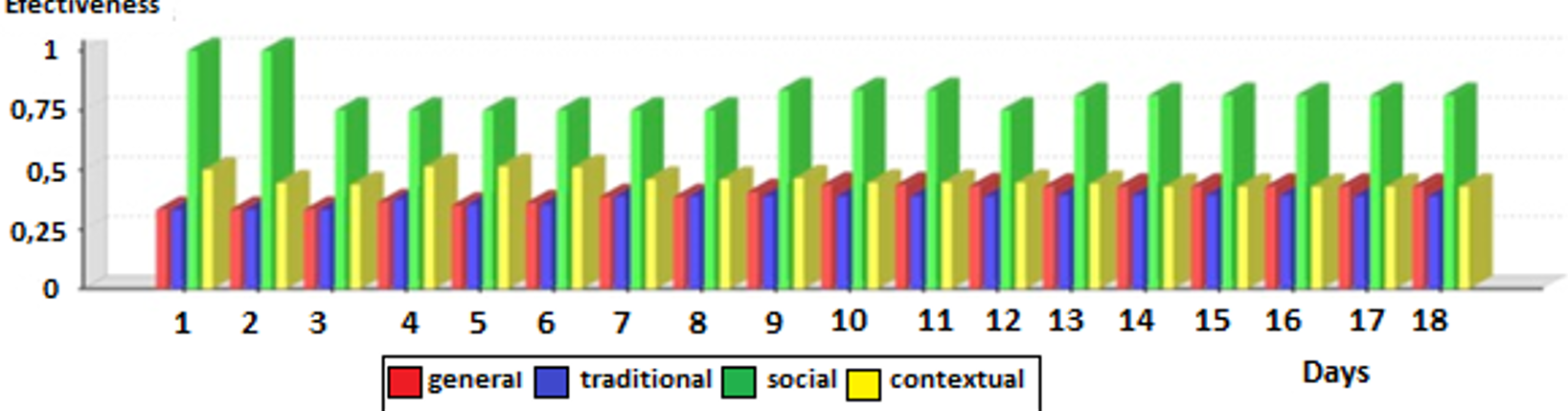 Figure 2: Performance comparison showing the effectiveness of V-SCR (red line) peaking higher than traditional methods.
Critical Insight: Why it Works
The success of Vanilla lies in its Inductive Bias: it assumes that a user’s behavior is more similar to their social experts in the same context than to a random "similar user" in general. By creating a "Social-Contextual" neighborhood, the system effectively bypasses the data sparsity problem (where a new user hasn't rated many apps) by "borrowing" the expertise of their social circle.
Conclusion & Future Outlook
Vanilla proves that context-awareness is not just about "GPS coordinates." By including factors like "Lighting" and "Movement" alongside social ties, it provides a blueprint for next-generation mobile assistants.
Limitations: The study relied on 50 users and required some manual input (Frame of Mind). Future Work: The next leap will involve using automated sentiment analysis or physiological signals (via wearables) to replace the manual cognitive context inputs, making the system truly friction-less.
Keywords: Context-Aware Systems, Social Networks, Mobile RSA, Implicit Feedback.