
Mobile-Based Real-Time HRV: Breaking the "Black Box" of Wearable Health
Implementation of Mobile-Based Real-Time Heart Rate Variability Detection for Personalized Healthcare
The paper introduces an open-source framework for real-time Heart Rate Variability (HRV) detection using commercial smartwatches and mobile devices. It successfully implements a five-layer physiological computing architecture that transforms raw photoplethysmography (PPG) signals into actionable health metrics for personalized mobile-VR interventions.
TL;DR
Researchers have developed an open-source framework that extracts Heart Rate Variability (HRV) from commercial smartwatches in real-time. By bypassing the proprietary restrictions of device manufacturers, this system enables developers to use physiological data to drive personalized interventions in mobile VR applications, achieving a fully portable "biocybernetic loop."
Background: The Problem with Proprietary "Health"
We live in an era where smartwatches are ubiquitous, yet the most valuable medical data they collect—Heart Rate Variability (HRV)—is often locked away. While raw Heart Rate is easy to access, HRV (the millisecond-level fluctuation between beats) is a window into the Autonomic Nervous System. Most commercial vendors provide only "summary scores," which are useless for researchers needing high-frequency, real-time data to drive immediate biofeedback.
Methodology: Engineering the Biocybernetic Loop
The authors utilized a five-layer model to bridge the gap between a sensor on the wrist and a VR headset on the face.
1. The Tech Stack
- Sensor: Samsung Gear Sport (Tizen OS) capturing PPG at 50Hz.
- Processor: Android Smartphone (Java/C) performing DWT denoising.
- Application: Mobile VR (Gear VR) providing a relaxation environment.
2. The Signal Pipeline
To handle the noise inherent in wrist-worn sensors (motion artifacts, etc.), the framework employs a sophisticated processing chain:
- Denoising: Uses a Daubechies 4 wavelet to decompose the signal and strip away frequencies below 0.78Hz (baseline drift).
- Peak Detection: An overlapping window strategy processes segments of 1024 samples to identify systolic peaks even when the signal jitters.
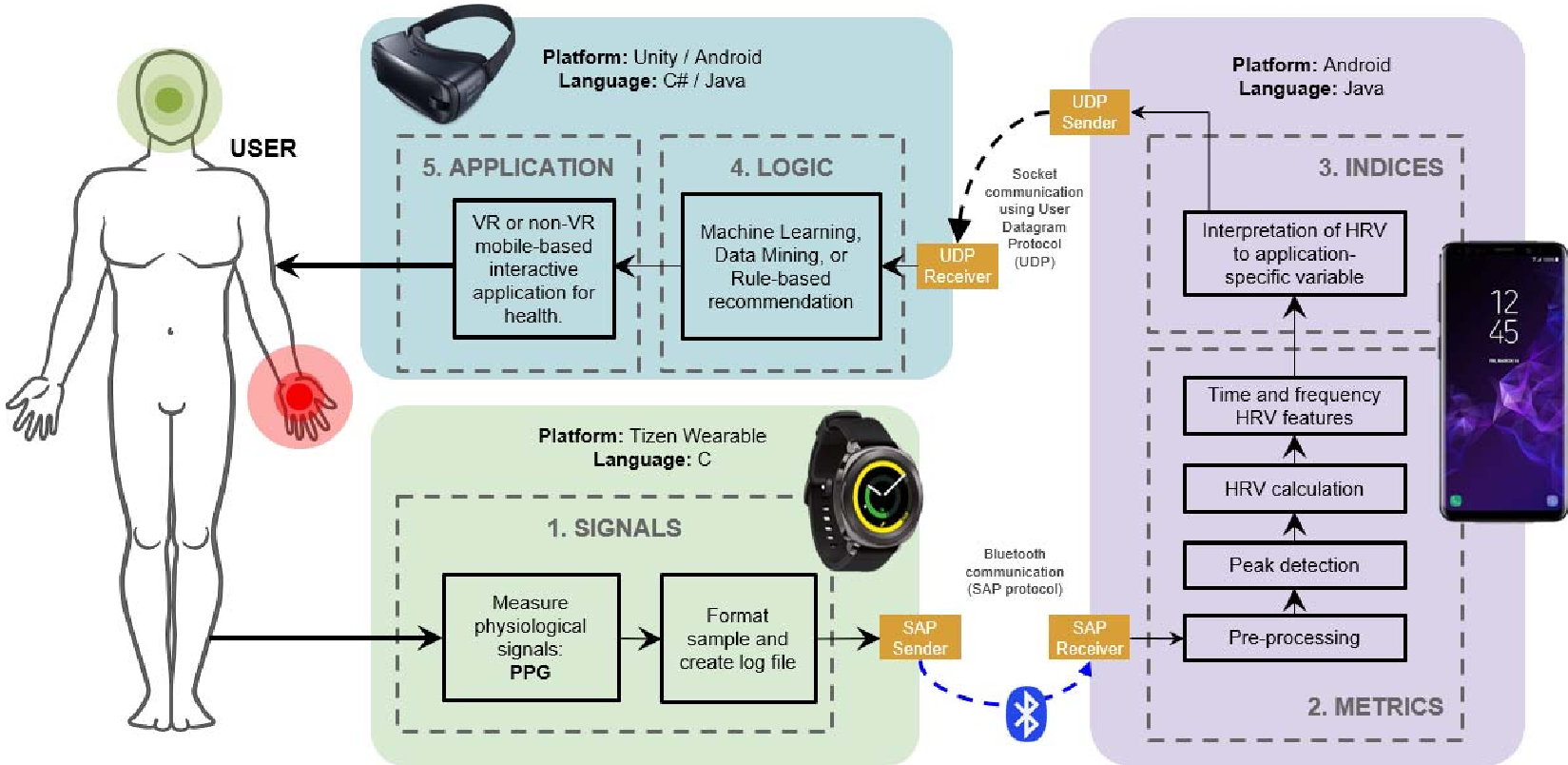 Figure 1: The architecture implementing the biocybernetic loop from sensor to VR application.
Experiments: Real-World Stress Testing
The system was tested on 11 volunteers participating in "slow-paced breathing" exercises (6 breaths per minute). This is a known physiological trigger that maximizes HRV amplitude.
Key Findings & Technical Bottlenecks
- Feasibility: The system successfully calculated HRV metrics like RMSSD and SDRR in real-time.
- The Android "Wall": A significant discovery was that Android's power management often killed the background processing app, identifying a major hurdle for "all-day" monitoring apps.
- Packet Loss: End-to-end packet loss reached ~50%, largely because the CPU was so taxed by the signal processing maths that it struggled to maintain the UDP socket connection.
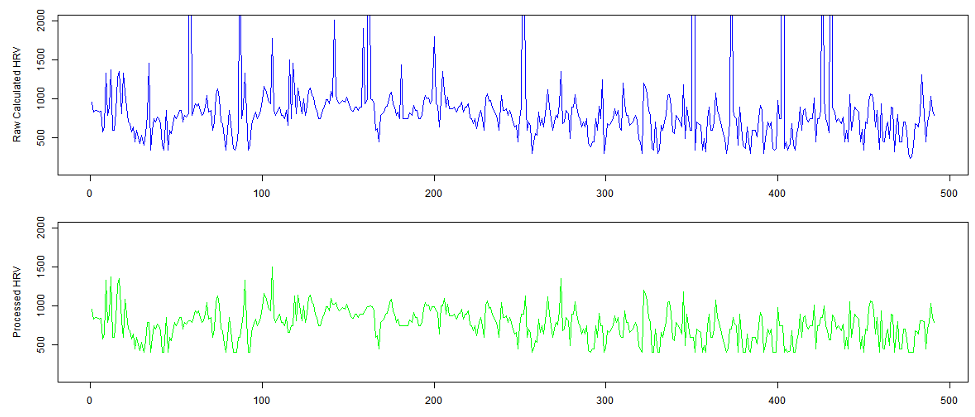 Figure 2: Real-time peak detection showing the raw PPG signal (Blue) and the denoised version (Green).
Critical Insight: Why This Matters
The value of this paper isn't just in the accuracy of the beats—it's in the infrastructure. By providing an open-source bridge (GitHub link included in the paper), the authors have cleared the path for:
- Personalized VR: Games that get harder/easier based on your stress level.
- Translational Medicine: Allowing doctors to monitor patient recovery at home with consumer hardware.
- Scalable Research: Moving HRV studies out of the lab and into the wild.
Future Outlook
While the "Heart is not a metronome," our mobile operating systems currently treat high-frequency signal processing as a battery-draining threat. To truly realize personalized healthcare, we need a "middle path" where OS architectures prioritize physiological computing threads.
Summary of System Performance
| Metric | Result |
|---|---|
| Sampling Frequency | 50 Hz |
| Peak Detection Window | 224 samples (overlapping) |
| Total Packet Loss | ~53% (Inter-app bottleneck) |
| Stability | Limited by Android Battery Optimization |
The framework is a critical first step toward a future where our devices don't just count our steps, but truly understand our inner state.