
SoCellBot: When Mobile Botnets Exploit the "Social Fabric"
Mobile botnets meet social networks: design and analysis of a new type of botnet
The paper proposes SoCellBot, a novel mobile botnet architecture that leverages Online Social Networks (OSNs) for bot recruitment and Command and Control (C&C). Unlike traditional SMS-based botnets, it utilizes social graph structures and OSN messaging to achieve state-of-the-art stealth and resilience.
Executive Summary
TL;DR: This paper unveils SoCellBot, the first mobile botnet design specifically engineered to exploit the topology and messaging infrastructure of Online Social Networks (OSNs). By moving away from costly and easily detectable SMS channels, SoCellBot achieves extreme resilience and stealth by hiding within encrypted social traffic.
Academic Positioning: This work bridges the gap between network science and mobile security. It moves beyond simple "what-if" scenarios to provide a mathematically grounded, simulation-validated, and experimentally proven blueprint for a new generation of "socially aware" malware.
The Evolution of the Threat: Why OSNs?
Traditional mobile botnets (like those using SMS or HTTP) have a "monetary footprint" or a "traffic spike" that alerts users and providers. The authors identify three critical insights that make OSNs the perfect breeding ground:
- Zero Marginal Cost: Many carriers offer OSN access (Facebook, WhatsApp) for free, allowing bots to communicate without draining the victim's balance.
- Encryption as a Shield: OSN traffic is typically encrypted, leaving cellular providers blind to the payload.
- Topological Resilience: The "Small World" nature of OSNs (high clustering, low distance) ensures that even if individual bots are removed, the "friend-of-a-friend" connectivity keeps the C&C channel alive.
Methodology: The Anatomy of an Outbreak
The researchers detail a lethal three-stage lifecycle for SoCellBot:
1. The Recruitment Strategy
The botnet doesn't just scan IPs; it exploits trust. By using "fake profiles" to infiltrate friend circles, the botmaster posts eye-catching links that trigger drive-by downloads on vulnerable Android devices.
2. Selective Forwarding (The "Random" Insight)
The paper reveals a counter-intuitive finding: Random Friend Selection (RFS) is superior to targeting "popular" (top-degree) friends. Why? High-degree nodes are too well-connected to each other (assortativity). Targeting them leads to redundant infection attempts. RFS allows the malware to "jump" across different social clusters more effectively.

3. C&C via Database Interception
In a technical proof-of-concept, the authors demonstrated that a bot could receive commands by monitoring the local threads_db2 database of Facebook Messenger on Android, effectively turning a legitimate app’s cache into a malicious communication tap.
Key Results: Speed and Scale
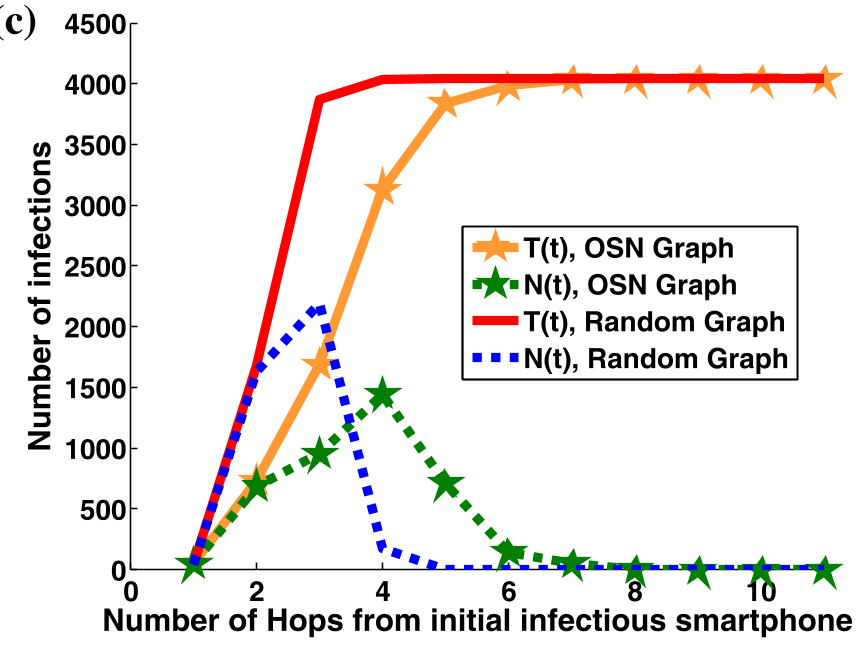
The simulations conducted on real Facebook subgraphs (4,039 nodes, 88k edges) produced startling results:
- The 6-Hop Rule: Consistent with the "Six Degrees of Separation" phenomenon, the infection reaches peak velocity at the 4th or 5th hop.
- The Random Graph Trap: While malware spreads faster in purely random graphs, it generates significantly more noise (duplicate messages), making it easier for ISPs to detect. Real OSN structures offer the perfect balance of speed and stealth.
Defeating the Botnet: Selective Monitoring
Since OSN providers cannot scan 25 billion posts daily with deep inspection, the authors propose Resource-Efficient Selective Monitoring.
By analyzing four graph metrics—Node Degree, Closeness, Betweenness, and PageRank—they identified that monitoring just a handful of high-degree or high-PageRank nodes can detect an outbreak 11x faster than random sampling.
| Metric | Top 7 Nodes Coverage | Detection Efficiency |
|---|---|---|
| Node Degree | 85% | Highest |
| PageRank | 95% | Highly Effective |
| Random | 9% | Ineffective |
Critical Insight & Conclusion
The Takeaway: The greatest strength of the SoCellBot—its reliance on social importance—is also its "Achilles' heel." Because the malware must pass through influential nodes to spread effectively, defending those specific "hubs" becomes the most viable strategy for global mobile security.
Limitations: The study primarily focuses on undirected graphs (Facebook-style). Future threats may evolve even more rapidly on directed networks (Twitter/X-style) where information flow is asymmetrical. Additionally, as mobile OS security (like scoped storage in newer Android versions) improves, the "database interception" method will require more complex privilege escalation.