
Kaleido: Revolutionizing Mobile Recommendations with the "Affective Pulse"
Mobile Contextual Recommender System for Online Social Media
This paper introduces Kaleido, a mobile contextual recommender system for online social networks that integrates "affective pulses" from media content. It combines visual emotional features with behavior, location, and social contexts using a cluster-based Latent Bias Model (LBM) to achieve SOTA prediction accuracy.
TL;DR
Social media consumption is increasingly driven by immediate emotional reactions rather than rational filters. Kaleido is a pioneer mobile system that captures this "affective pulse"—the first feeling triggered by media. By combining affective computing with social and location context through a Cluster-based Latent Bias Model (LBM), it achieves a remarkable 87% prediction accuracy, outperforming traditional content-based models by a wide margin.
Motivation: The Missing Piece in Recommendations
Why do we click on some tweets and scroll past others? Research shows that 60% of user clicks are motivated by media content, and 76% of those are triggered by explicit affective pulses like happiness or surprise.
Current systems focus on "What" (content labels) and "Where" (GPS), but they ignore "How" the user feels. The authors argue that because emotions trigger decisions faster than rational thought, a truly effective recommender must understand the visual-emotional variables of the media in real-time.
Methodology: The Core of Kaleido
1. Inferring the Affective Pulse
Kaleido treats emotion as a learning problem. It maps visual features—such as Saturation Contrast (SRC), Brightness (B), and Cool Color Ratio (CCR)—into a 6-dimensional affective space (Happiness, Surprise, Anger, Disgust, Fear, Sadness). Using multi-variant logistic regression, it achieves 75% accuracy in identifying the dominant emotion of a file.
2. The Cluster-based Latent Bias Model (LBM)
The system doesn't just look at emotion in isolation. It uses an advanced LBM to balance four key contexts:
- Affective Pulse: The emotional signature of the media.
- Social Closeness: Clustering friends into "Close," "Familiar," and "Unfamiliar."
- Location Preference: Identifying "Home" vs. "Office" centrals.
- Behavioral Patterns: Time-sensitive usage habits.
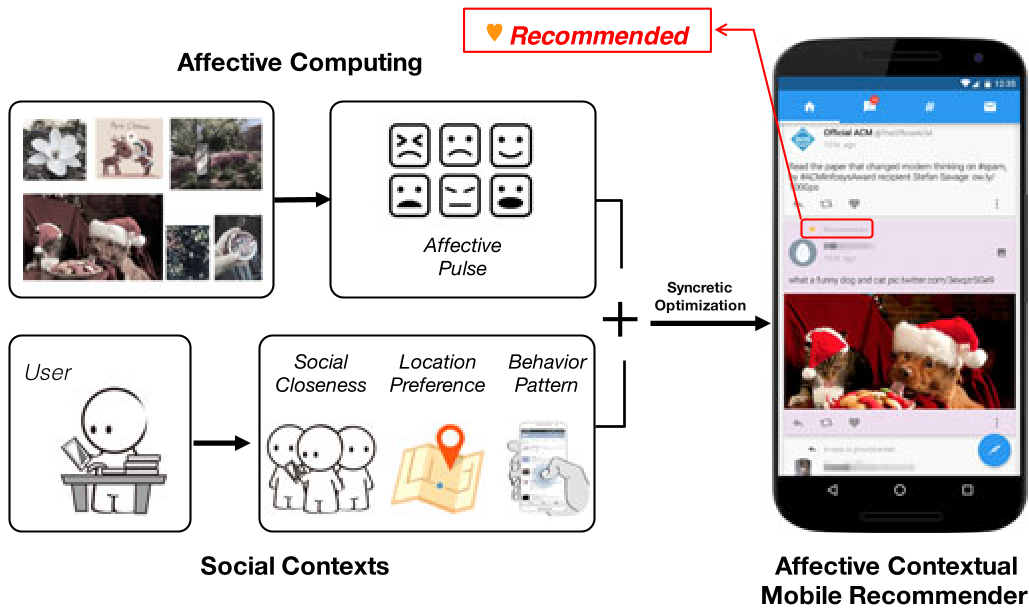 Fig 1. The overall framework of the Kaleido system integrating cloud and mobile components.
Experiments & Results
Performance Superiority
Kaleido was tested on a massive trace-driven dataset from nearly 17,000 participants. The results are definitive:
- Accuracy: 87% vs. 66% for standard Linear Regression.
- Efficiency: By offloading heavy model training to an edge-cloud testbed and keeping only "Testing/Inference" on the local device, Kaleido achieves a 1,000x speed-up.
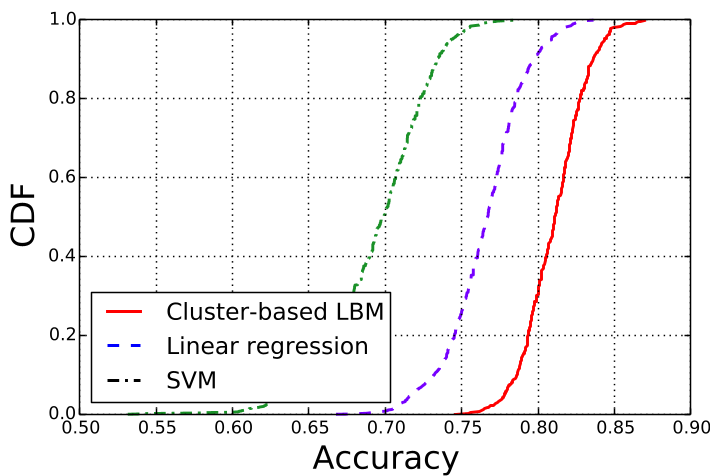 Fig 2. CDF of prediction accuracy showing Kaleido (Cluster-based LBM) significantly outperforming SVM and LR.
The Importance of Affect
The authors conducted an ablation study to see if the "Affective Pulse" really matters. When the affective feature was removed, the model’s accuracy dropped by 11%. This proves that emotion is not just "noise"—it is a critical signal for predicting user behavior in the mobile social era.
Critical Insight: Why Cloud-Training/Local-Testing is the Future
A key takeaway from this work is the architecture of Mobility Support. Training a latent bias model is computationally expensive. Kaleido cleverly offloads the Learning (Training) to the cloud when the phone is charging and on WiFi, but performs the Prediction (Testing) locally on the device. This ensures real-time recommendations with minimal battery drain and negligible latency (670ms round trip for updates).
Conclusion & Future Outlook
Kaleido bridges the gap between psychological theory and mobile systems engineering. By quantifying the "gut feeling" (affective pulse), it sets a new standard for social media engagement.
Limitations: Currently, the system focuses primarily on images. As the world moves toward short-form video (TikTok/Reels), the next frontier for Kaleido will be moving from static visual features to temporal, multi-modal affective computing that includes audio and motion signals.
Takeaway for Practitioners: If your recommendation logic doesn't account for the user's emotional context and social friendship "closeness" clusters, you are likely leaving over 20% of your potential accuracy on the table.