
Google's Crowdsource: Cracking the Code of Global, Non-Monetary Microtasking
Mobile crowdsourcing in the wild: challenges from a global community
This case study examines "Crowdsource," a global mobile application by Google designed to collect high-quality Machine Learning training data through microtasks. By analyzing over 540,000 users from 200 countries, the paper identifies key intrinsic motivators and gamification strategies that sustain engagement in non-monetary mobile crowdsourcing at a massive scale.
TL;DR
How do you convince over half a million people across 200 countries to label data for free? This case study on Google’s Crowdsource app reveals that while gamification (badges and levels) gets users in the door, the real driver for long-term engagement is the intrinsic desire to improve AI and a clear understanding of how their specific contributions impact the real world.
The "Skin in the Game" Motivation
Most crowdsourcing platforms face a "quality vs. cost" dilemma. If you pay users, you risk attracting "spammers" who prioritize speed over accuracy. Google took a different path with Crowdsource, opting for a non-monetary model.
The challenge? Maintaining momentum without a paycheck. The authors found that the motivation is deeply tied to Product Altruism. Users aren't just clicking buttons; they believe they are making Google Translate better for their native language or Maps more accurate for their local neighborhood.
Methodology: High-Volume User Insights
The research team targeted "Power Users"—those who had completed over 10,000 tasks. These users represent the "Gold Standard" of engagement.
The Reward Hierarchy
Interestingly, when users were asked what they valued most, the results defied typical gaming logic:
- Feedback on Accuracy (4.23/5): Users want to know they are doing it right.
- Upvotes from Others (4.01/5): Social validation within a community.
- Leveling Up (3.71/5): Though helpful, the abstract "level" was less important than the quality of the work itself.
 Figure 1: The UI design focuses on extreme simplicity for "in-the-wild" microtasking.
Why It Works: The "Impact" Notification
One of the most profound findings in the study relates to notifications. While many apps use social competition ("Your friend just passed you!"), Crowdsource found these were largely ineffective (47.4% encouragement).
Instead, the most powerful motivator was Impact Transparency. A notification saying "Complete 20 tasks to find out how we use this for Machine Learning" achieved a 77% encouragement rate. Users want to see the bridge between their "micro-effort" and the "macro-result."
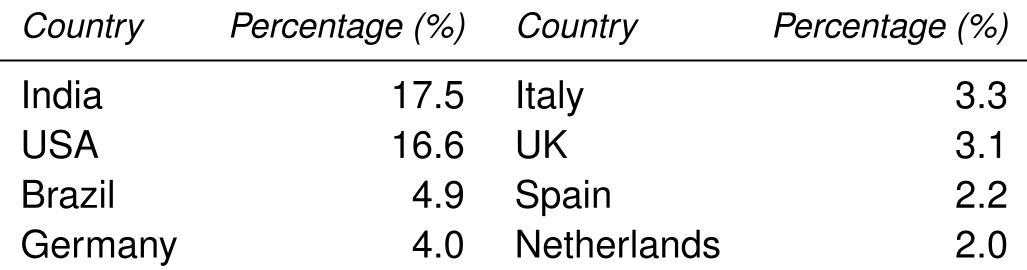 Table 1: The geographic diversity of Crowdsource demonstrates high engagement in emerging markets like India.
Critical Insight: The "Curiosity" Engine
The study highlights that 69.9% of users stay for curiosity. By automatically presenting the next task, the app creates a "flow state." However, the authors admit a weakness: the delay between contributing data and seeing it improve an AI model is too long. This "feedback latency" is the next big hurdle for crowdsourcing UX.
Conclusion & Future Look
Crowdsource proves that global communities are willing to contribute to the AI ecosystem if they feel recognized and useful.
Key Takeaways for Developers:
- Prioritize Accuracy Feedback: Users are intrinsically motivated by mastery.
- Explain the 'Why': Connect microtasks to real-world product improvements.
- Fight Fatigue: 54% of users switch task types frequently; variety is essential for "in-the-wild" survival.
As we move into an era dominated by LLMs and RLHF (Reinforcement Learning from Human Feedback), the lessons from Crowdsource's global community will be more relevant than ever.