
Hyperlocal News & Mobile Crowdsourcing: Why Readers Don't "Scoop" Everything
A Field Trial on Mobile Crowdsourcing of News Content Factors Influencing Participation
This paper presents a five-week field trial of a mobile crowdsourcing platform (Scoopshot) used by a hyperlocal news publisher to engage readers in content creation. It identifies how participant demographics, task significance, and spatial/temporal contexts influence the success of mobile-based "reader reporter" initiatives.
TL;DR
Hyperlocal news thrives on community involvement, but mobilizing a "crowd" via smartphones is harder than it looks. This study examines a field trial using the Scoopshot platform, revealing that while readers love the idea of being citizen journalists, their actual participation is dictated by a strict "effort vs. reward" calculus, task relevance, and their physical proximity to the assignment.
Context: The Digital Shift in Journalism
The traditional "top-down" model of journalism is evolving into a collaborative ecosystem. Newsrooms are increasingly relying on User-Generated Content (UGC) for "soft" or breaking news. Hyperlocal news—content focused on small, geographically defined communities—is the perfect sandbox for Mobile Crowdsourcing.
However, the gap between "having a smartphone" and "contributing to the news" remains wide. The researchers set out to understand why.
Methodology: The Scoopshot Trial
The study involved 104 participants over five weeks. The publisher, Sanoma News, sent weekly assignments ranging from "Cleaning the Environment" to "Street Conditions" (#potholes).
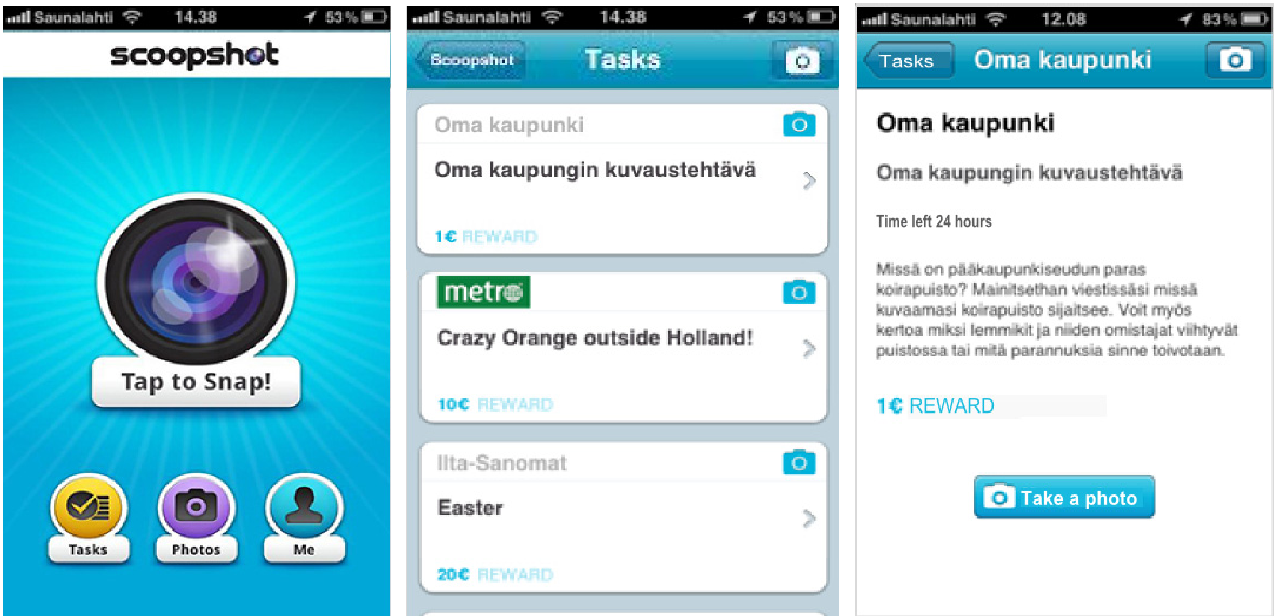 The interface used by participants to view and submit assignments.
The Assignments and Engagement
Activity levels notably declined as the weeks progressed. While 87 people viewed the first task, only 56 viewed the fifth.
| Assignment | Theme | Submitters | Notes |
|---|---|---|---|
| #1 | Cleaning the environment | 9 | Highest participation |
| #2 | Tallinn shipping | 2 | One user sent 26 photos |
| #5 | Street conditions | 3 | Highest reward (50€) |
Core Insights: What Drives Participation?
1. The Demographic Divide
There was a stark contrast in perception between age groups. Users aged 15-25 frequently rated assignment themes as "boring" or "demotivating." In contrast, older participants (25+) perceived the same themes as "communal" and "useful." This suggests that "hyperlocal" isn't a one-size-fits-all category; youth interests differ significantly from the general community's.
2. Proximity is King (The Spatio-Temporal Factor)
The study highlights that crowdsourcing tasks must interweave with daily life.
- The Gap: In questionnaires, users said they’d travel 5km for a task.
- The Reality: Interviews revealed they only wanted to do tasks "on the way" to work, home, or while walking the dog.
- The Takeaway: If a task requires a specific detour, the monetary or social incentive must be significantly higher.
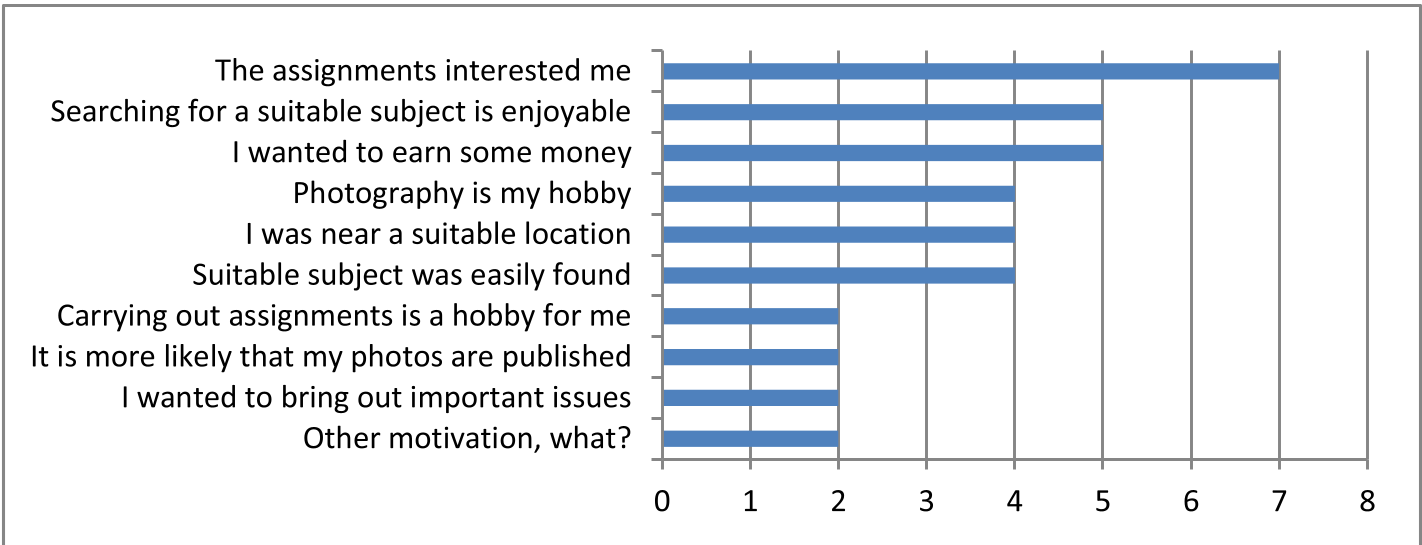 Motivation factors: Interesting assignments and "being close to a suitable location" were top drivers.
3. Motivations: Beyond the Money
While Scoopshot facilitates monetary transactions, the field trial showed that intrinsic motivations were often stronger for "hobbyist photographers."
- Influence: The feeling of "getting something fixed" (e.g., a pothole repaired after a photo was published) provided more satisfaction than the €1 reward.
- Creative Outlet: Participants enjoyed the "challenge" and the "fun" of hunting for a specific shot.
Critical Analysis & Future Outlook
The trial exposes a critical design flaw in many crowdsourcing platforms: a lack of community and reputation.
The "Expert" Problem
The platform treated all users as a generic "crowd." However, the data shows that the most active contributors are often dedicated hobbyists who want professional feedback, reputation systems, and the ability to see what others have submitted.
Strategic Recommendations for Newsrooms:
- Dynamic Validity: Assignments should have a "Goldilocks" duration—roughly two days. Half a day is too short to plan; a week is too long to maintain urgency.
- Location Intelligence: Platforms should "push" tasks based on a user's frequent routes, not just their current static GPS point.
- Community Loop: Provide social rewards (comments, "likes," or "Impact" badges) to supplement small monetary rewards.
Conclusion
Mobile crowdsourcing isn't just a technical challenge; it's a human-centric one. To succeed, news publishers must stop viewing readers as "on-demand sensors" and start treating them as community members whose participation is a byproduct of their daily movements and social values.
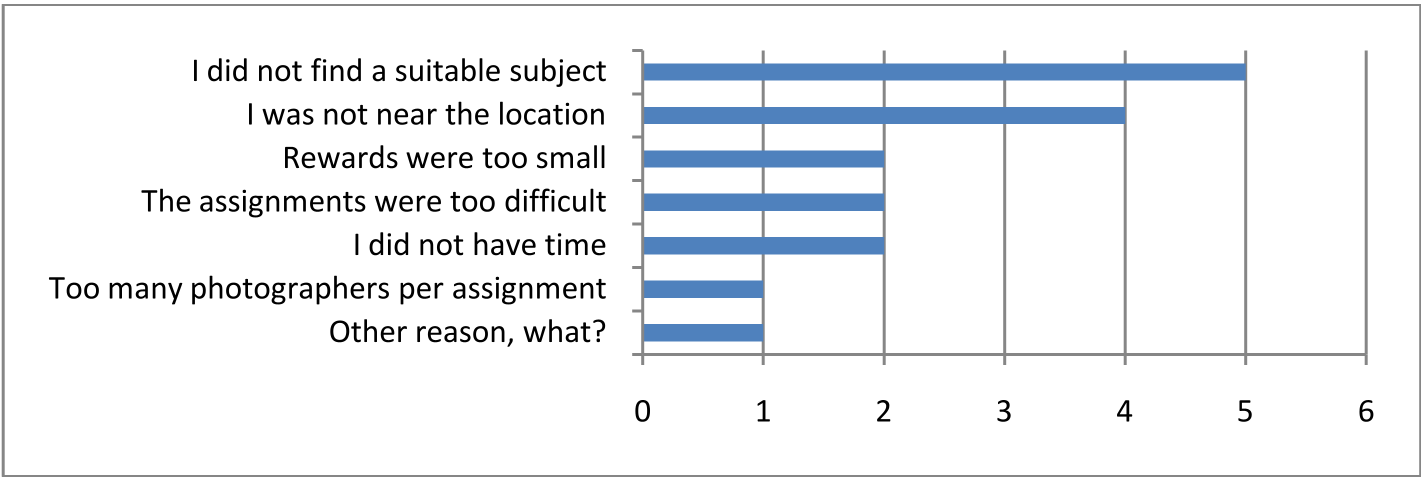 The main barriers: Not finding a subject and being outside the location vicinity.