
Mobile Crowdsourcing: Transforming Smartphones into Pervasive Cloud Servers
13187_Exploiting mobile crowdsourcing for pervasive cloud services challenges and solutions.
This paper explores the paradigm of Mobile Crowdsourcing (MC) within the context of Mobile as a Service Provider (MaaSP). It introduces the SATA (Social-Aware Task Allocation) scheme and an anonymous reputation management system to address key challenges in pervasive cloud services.
TL;DR
Mobile devices are no longer just consumers of cloud data; they are becoming the cloud itself. This paper investigates the transition from Mobile as a Service Consumer (MaaSC) to Mobile as a Service Provider (MaaSP). By leveraging the SATA (Social-Aware Task Allocation) mechanism and anonymous reputation management, the authors provide a blueprint for a cost-effective, secure, and socially-intelligent mobile crowdsourcing ecosystem.
Background: The Shift to MaaSP
For years, mobile cloud computing focused on offloading heavy tasks from phones to centralized servers. However, with the explosion of smartphone hardware—quad-core CPUs, diverse sensors (GPS, Gyro, Camera), and ubiquitous connectivity—we are seeing the rise of Mobile Crowdsourcing. Here, the "cloud" is a dynamic, ad-hoc network of mobile users who provide data collection (Sensing) and human-intelligence-plus-machine computation (Computing).
The Core Dilemma: Trust, Privacy, and Efficiency
Despite the potential, building a pervasive mobile cloud is plagued by three fundamental issues:
- Selfishness: Why should a user drain their battery for a stranger's task without a fair incentive?
- Matching Complexity: Not every user is suited for every task. A "Sport" related task should go to a user at a stadium, not just any available device.
- Security Paranoia: In local-based scenarios (e.g., smart malls), local servers are often untrusted. How can users submit reports without exposing their precise movement trajectories?
Methodology: SATA and Anonymous Reputation
1. Social-Aware Task Allocation (SATA)
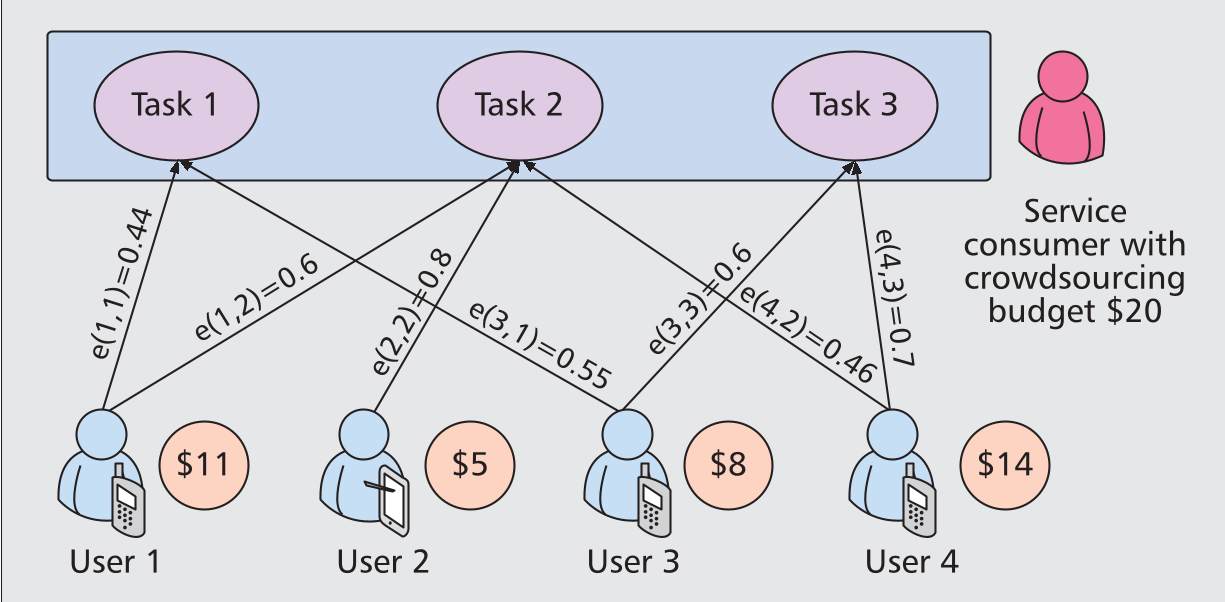
The paper moves beyond simple bidding. It proposes a Matching Degree based on:
- Social Attribute Overlap (): Matching user interests (e.g., sports, tech) to task categories.
- Task Delay (): Predicting the time-to-completion based on user mobility.
- Reputation (): Historical reliability of the participant.
The allocation is then formulated as a Knapsack Problem, where the goal is to maximize the cumulative matching degree of participants under a strict budget constraint.
2. Anonymous Reputation Management
To handle privacy, the authors employ Blind Signatures.
- A Reputation and Pseudonym Manager (RPM) issues certificates.
- Users generate a "Blind ID" for each submission.
- This allows the service consumer to evaluate the report’s quality and provide feedback without ever knowing the user's real-world identity. This "linkage-proof" design is crucial for preventing de-anonymization via multiple sensing reports.
Performance Benchmarks
The authors compared SATA against a Greedy Allocation Scheme (GAS).
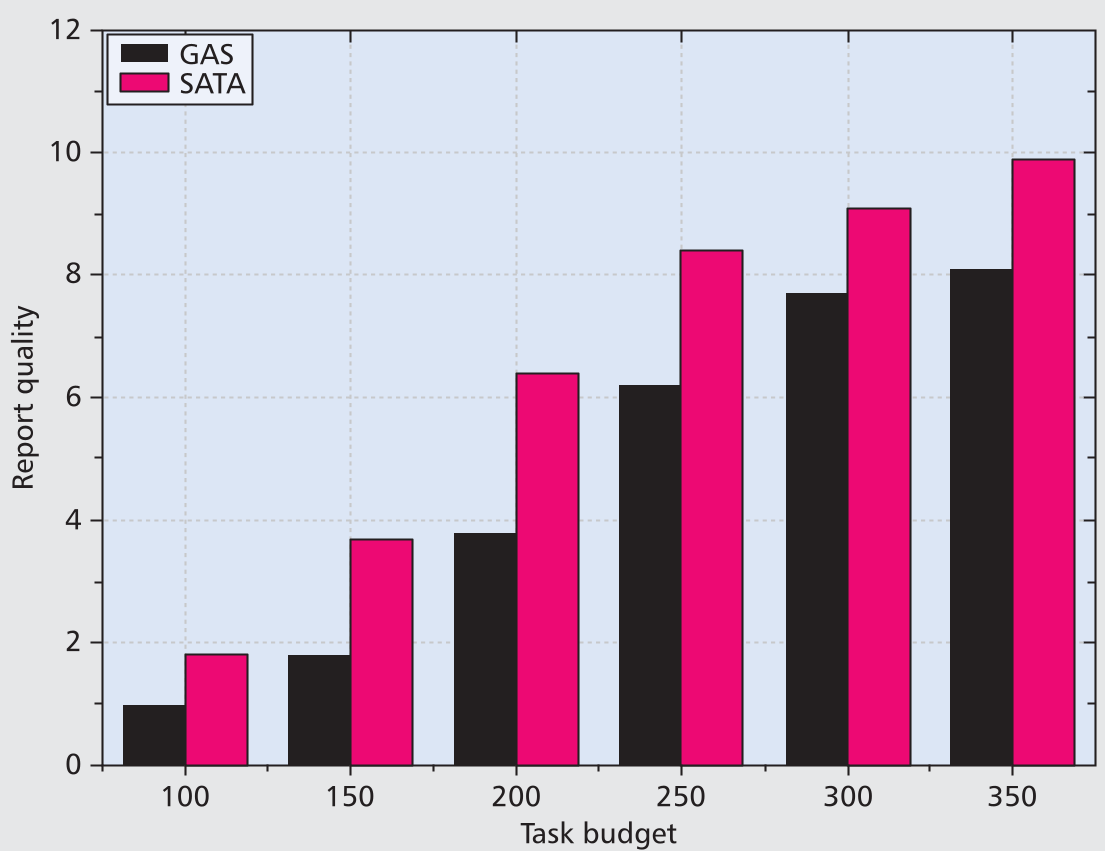
The results show two major wins:
- Higher Task Quality: By choosing "well-suited" users rather than just "cheap" users, the accuracy of the completed tasks improved significantly.
- Sustainable Profits: Both service consumers and mobile users saw higher utility, proving that social-awareness creates a "win-win" incentive structure.
Future Outlook: The Multimedia Challenge
The paper concludes with a forward-looking critique: Multimedia Report Evaluation. While text or sensor data (temperature, GPS) is easy to verify, how do you automatically verify the "truthfulness" of a crowdsourced video or photo?
Current similarity-based analysis falls short for rich media. Future research must integrate robust multimedia signal processing and perhaps decentralized AI to validate these complex reports without reverting to manual (and expensive) human auditing.
Conclusion
This work highlights that the future of the cloud is decentralized and social. By addressing the "human" factors of mobile networks—social ties and the need for privacy—we can unlock the spare processing power of billions of devices to solve massive, real-world problems.