
Mobile Crowdsourcing: Unlocking the Pocket Workforce
Mobile crowdsourcing: four experiments on platforms and tasks
The paper investigates the adequacy of current commercial crowdsourcing platforms and task types for mobile devices through four diversified experiments. Using platforms like Amazon Mechanical Turk and Micro Workers, the authors identify that while mobile tasks are perceived as more difficult, specific optimizations and task types (like voice-to-text writing) can bridge the performance gap between desktop and mobile.
TL;DR
Is your smartphone ready for the gig economy? This study systematically dissects the intersection of mobile computing and crowdsourcing. Through four experiments, the authors prove that while existing platforms (mTurk, etc.) are clunky on mobile, the bottleneck isn't the task complexity—it's the interface. Surprisingly, for creative writing tasks, mobile can actually beat desktop performance thanks to voice-to-text input.
Background & Motivation: The Untapped "Wait Time"
We live in a world of "dead time"—waiting for the bus, commuting, or standing in line. This represents a massive, untapped human workforce. While crowdsourcing (outsourcing micro-tasks to the "crowd") is a multi-million dollar industry, it has historically been tethered to the desktop. The authors ask a critical question: Are the tasks we see today actually feasible on the devices we carry in our pockets?
The Core Friction: Platforms and Tasks
The research addresses two fundamental questions:
- Q1 (Platforms): Which existing marketplaces are mobile-friendly?
- Q2 (Tasks): Which specific types of work (categorization vs. writing) translate best to small screens?
Methodology: A Multi-Angle Attack
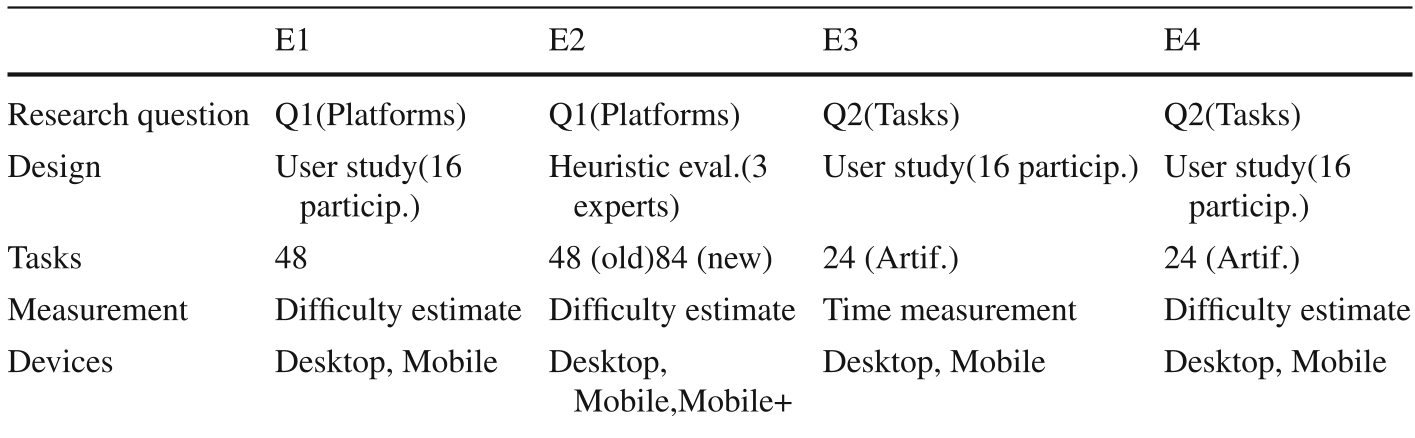
The researchers didn't just look at data; they built tools. They developed a prototype Android app and a desktop application to measure real performance metrics.
- Heuristic Evaluation: Experts analyzed "Mobile+" scenarios—imagining tasks redesigned for touch interfaces without "superficial" issues like Flash or small text.
- User Studies: 16 participants performed real tasks (Transcription, Sentiment Analysis, etc.) while being timed.
Deep Dive: Why is Mobile Hard?
The study identified several "Superficial Inadequacies":
- Technical Obstacles: Unsupported audio/video formats and legacy plugins (Flash).
- Input Friction: High-intensity typing (Transcription) is a nightmare on soft keyboards.
- Layout Failures: Non-responsive web designs that require excessive horizontal scrolling.
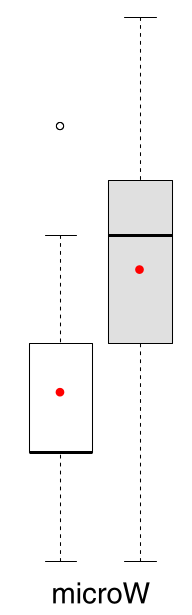 Figure: mTurk consistently shows higher difficulty across both platforms, though it also offers the most "serious" non-spam tasks.
The "Voice" Advantage: A Statistical Surprise
One of the most compelling findings comes from Experiment 3 (Task Execution). While "Image Tagging" and "Transcription" took significantly longer on mobile, Writing (Wri) tasks saw a performance boost.
How? Users intuitively bypassed the keyboard. By leveraging voice-to-text functionality, mobile workers completed writing assignments faster than their desktop-bound counterparts. This highlights a critical Inductive Bias: the device dictates the method. Mobile isn't just a "smaller desktop"; it's a different modality of interaction.
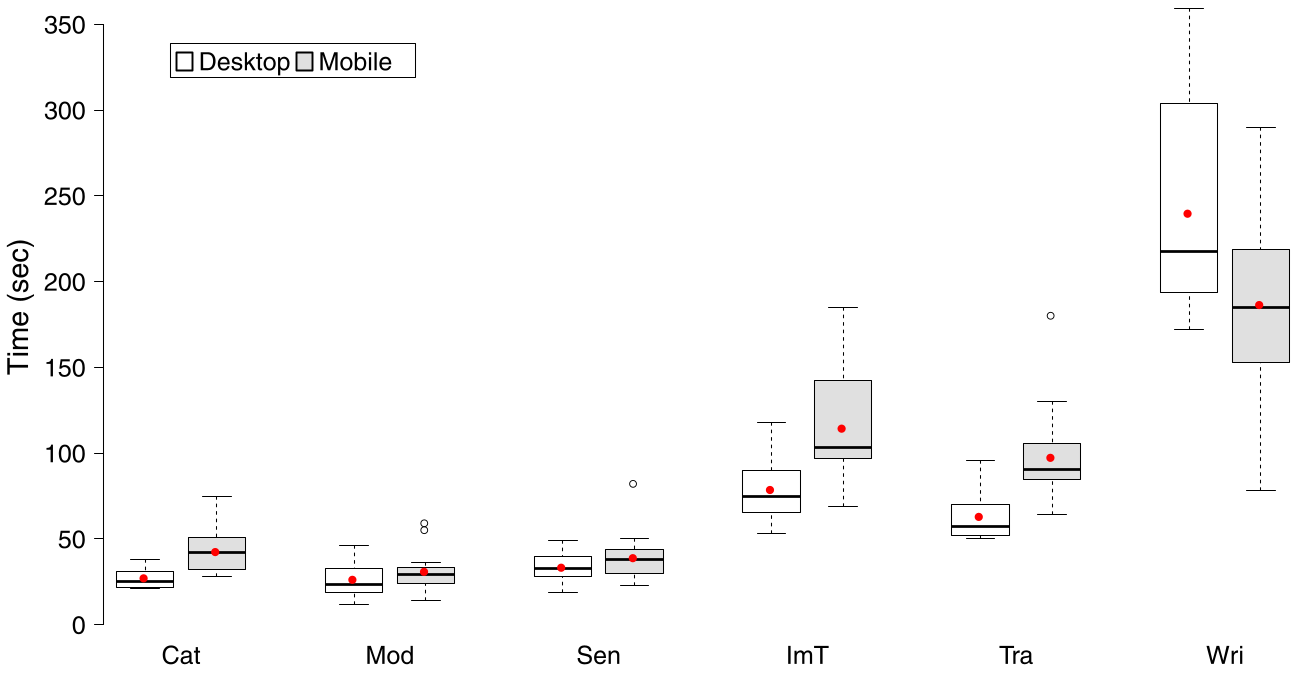 Figure: Note the "Writing" (Wri) category where mobile performance rivals or exceeds desktop speed.
Critical Insight: The Spam Problem
The authors discovered a worrying trend in secondary platforms (Micro Workers, Minute Workers). While mTurk had cleaned up its act (partly due to policy changes), the other platforms were rife with Requester Spam—tasks designed to game SEO or harvest personal data. This suggests that for mobile crowdsourcing to scale, platform-level governance is as important as UI design.
Conclusion & Future Outlook
This paper serves as a blueprint for the next generation of "Context-Aware" crowdsourcing. The takeaway is clear:
- Redesign, don't just Rescale: Removing technical debt (like frames and plugins) significantly lowers the "Mobile+" difficulty.
- Leverage Sensors: The future of mobile work lies in voice, GPS, and cameras—not just filling out forms.
- Task Filtering: Platforms should automatically route high-input tasks to desktops and high-sensor/voice tasks to mobile.
As we move deeper into the era of AI-human collaboration, the findings here remind us that the interface is often the loudest part of the system.