
Mobile Crowdsourcing: The Living Pulse of the Future Smart City
Mobile Crowdsourcing in Smart Cities: Technologies, Applications, and Future Challenges
This paper provides a comprehensive survey of Mobile Crowdsourcing (MCS) in the context of Smart Cities, detailing a general framework involving service providers, workers, and end-users. It synthesizes state-of-the-art technologies in task scheduling, data processing, and incentive mechanisms, while highlighting SOTA applications in smart transportation and public services.
TL;DR
Mobile Crowdsourcing (MCS) is transforming urban infrastructure by turning every smartphone carrier into a mobile sensor. This survey explores the shift from static sensors to dynamic, human-powered data networks that optimize everything from traffic flow to public health. By leveraging human intelligence and mobile mobility, MCS creates a cost-effective, pervasive layer of urban intelligence.
Problem & Motivation: Beyond Static Sensors
Urbanization has brought about a paradox: as cities grow, they become harder to manage using traditional, static infrastructure. Fixed sensors for air quality or traffic are expensive to deploy and maintain, and they provide a fragmented view of the city.
The authors identify a critical gap—the need for a human-centric sensing paradigm. Instead of populating the city with "dead" hardware, we can leverage the sophisticated sensors already in our pockets (accelerometers, GPS, microphones). The challenge, however, is orchestrating thousands of autonomous, privacy-conscious individuals to provide reliable data on demand.
Methodology: The Core Architecture of MCS
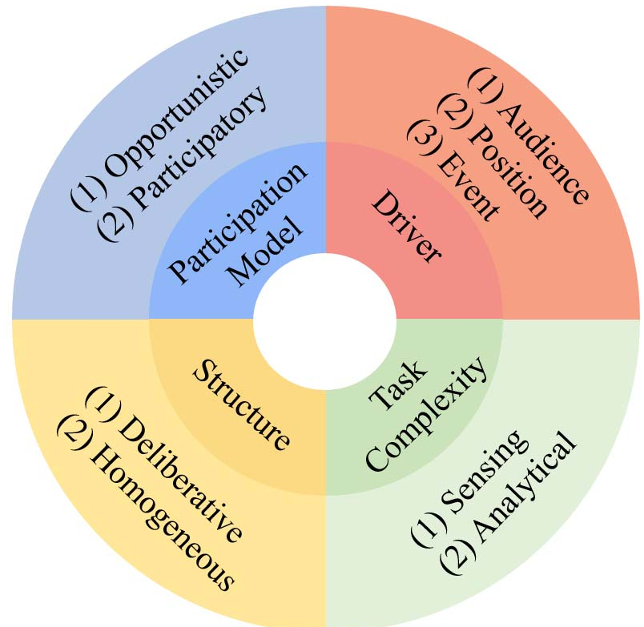
The paper defines MCS through three core characteristics: Mobility, Collaboration, and Human Capacity. Unlike opportunistic sensing where data is collected silently, MCS often requires participatory action, where users consciously contribute to a task.
The MCS Framework
The architecture consists of a triad:
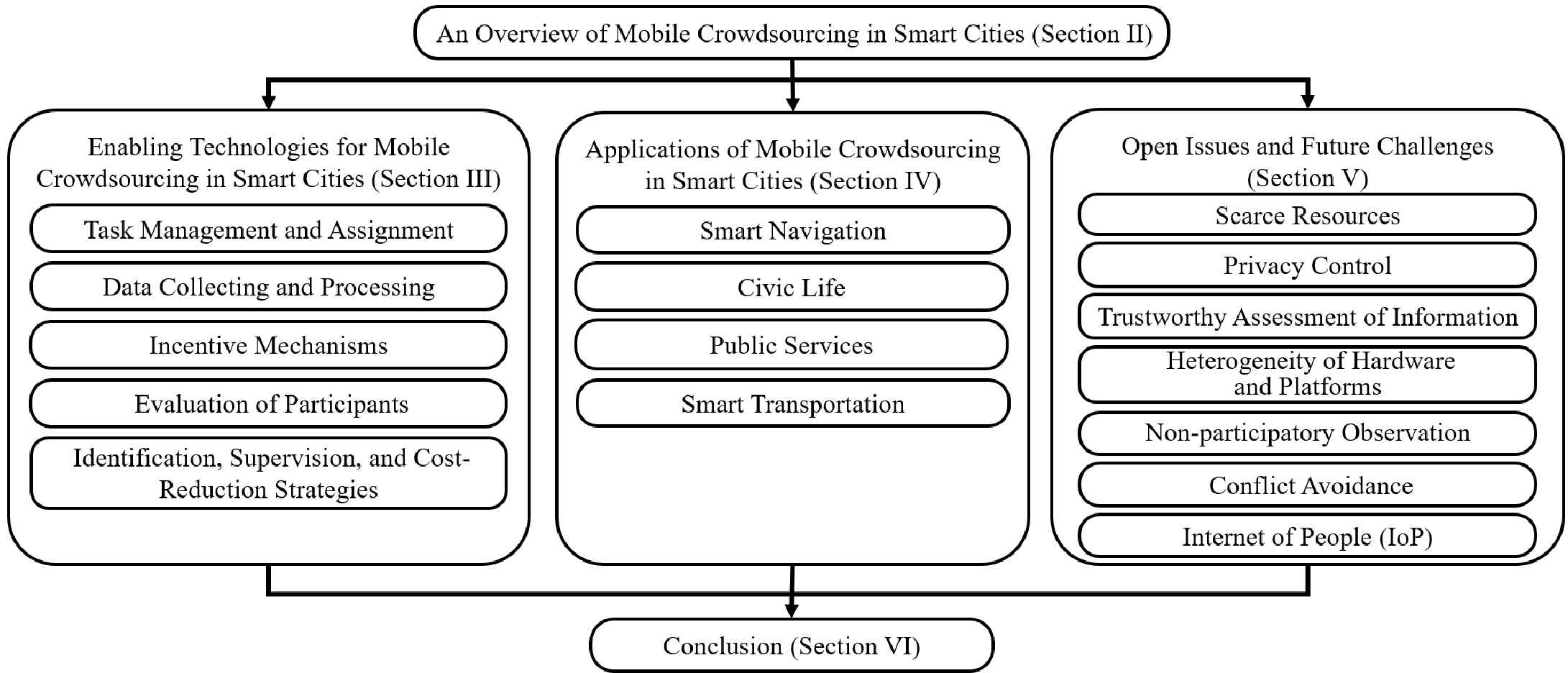
- Service Providers: The platforms that handle task decomposition and worker allocation.
- Working Crowds: The sensing and computing entities (humans with devices).
- End-Users: Requesters who consume the crowdsourced services.
A pivotal insight in the methodology is the Incentive Mechanism. Why would a citizen drain their battery to report a pothole? The paper categorizes solutions into:
- Monetary: Auction-based pricing that ensures "truthfulness" (preventing workers from gaming the system).
- Entertainment: Gamifying data collection (e.g., collecting geographic data through location-based games).
- Social Responsibility: Appealing to altruism for public safety and disaster response.
Smart City Applications: From Navigation to Healthcare
The value of MCS is best seen through its diverse application layers:
- Smart Transportation: Real-time bus arrival prediction and "Smart Parking" systems where drivers share data to reduce urban congestion.
- Environment Monitoring: Using microphones for noise pollution mapping (NoiseSense) and camera sensors for real-time air quality estimation (AirTick).
- Public Safety: Mobilizing the crowd for disaster relief or reporting criminal activities, turning the community into a distributed security network.
Experimental Insights & Technical Challenges
Data quality remains the "Achilles' heel" of MCS. The paper highlights that quality is not just about the hardware (sensor accuracy) but the reliability of the participant. Reputation systems are introduced as a SOTA method to filter malicious or low-quality data, with some models showing a 3x improvement in system trustworthiness over baseline methods.
However, the survey admits to several unresolved hurdles:
- Privacy Control: How to use a worker's location for task allocation without revealing their home address.
- Heterogeneity: Managing the measurement variance across different hardware (an iPhone's microphone vs. a budget Android device).
- Resource Scarcity: The inherent conflict between high-frequency sensing and mobile battery life.
Critical Analysis & Conclusion
This work positions MCS as a stepping stone towards the Internet of People (IoP). The core takeaway is that the "Smart" in Smart Cities isn't just about AI—it's about the Collective Intelligence of the residents.
While the paper provides a masterclass in the what and how of MCS, the future lies in nonparticipatory observation (capturing human behavior without active input) and conflict avoidance in overlapping sensing regions. For researchers and urban planners, the message is clear: the future of city management is decentralized, incentivized, and mobile.
Key Takeaway
The success of a smart city depends less on the density of its sensors and more on the incentive alignment of its citizens.