
Mobile Data Offloading: Harnessing Human Serendipity to Rescue 3G Networks
Mobile Data Offloading through Opportunistic Communications and Social Participation
This paper introduces a framework for offloading mobile data traffic from overloaded 3G networks to opportunistic Device-to-Device (D2D) communications within Mobile Social Networks (MoSoNets). By utilizing a Greedy target-set selection algorithm on time-expanded contact graphs, the authors achieve up to 73.66% data offloading in real-world mobility scenarios.
TL;DR
As cellular networks struggle under the weight of "data explosions," this paper proposes a clever pivot: instead of building more towers, why not let the users do the work? By seeding content to a tiny fraction of "active" users (the target set), information can spread through free Bluetooth/WiFi opportunistic contacts. This work proves the theoretical efficiency of this approach and demonstrates a practical heuristic that offloads over 70% of traffic by predicting who you'll bump into tomorrow based on where you were today.
The Problem: The Infrastructure Bottleneck
The surge in smartphone usage created a 5,000% increase in data traffic for some carriers, leading to the "3G overload" crisis. Existing fixes like WiFi hotspots or femtocells are tethered to the ground—if you aren't near a router, you're back on the congested cellular grid.
The authors identify a missed opportunity: Human Mobility. People are social and mobile. They gather in clusters, commute on the same trains, and sit in the same cafes. This creates a "Mobile Social Network" (MoSoNet) that can act as a shadow transport layer for non-real-time data like news and media updates.
The Insight: Submodularity and Human Regularity
The core challenge is the Target-Set Selection Problem: If you can only afford to send a file to users via the expensive cellular network, which users would result in the maximum spread through free person-to-person contacts?
1. Theoretical Proof (The "Why")
The authors prove that the information dissemination function in these dynamic, time-stamped contact graphs is submodular. In plain English: the "marginal gain" of adding more seed users decreases as the set grows. This is crucial because it allows the use of a Greedy Algorithm that is guaranteed to be within (~63%) of the optimal solution.
2. The Mobility Heuristic (The "How")
A pure Greedy algorithm requires knowing the future (who will meet whom). To bridge this, the authors exploit the regularity of human behavior. If Alice was a "hub" of activity at 11:00 AM yesterday, she is likely to be one tomorrow. The Heuristic algorithm uses yesterday's contact history to select today's seeds.
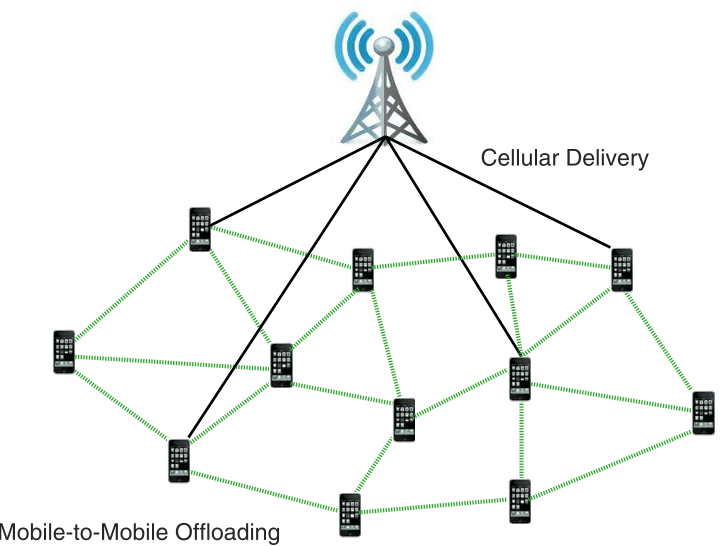 Figure 1: Conceptual overview of offloading where target users (blue) propagate data to others through opportunistic contacts.
Real-World Feasibility: The "Opp-Off" Prototype
Theoretical gains are meaningless if hardware can't keep up. The authors built Opp-Off on Nokia N900 smartphones. They compared Bluetooth and WiFi for discovery and found:
- WiFi Scanning: Drains a battery in 5 hours.
- Bluetooth Inquiry: Lasts over 20 hours.
Their experiments between a static and a moving user (walking at 1 m/s) showed that even during a brief 20-second window, phones could reliably swap ~1.5 MB of data via Bluetooth—plenty for a news digest or a weather update.
Experimental Results: High-Impact Offloading
Using traces from the Haggle project (iMotes) and MIT's Reality Mining (cell towers), the study compared Random, Heuristic, and Greedy selection.
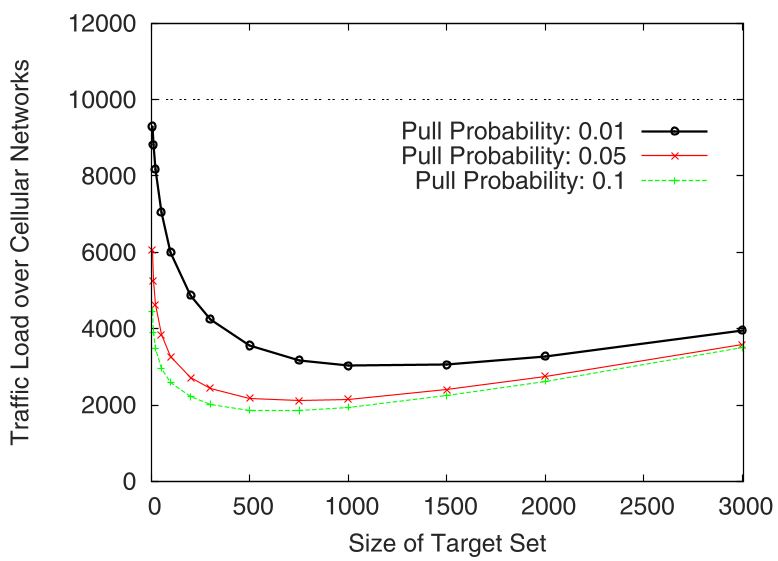 Figure 2: Performance of selection algorithms. As pull probability increases, cellular load drops drastically.
Key Findings:
- Offloading Efficiency: In the Reality Mining trace, the Heuristic algorithm achieved a massive 73.66% reduction in cellular traffic.
- Resilience: Even the Random selection algorithm performed surprisingly well, suggesting that as long as a few "hubs" are accidentally picked, the network's social structure does the rest.
- Latency Trade-off: The longer users are willing to wait (the "Delay Tolerance Threshold"), the more traffic can be offloaded. Moving from a 1-hour to a 2-hour window significantly improves performance.
Critical Analysis & Conclusion
This paper is a seminal look at the intersection of social networking and wireless protocols. It shifts the burden of connectivity from the ISP to the social fabric of the users.
Limitations:
- Privacy & Incentives: Why would a user let their phone battery be used to relay data for a stranger? The authors suggest "coupons" or discounts, but the social incentive remains the hardest "layer" to solve.
- Modern Scale: In the 5G/6G era, data packages are much larger. While 1.5 MB was great for 2012, today's offloading might require high-speed mmWave or WiFi-6 D2D handshakes to move gigabytes.
Takeaway: Mobile data offloading isn't just a technical problem; it's a social one. By treating human mobility as a predictable resource, we can build networks that are both cheaper and more resilient.