
M-Pesa: Decoding the Digital Pulse of Financial Inclusion in Developing Economies
Mobile Money: Understanding and Predicting its Adoption and Use in a Developing Economy
This paper presents a large-scale quantitative study of M-Pesa, the world's leading mobile money service, in an African developing economy. By analyzing 140 million Call Detail Records (CDRs) and 27 million financial transactions, the authors built machine learning models to predict mobile money adoption and spending intensity among unbanked populations.
TL;DR
Accessing a bank is often a luxury in developing nations, but mobile phones are ubiquitous. This study by Centellegher et al. analyzes millions of transaction records from M-Pesa to predict who will adopt mobile money and how much they will spend. Scaling beyond qualitative surveys, the researchers demonstrate that your social circle and mobile activity intensity are the strongest predictors of your financial digital future.
Background & Motivation
For approximately 2 billion "unbanked" individuals, mobile money isn't just a convenience—it is a lifeline for escaping poverty. While we know services like M-Pesa are successful, the industry has largely operated on intuition regarding user adoption. The authors sought to provide a data-driven "weather forecast" for financial behavior, asking: Can we look at how someone uses their phone today to predict if they will use mobile money three months from now?
Methodology: Bridging CDRs and Cash
The researchers combined two massive datasets:
- Call Detail Records (CDRs): 140 million logs of calls and SMS (capturing the "social" side).
- M-Pesa Transactions: 27 million logs of deposits, withdrawals, and P2P transfers (capturing the "financial" side).
They engineered features categorized into 11 groups, including:
- Ego-network: How many of your friends already use M-Pesa?
- Mobility: How far do you travel daily (Radius of Gyration)?
- Temporal Patterns: Do you call more at night or on weekends?
Technical Insight: The Long-Distance Flow of Money
One of the most striking findings was the spatial difference between social and financial interaction. While 63% of calls stay within the same district, 72.5% of M-Pesa transfers are inter-district. This quantitatively proves M-Pesa's role in facilitating urban-to-rural remittances.
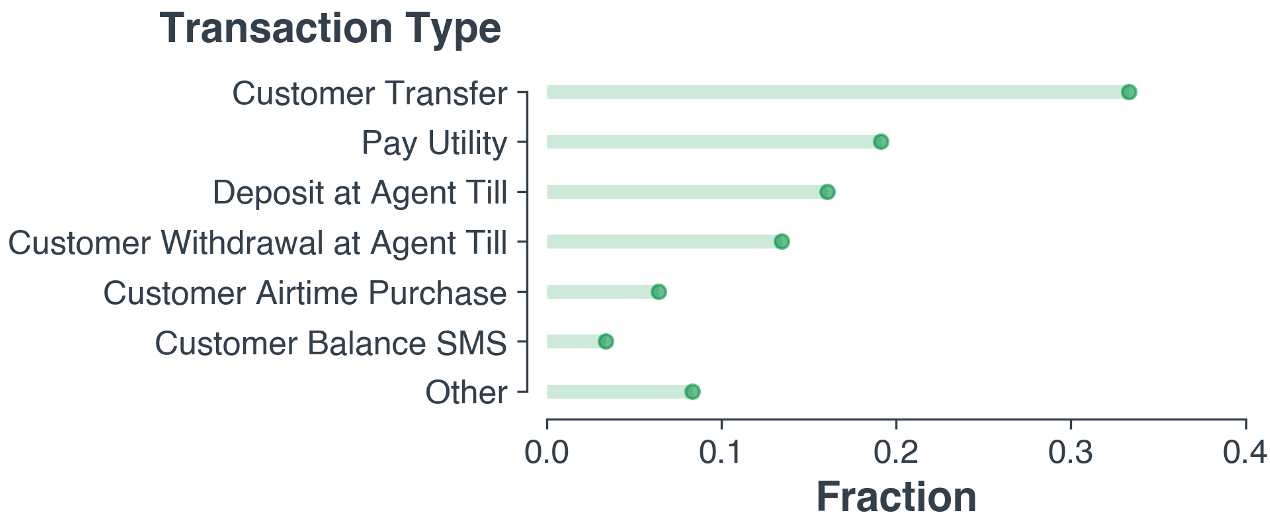 Figure 1: Breakdown of M-Pesa transaction types, highlighting the dominance of P2P transfers.
Predictive Power: GBTs and Spending Thresholds
The team formulated two primary tasks:
- Adoption Prediction: Classifying users who were inactive in T1 but became active in T2.
- Spending Classification: Distinguishing "High Spenders" (top 25%) from "Low Spenders" (bottom 25%).
The Gradient Boosted Trees (GBT) model achieved an AUC of 0.691 for adoption. Interestingly, the model's performance remained robust even when the training window was shortened to just two weeks, suggesting that core mobile habits are stable predictors.
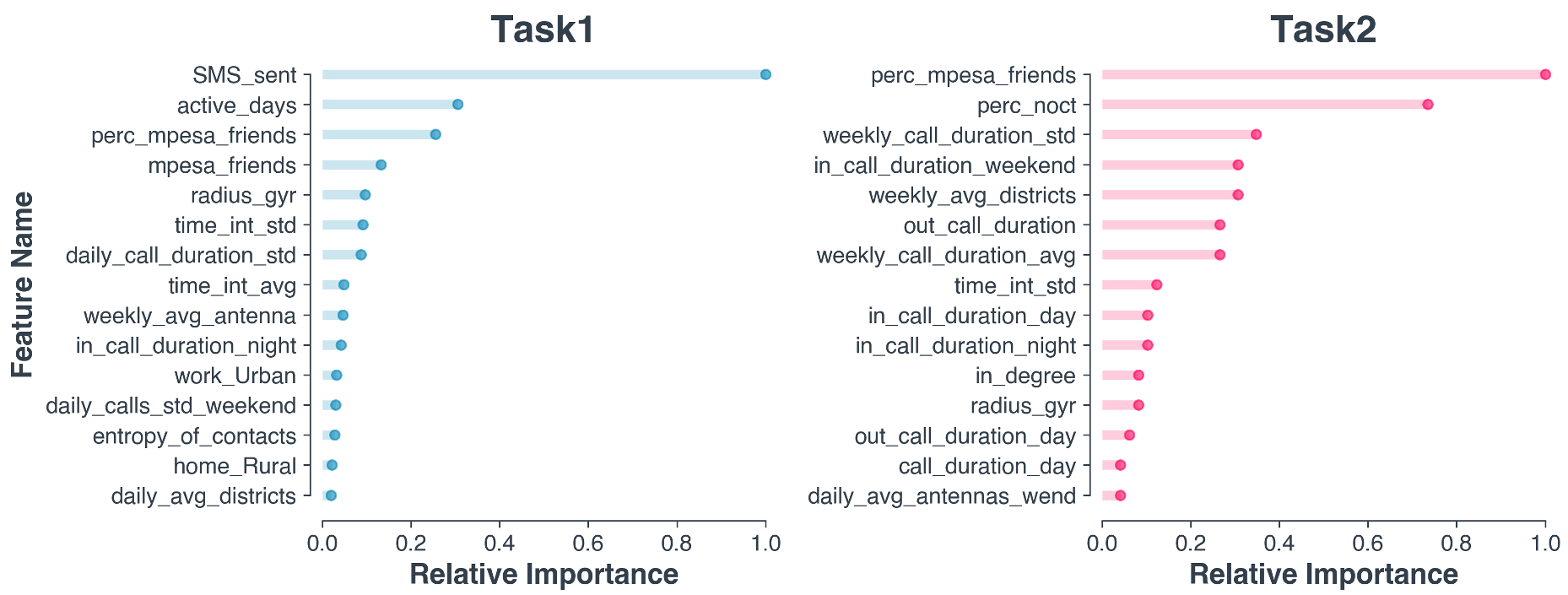 Figure 2: Top predictive features for Task 1 (Adoption) and Task 2 (Spending). Note the heavy influence of SMS volume and social network composition.
Key Discoveries & Directives
- Social Virality is King: If your "ego-network" is saturated with M-Pesa users, you are significantly more likely to join. Adoption is a social contagion.
- Mobility as a Wealth Proxy: Higher mobility (more unique districts visited) positively correlates with higher spending, echoing previous findings that physical range is often a proxy for socio-economic status.
- The "Agent" Surprise: Proximity to an M-Pesa agent was not a top-15 predictor. This suggests that in the studied country, the agent network might already be "dense enough," making social factors the primary remaining bottleneck.
Critical Analysis & Conclusion
This work provides a vital roadmap for fintech in emerging markets. It shifts the focus from "infrastructure" (building more stalls) to "incentives" (leveraging social networks).
Limitations: The study is a snapshot of one African country. As the authors admit, "Predictors without borders" are rare; what works in Kenya might not work in Pakistan due to differing cultural and regulatory landscapes.
Future Outlook: The next frontier lies in Transfer Learning—can we train a model in a mature market like Kenya and "zero-shot" or "few-shot" deploy it to a new market like Egypt? Centellegher et al. have provided the behavioral baseline to make that exploration possible.