
Deciphering the Digital Wallet: What Truly Drives Mobile Payment Satisfaction?
What Affects Usage Satisfaction in Mobile Payments? Modelling User Generated Content to Develop the “Digital Service Usage Satisfaction Model”
This paper develops and validates the "Digital Service Usage Satisfaction Model" (DSUSM) to identify determinants of mobile payment satisfaction in India. Using a hybrid methodology of Latent Dirichlet Allocation (LDA) topic modeling and sentiment mining on 400,242 tweets, the study maps social media discourse to theoretical constructs and validates them through multiple regression analysis.
TL;DR
While the industry often fixates on making apps "easy to use," new research suggests that for the modern, tech-savvy user, Ease of Use is no longer a differentiator. By mining over 400,000 tweets, this study introduces the Digital Service Usage Satisfaction Model (DSUSM), revealing that factors like Responsiveness and Information Privacy are the real heavyweights in determining whether a user remains satisfied after a transaction.
The Motivation: Capturing the "Moment of Truth"
The gap in existing research is a practical one: how do you measure a user's feelings exactly when a payment fails or succeeds? Traditional surveys suffer from recall bias and low response rates. The author, Arpan Kumar Kar, realized that users already broadcast their "moments of truth" on Twitter. By treating social media as a massive, real-time focus group, this work bridges the gap between Service Science and Big Data Analytics.
Methodology: From Tweets to Theory
The study utilizes a rigorous multi-stage pipeline to transform unstructured noise into academic insight:
- Mining: 400,242 tweets related to Indian payment giants (Paytm, BHIM, etc.).
- Topic Modeling (LDA): Distilling thousands of conversations into 100 dominant themes.
- Sentiment Mining: Assigning polarity scores to these themes to act as a proxy for "Usage Satisfaction."
- Network Analysis: Visualizing how words like "refund," "trust," and "privacy" cluster together.
- Inferential Validation: Using Multiple Regression to see which clusters actually move the needle on satisfaction.
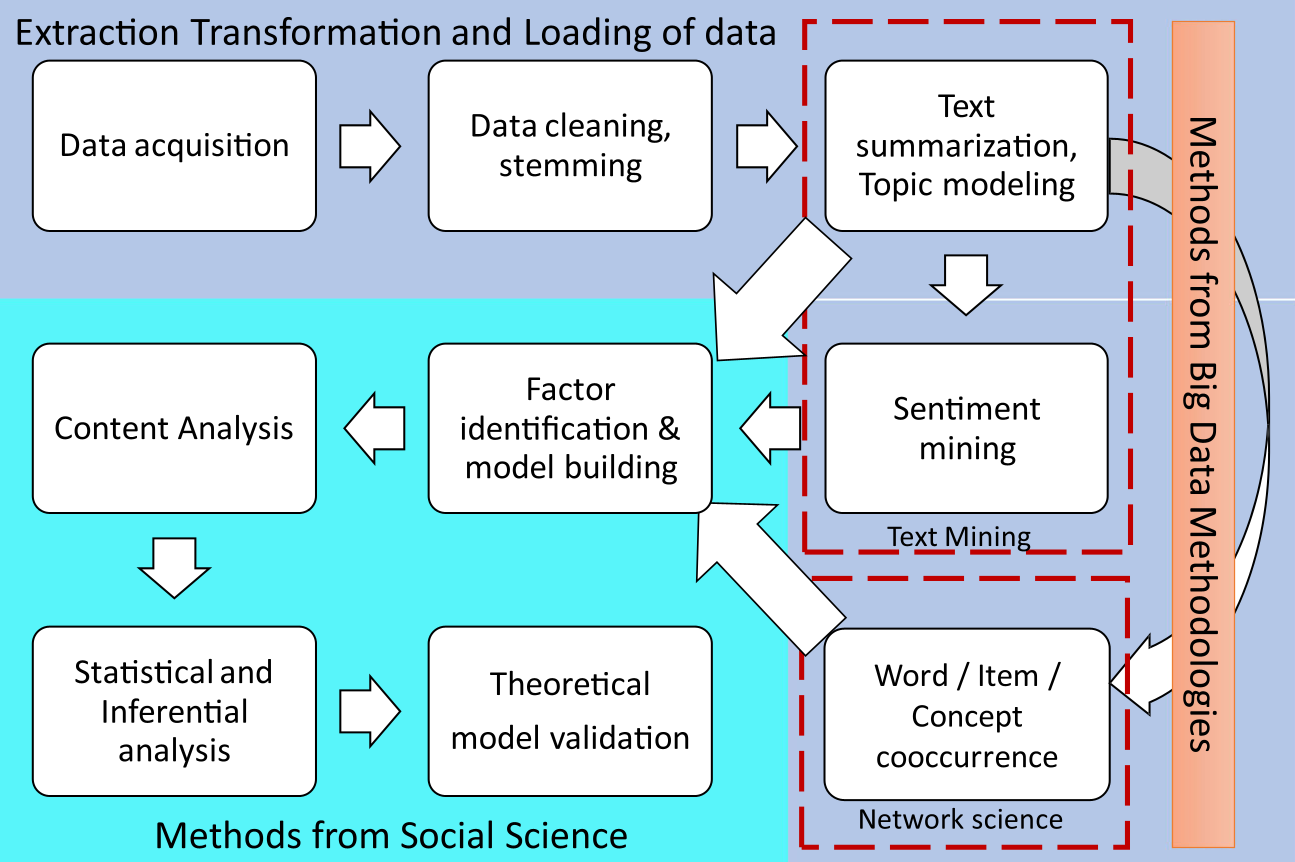 Figure: The interplay of sentiment and topic clusters in mobile payment discussions.
High-Stakes Findings: What Matters (and What Doesn't)
The most striking result is the "slaughter" of traditional adoption constructs. In the validated DSUSM model:
- The Winners: Cost, Usefulness, Trust, Social Influence, Credibility, Information Privacy, and Responsiveness. If a system is responsive (resolving errors quickly) and respects privacy, satisfaction sky-rockets.
- The Losers: Ease of Use, Performance, and Reliability.
- Why? The author suggests "Inductive Bias": for tech-savvy users, an app should be easy to use and reliable by default. These are no longer "delighters" but "must-haves" that don't actively increase satisfaction in a statistical sense.
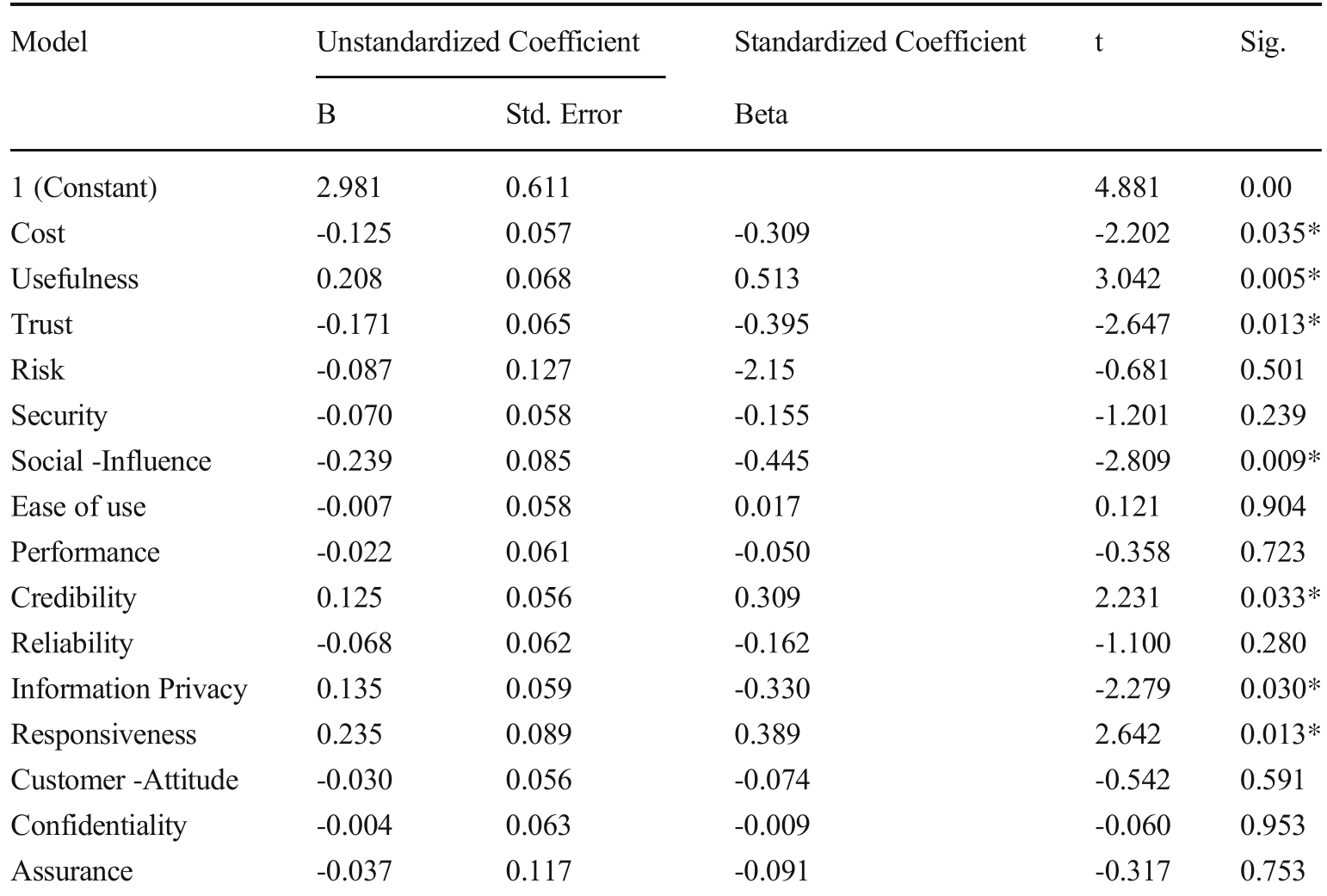 Table: Regression coefficients showing the specific impact of each determinant.
Critical Insights for the Industry
This research offers a wake-up call for Fintech product managers.
- Responsiveness is King: When a digital transaction fails, the speed and transparency of the resolution (Responsiveness) are more important than the slickness of the UI.
- Privacy as a Satisfaction Driver: Information Privacy isn't just a legal hurdle; it is an emotional determinant of usage satisfaction. Users are increasingly sensitive to how apps access location and contact data.
- Beyond the Download: Success isn't just about adoption (getting someone to install the app); it’s about the "usage experience" during every single encounter.
Conclusion and Future Outlook
The DSUSM provides a robust framework for understanding the "Post-Adoption" world. While the study is centered on the Indian context (heavily influenced by events like demonetization), the methodological blueprint—combining LDA topic modeling with regression for theory building—sets a new standard for how we should use Big Data to understand human behavior.
Future research should look toward longitudinal studies: does satisfaction evolve as a mobile payment market moves from "emerging" to "mature"? For now, the message is clear: stop worrying about the buttons, and start worrying about the "Responsiveness" of your service.