
Leveraging Social Graphs for Mobile P2P Discovery: A Decentralized Approach
8117_A Mobile Peer-to-Peer Query in a Social Network.
This paper proposes a Mobile Peer-to-Peer (P2P) query propagation mechanism for decentralized social networks. It introduces a structured message routing protocol implemented on the Android platform using XMPP, achieving efficient resource discovery without a central indexing server.
TL;DR
In the era of centralized cloud dominance, this paper revisits the power of Decentralized Peer-to-Peer (P2P) networks. It introduces a novel mechanism for mobile users to find resources (contacts, info) by traversing their social links rather than querying a central server. By implementing a constrained query propagation protocol on Android, the authors demonstrate an efficient way to search "Mobile Social Networks" while avoiding the classic pitfalls of network congestion and infinite loops.
Background & Motivation: The Limits of Centralization
Most modern social apps rely on a central "brain" to connect users. While efficient, this architecture creates privacy bottlenecks and single points of failure. Traditional decentralized search (like Gnutella-style flooding) is too "chatty" for mobile phones, quickly draining batteries.
The authors' core insight is that social networks are naturally "searchable." If you are looking for an expert in AI, you don't ask the whole world; you ask a friend who might know a friend. This "Small World" phenomenon (referenced via Watts et al.) suggests that any node can be reached in a few hops, provided the routing is intelligent.
Methodology: High-Efficiency Query Propagation
To prevent a query from exploding into a "broadcast storm," the paper defines three node roles: Requesting Node, Relaying Node, and Responding Node.
The Routing Protocol
The core innovation lies in how a query moves through the graph. The authors define a query (at hop ) with two critical properties:
- Hop Count (): A strictly incrementing distance metric to enforce a Maximum Distance ().
- Breadth-First History (): Each query carries a set of visited nodes. This ensures that a node never relays a message back to someone who has already seen it.
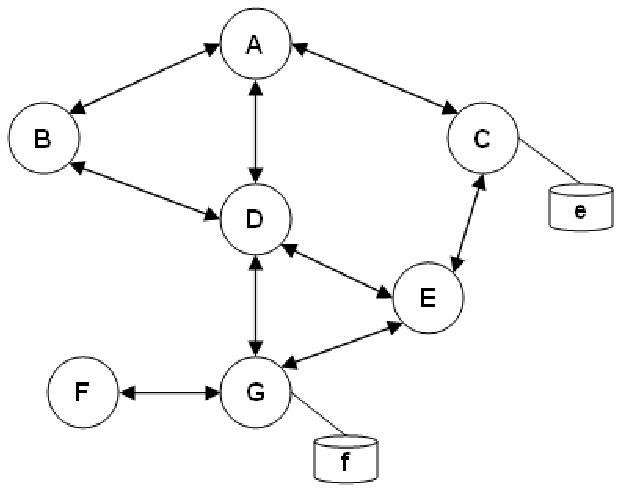
The search essentially constructs a Minimum Spanning Tree dynamically for each request, rooted at the requester. By limiting relay nodes based on user-defined "social paths," the network avoids unnecessary traffic.
Implementation on Android
The system uses:
- XMPP (Extensible Messaging and Presence Protocol): Leveraged via the Openfire server for managing local rosters.
- Smack API: Facilitating the actual peer communication on mobile handsets.
Experiments & Performance Analysis
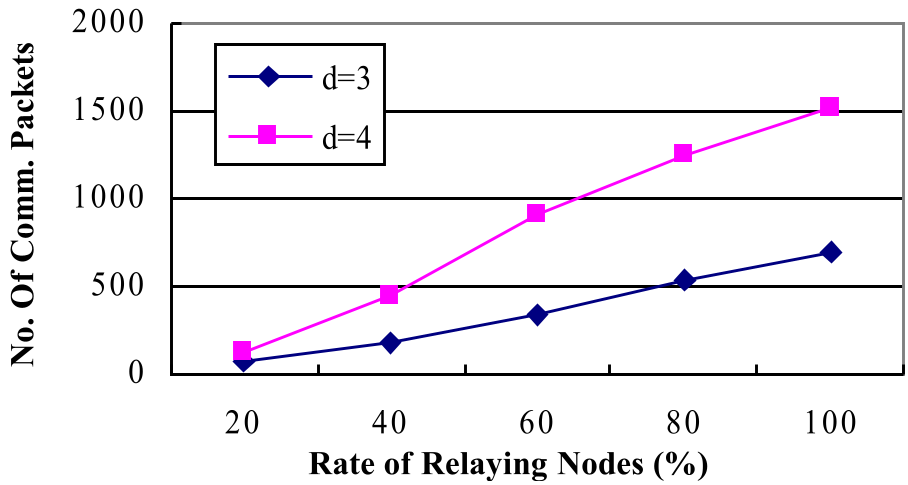
The researchers tested the protocol on a power-law random graph—a structure that closely mimics real human social groups, where a few "hubs" have many connections while most people have few.
Key Findings:
- Cost Reduction: By allowing users to select specific relay paths (knowledge-based routing), the total number of packets () transmitted across the network was significantly reduced.
- Scaling: The search cost decreases linearly as the percentage of participating relay nodes is narrowed down, proving that a "smarter" search is better than a "wider" search.
Deep Insight & Conclusion
This work highlights a critical trade-off in decentralized systems: Privacy vs. Reachability. By using social links as the "map" for the network, the protocol respects the natural boundaries of human interaction.
Takeaway: The future of decentralized mobile apps may not lie in complex DHTs (Distributed Hash Tables) but in mimicking human social behavior. However, the current limitation remains the reliance on XMPP servers for "presence"—a truly serverless implementation using Bluetooth or WiFi-Direct would be the logical next step for this research.
In summary, the paper successfully bridges the gap between social graph theory and practical mobile systems engineering.