
iTrust over SMS: Engineering Censorship-Resistant Social Search via P2P Messaging
A Mobile Peer-to-Peer Search and Retrieval Service for Social Networks
iTrust over SMS is a decentralized peer-to-peer (P2P) search and retrieval service designed for mobile social networks. It leverages SMS as a transport layer to distribute metadata and queries across a global membership of nodes, achieving censorship-resistant information sharing without a centralized server.
TL;DR
This research presents iTrust over SMS, a decentralized P2P search engine that operates entirely over the SMS protocol. By removing the central intermediary (like Google or Facebook), it creates a social network where mobile devices collaborate to index, search, and retrieve information, making it virtually immune to central authority filtering and censorship.
Problem & Motivation: The Centralization Trap
Most existing social networks are "walled gardens." They store your data on private servers, monitor your interactions, and—most importantly—possess the power to silence voices through censorship. For mobile users in politically sensitive regions, relying on a centralized web service is a risk.
The authors argue that Trust should be placed in the community rather than a single provider. However, building a P2P network on mobile devices is notoriously hard due to battery limits and unstable data connections. iTrust over SMS solves this by using the most basic and ubiquitous mobile service: Short Message Service (SMS).
Methodology: How Search Works Without a Server
iTrust over SMS doesn't 100% flood the network (which would be too expensive). Instead, it uses a clever Randomized Distribution strategy.
- Metadata Distribution: When a "Source Node" has information to share, it creates metadata (keywords) and sends it to a random subset of nodes (roughly nodes).
- Querying: When a "Requesting Node" searches for something, it also sends its query to a random subset of nodes.
- The Encounter: When a node receives a query that matches the metadata it is holding, an "encounter" occurs. It then sends the source node's address (phone number) back to the searcher.
- Retrieval: The searcher retrieves the full document directly from the source.
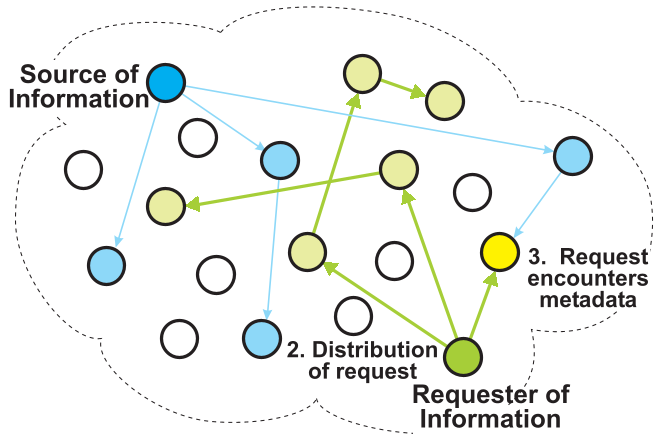 Figure 1: A source node distributes metadata to randomly selected peers.
To prevent the "network flooding" typical of Gnutella-like systems, iTrust uses a specific relaying probability. This ensures that searches are efficient without blowing up the user's phone bill.
User Experience & Social Incentives
The researchers developed an Android application that looks like a standard messaging app but performs complex P2P routing in the background.
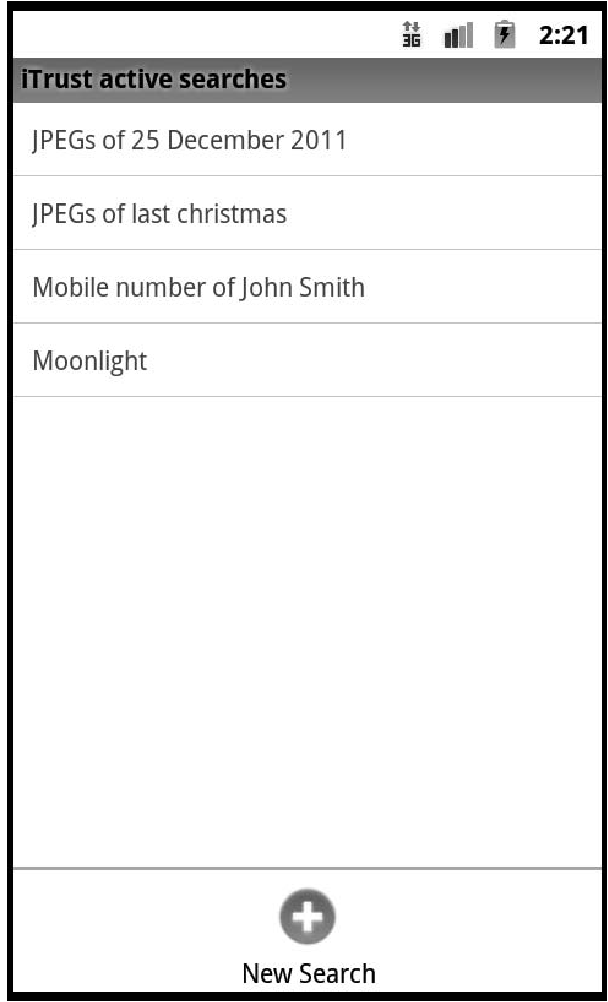 Figure 2: The iTrust Search List and Interface.
The paper identifies four types of users, each with different incentive structures:
- Sporadic & Casual Searchers: Use the service occasionally. Their "membership" (the list of known peers) grows automatically as they interact with the network.
- Avid Searchers: Power users who retrieve multiple results. They benefit from "instant gratification" as their larger local index leads to faster matches.
- Pure Searchers (Leechers): Users who search but don't share. The system naturally penalizes them because they don't gain visibility in other nodes' memberships, making their future searches harder.
Experimental Insights: Balancing Cost and Connectivity
One of the critical parts of the methodology is the SMS Settings. Since SMS often costs money, the app allows users to "Limit SMSes." This introduces a fascinating trade-off: higher participation increases your network "footprint" (and thus your search efficiency), but it also increases your cost.
The system uses an Adaptive Method derived from the iTrust over HTTP ancestor. It detects if the number of matches received aligns with mathematical expectations; if not, it strategically increases the proportion of queried nodes.
Critical Analysis & Conclusion
Takeaway
iTrust over SMS proves that high-level social networking and robust information retrieval are possible without an internet data plan or a central authority. It’s a "grassroots" approach to the internet.
Limitations
- Latency: SMS is significantly slower than TCP/IP, making "instant" search impossible.
- Privacy: While the paper mentions investigating masking techniques, the current metadata distribution reveals phone numbers (node addresses) to peers, which could be a privacy risk.
- Scalability: While the rule is mathematically sound, the sheer volume of SMS messages in a million-node network might hit provider limits or anti-spam filters.
Future Work
The authors plan to release the app on public stores and evaluate it within large-scale, real-world social networks to test its performance under heavy "churn" (users moving in and out of the network).