
Mobile PHRs: Bridging the Gap Between Personal Monitoring and Social Support
Mobile Personal Health Systems for Patient Self-management: On Pervasive Information Logging and Sharing within Social Networks
This paper presents a mobile Personal Health System (PHR) designed for chronic patient self-management, integrating wearable multi-sensing devices with social networking. It leverages an event-driven framework and micro-blogging services (e.g., Twitter) to enable "anytime-anywhere" health data logging and pervasive sharing among social circles.
TL;DR
The paper introduces a mobile framework that transforms Personal Health Records (PHR) from static logs into dynamic social experiences. By combining wearable sensors (Zephyr BioHarness), event-driven logic, and micro-blogging (Twitter), it enables chronic patients to share filtered, context-aware health updates—such as symptoms or heart rate alerts—seamlessly with their social and medical circles.
Background and Motivation
Self-management is a cornerstone of effective chronic disease treatment. However, the data recorded by patients (subjective) and sensors (objective) often remains trapped in "data silos" or requires manual upload efforts. The authors identify a critical gap: the lack of a pervasive system that allows patients to share their health status "anytime-anywhere" to gain emotional support or professional advice.
The core Insight here is that social networking, specifically micro-blogging, offers a lightweight, high-frequency channel perfect for real-time health updates, provided that the raw data can be filtered and formatted intelligently.
Methodology: The Architecture of Sharing
The system is built on a Service Oriented Architecture (SOA), ensuring that the Mobile Base Unit (MBU) stays lightweight while delegating heavy processing to back-end servers.
Data Dimensions
The framework synthesizes four key data streams:
- Vital Signs: Heart rate and activity filtered via event-driven patterns.
- Subjective Symptoms: Manual logging of dizziness, stress, or nausea.
- Patient Context: Current activity (working, exercising, etc.).
- Spatio-temporal Data: Time and location.
The Sharing Loop
The "magic" happens in the Mobile PHR Controller. Instead of bombarding followers with raw heart rate data, the system uses IF-THEN rules. For instance: IF (Heart Rate > Threshold) AND (Situation == "Resting"), THEN (Generate Social Post).
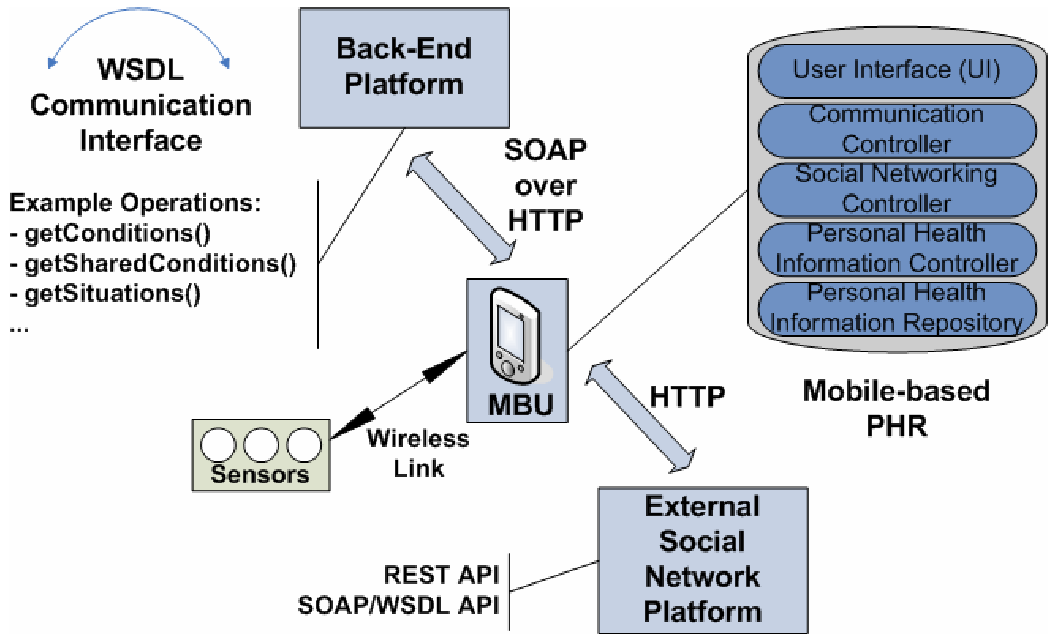 Figure 1: The SOA-based architecture connecting sensors, the mobile app, and social platforms.
Semantic Micro-blogging
By integrating the SNOMED-CT medical terminology, health status is mapped to standard concepts. Messages are sent via Twitter’s REST API using specialized hashtags (e.g., #*Light-headedness). This allows for "social analytics" where caregivers can search for specific health tags across their network of patients.
Experiments and Results
The authors validated their design using a Nokia N86 (JavaME) and a Zephyr BioHarness chest strap.
- Inference/Network Latency: The communication from the mobile device to the backend was snappy, averaging 1.45s.
- Social Dissemination: Posting a health event to Twitter took only 1.9s, while fetching and de-serializing XML responses for 10 messages from the network took 4.2s.
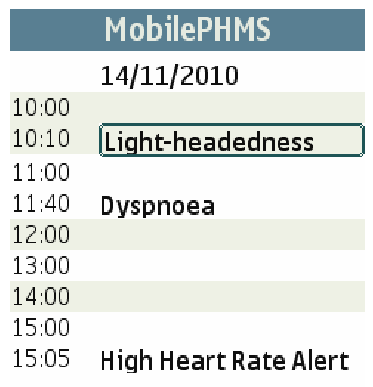 Figure 2: Prototype UI showcasing health information recording and social group selection.
These results proved that even with the hardware constraints of the late 2000s/early 2010s, a pervasive, real-time health-sharing ecosystem was technically viable.
Critical Insight & Conclusion
The significance of this work lies in its Inductive Bias toward collaborative care. It recognizes that health is not just a clinical metric but a social one.
Limitations
- Privacy: While the paper mentions OAuth and private lists, the inherent risks of sharing health data on a public-facing platform like Twitter remain a hurdle.
- Manual Effort: Some context (like current situation) still requires manual patient input, which may lead to compliance fatigue.
The Future of Social Health
As we move into an era of AI-driven health agents, the "Social PHR" concept provides the foundation for decentralized patient communities where peers—rather than just doctors—provide the first line of emotional and behavioral support.