
Mobile Search: Decentralizing Discovery through Social Proximity
Mobile Search -Social Network Search Mobile Devices Demonstration
The paper presents a "Mobile Search" prototype designed for the Nokia N800 platform, enabling decentralized social network search across mobile address books. It leverages mobile web servers and Drupal CMS integration to facilitate peer-to-peer data discovery among trusted contacts.
TL;DR
This research introduces a prototype for Mobile Search, a decentralized system that turns mobile devices into searchable nodes within a social network. By moving away from centralized indexing, it allows users to search the "hidden web" of their contacts' private data (calendars, phone numbers) in real-time while maintaining strict access control via mobile web servers.
Background Positioning
In the landscape of information retrieval, this work represents an early and bold move toward P2P (Peer-to-Peer) Social Search. It shifts the paradigm from "global indexing" (The Google Model) to "local discovery," placing it as a precursor to modern decentralized social protocols and edge-computing-based data sharing.
Problem & Motivation: The "Hidden Web" Blind Spot
The authors identify three fatal flaws in traditional centralized search:
- Invisibility: Massive amounts of useful, personal data are hidden behind private devices and are never crawled by search bots.
- Latency: Web crawlers take time; centralized indexes are often outdated.
- Irrelevance: A global search doesn't know your social context. Your best friend's available calendar slot is more relevant to you than a public holiday list.
The Insight here is simple but profound: If every phone acts as a server, the "Social Graph" becomes the index. By traversing your address book, you are effectively searching a trusted, high-relevance database.
Methodology: The Mobile Device as a Web Server
The core of the system is the integration of the Nokia N800 mobile device and the Drupal CMS.
Architecture Breakdown
- Node Hosting: Each device runs a mobile web server. Users select specific datasets (e.g., calendar, address book) to "share."
- Query Propagation: When a search is initiated, the query doesn't hit a central database. Instead, it hits the APIs of contacts listed in the caller's address book.
- Trust & Privacy: By logging into Drupal instances on the move, the system uses existing CMS authentication to ensure that only authorized "neighbors" can view sensitive data.
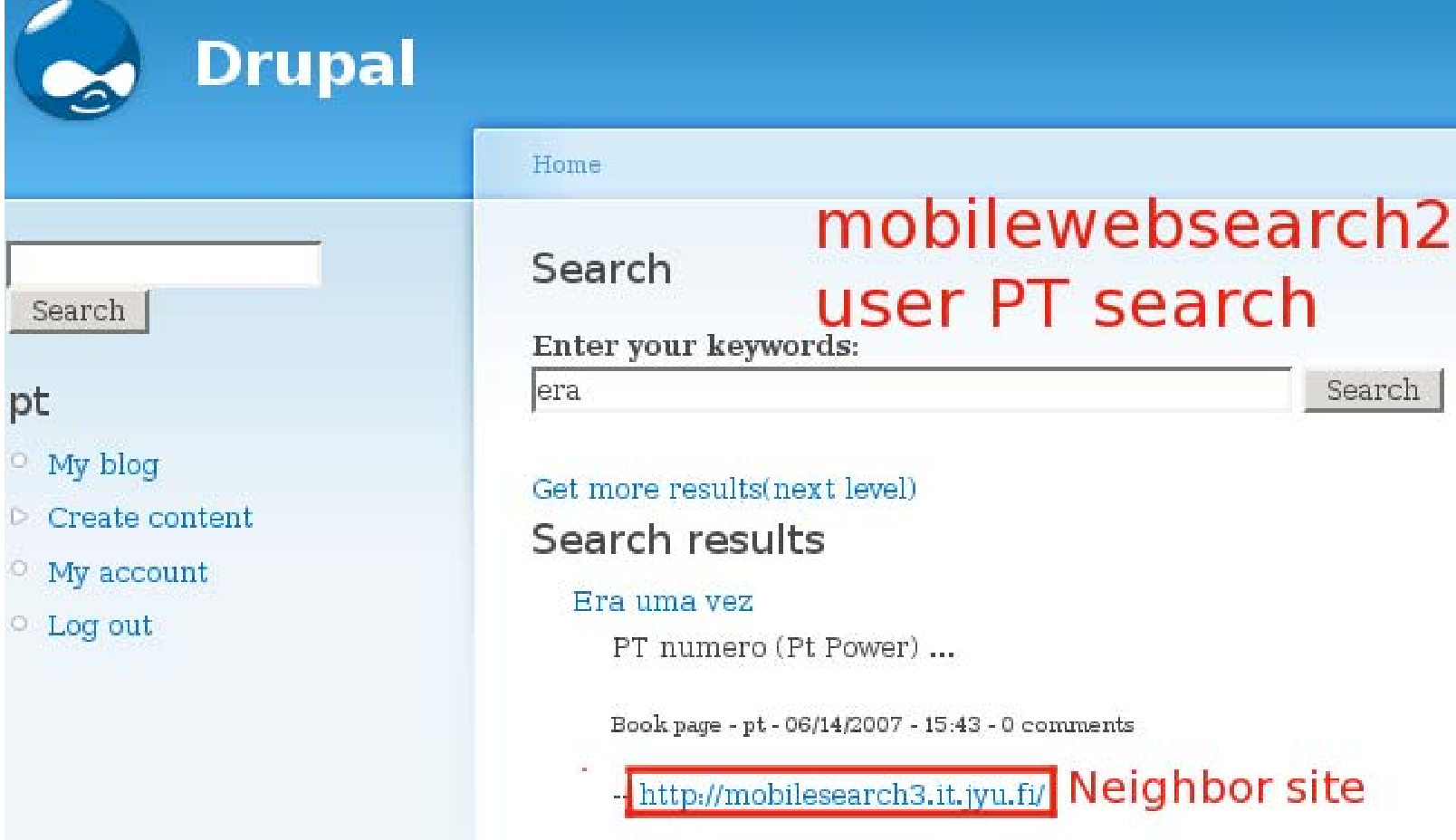 Figure 1: The modified Drupal interface on the N800, allowing for real-time contact-based keyword searches.
Experiments & Results: Precision over Popularity
The prototype confirms that a decentralized social search is uniquely suited for rare or private information.
- Real-time Accuracy: Unlike Google, there are no "404 Not Found" errors because the search is live.
- Contextual SOTA: The system provides results that are inherently more relevant because they originate from the user's immediate social circle.
- Trade-offs: The authors honestly acknowledge that for "popular data" (e.g., news, public Wikipedia pages), this system cannot compete with the efficiency of centralized servers.
Critical Analysis & Conclusion
Takeaway
The value of this work lies in its Data Sovereignty model. It proves that social networks can function as efficient routing protocols for information discovery without a middleman harvesting the data.
Limitations
- Scalability: P2P search often suffers from high latency if the network depth (the number of "hops" between contacts) increases.
- Availability: If a contact's phone is offline, their data "disappears" from the network—a classic P2P hurdle.
Future Outlook
As we move toward Web3 and dApps, the principles in this 2008-era prototype are more relevant than ever. This work laid the conceptual groundwork for searching the "Dark Matter" of the internet—the private, social data that remains the final frontier of information retrieval.