
Mobile Sensing in the Field: Automating Agricultural Activity Detection
Mobile sensing for agriculture activities detection
This paper introduces a mobile sensing framework for detecting agriculture activities using machine learning. By utilizing built-in sensors (accelerometer, GPS, microphone) in smartphones, the researchers classify activities such as harvesting and bed-making, achieving high accuracy with Linear Discriminant Analysis (LDA).
TL;DR
Researchers have developed a mobile sensing framework that transforms standard smartphones into professional agricultural monitoring tools. By leveraging 3-axis accelerometers and machine learning—specifically Linear Discriminant Analysis (LDA)—the system can accurately distinguish between complex tasks like manual harvesting and bed-making with over 80-90% accuracy, even accounting for where the farmer carries the phone.
Contextual Positioning
This work bridges the gap between generic Human Activity Recognition (HAR) and precision agriculture. While most HAR research focuses on fitness (walking, running), this paper addresses the "dirty" reality of manual labor in the field, making it a practical contribution to the "mKRISHI" agro-advisory ecosystem.
The Challenge: From Urban Fitness to Rural Productivity
Monitoring farm activities is critical for optimizing crop yields and ensuring resources are used correctly. However, manually logging every spray or harvest is tedious for farmers. The technical hurdle? Agricultural movements are often non-cyclic and messy. Furthermore, a farmer might put their phone in a trouser pocket or strap it to their arm—different placements produce vastly different signal signatures for the same physical task.
Methodology: The Core Engine
The framework utilizes a three-pronged sensing approach: GPS for location/frequency, Microphone for machinery usage, and the Accelerometer for manual body movements.
The Classification Pipeline
The authors utilize a robust 5-step process:
- Preprocessing: Applying a 5-point moving average low-pass filter to remove sensor noise.
- Windowing: Segmenting data into windows of 64 samples with 50% overlap.
- Feature Extraction: Computing 31 distinct features, including Time-domain (RMS, variance, cross-correlation) and Frequency-domain (signal energy, entropy).
- Placement Detection: A "pre-check" step that identifies if the phone is on the arm or in a pocket to calibrate the model.
- Activity Classification: Using LDA, Naive Bayes, or k-NN to determine the final activity.
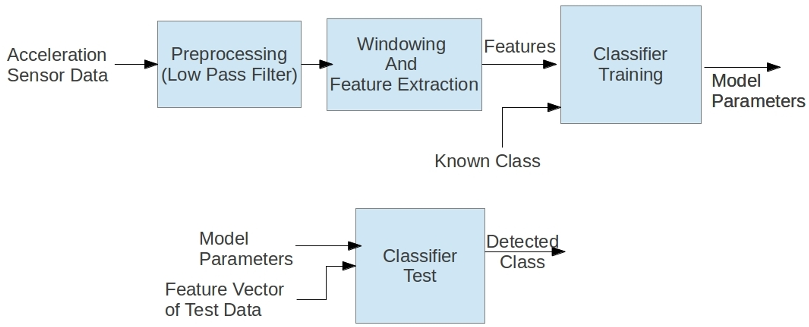 Fig 1: The signal processing and machine learning workflow for activity detection.
Experiments and Results
The researchers tested their models at Saguna Baug (a farm near Mumbai) and the TCS Thane campus. The results clearly favored Linear Discriminant Analysis (LDA) over the others.
Key Performance Metrics:
- Stand-still: 100% Accuracy (all classifiers).
- Walking: 94% Accuracy (LDA).
- Harvesting: 86% Accuracy (LDA).
- Bed-making: 80% Accuracy (LDA).
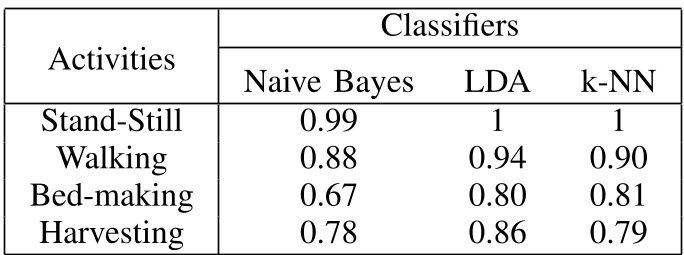 Table 1: Comparison of classification accuracy across different models and activities.
One of the most impressive findings was the Placement Detection. LDA was able to distinguish between a phone in a pocket versus on the upper arm with nearly 100% accuracy. This is a critical "usability" feature, as it allows farmers to carry their devices however they find most comfortable without breaking the tracking algorithm.
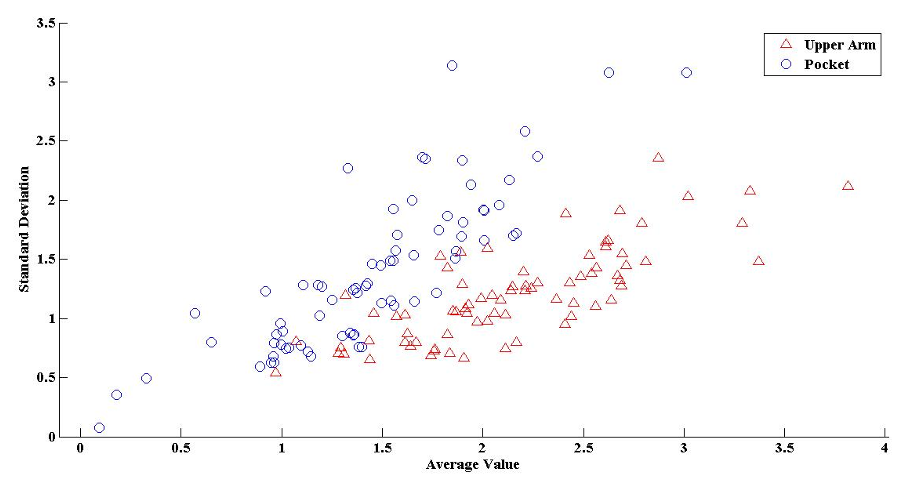 Fig 2: Clustering in feature space showing how different phone placements create separable data patterns.
Critical Analysis & Takeaways
The paper successfully demonstrates that sophisticated activity monitoring doesn't require expensive, specialized wearables; the smartphone already in a farmer's pocket is sufficient.
Insights:
- Why LDA? LDA's ability to maximize the ratio of between-class variance to within-class variance makes it particularly suited for this type of movement data where signal signatures can be subtle but distinct.
- The Power of Placement: By solving the "placement problem" first, the authors effectively neutralized the biggest source of noise in mobile context-sensing.
Limitations:
- Sample Size: The study used a relatively small number of volunteers and specific farm locations.
- Energy Efficiency: Continuous sensor polling (GPS + Accelerometer + Mic) is notorious for draining battery life—a major concern for farmers who may not have easy access to charging in the field.
The Future
The authors plan to integrate "Event-based Likelihood." For example, if the system knows it rained yesterday, the likelihood of "Irrigation" being the detected activity should decrease while "Plowing" might increase. This Bayesian approach to environmental context could push accuracy closer to 100%.