
MSNSM: Empowering Families with CDD through Mobile Social Network Services
Mobile Social Network Services for Families With Children With Developmental Disabilities
This paper presents the Mobile Social Network Service Management (MSNSM) system, a platform designed to support families with children with developmental disabilities (CDD) through Location-Based Services (LBS), volunteer matching, and professional community interaction.
TL;DR
The MSNSM (Mobile Social Network Service Management) system is a purpose-built platform that bridges the gap between professional caregivers, volunteers, and families of children with developmental disabilities (CDD). By combining Location-Based Services (LBS) with a sophisticated matching module, the system ensures that parents can find help exactly when and where they need it, resulting in a nearly 20% increase in user satisfaction.
Problem & Motivation: Beyond General Social Media
Families caring for children with developmental disabilities face unique challenges that traditional social networks like Facebook or Twitter cannot solve. These challenges include:
- The Need for Verification: Standard platforms cannot guarantee the expertise or credentials of caregivers.
- Contextual Assistance: Finding a volunteer is useless if they are across the city during an emergency.
- Behavioral Continuity: Children with CDD often have specific habits; the lack of a shared "habit record" makes it difficult for new volunteers to provide effective care.
The authors recognized that while "Web 2.0" promised interaction, it hadn't yet been tailored to create a high-trust, location-aware environment for social welfare.
Methodology: The Core Architecture
The MSNSM system is built on a heterogeneous network environment, supporting both PC and mobile devices (PDAs/Smartphones). The technical stack utilizes the LAMP (Linux, Apache, MySQL, PHP) architecture, integrated with AJAX for seamless data updates and XML for configuration management.
Key Modules
- Matching Module: Instead of a "one-size-fits-all" list, this module allows parents to filter volunteers by schedule, service category, and specific qualifications.
- Location-Based Service (LBS) Module: Utilizing GPS data, the system allows administrators (with strict privacy controls) to locate missing children or identify the nearest available volunteer for urgent help.
- Private Habit Record: A "digital memory" for the child, where volunteers log behavioral nuances, ensuring the next caregiver is fully briefed before arrival.
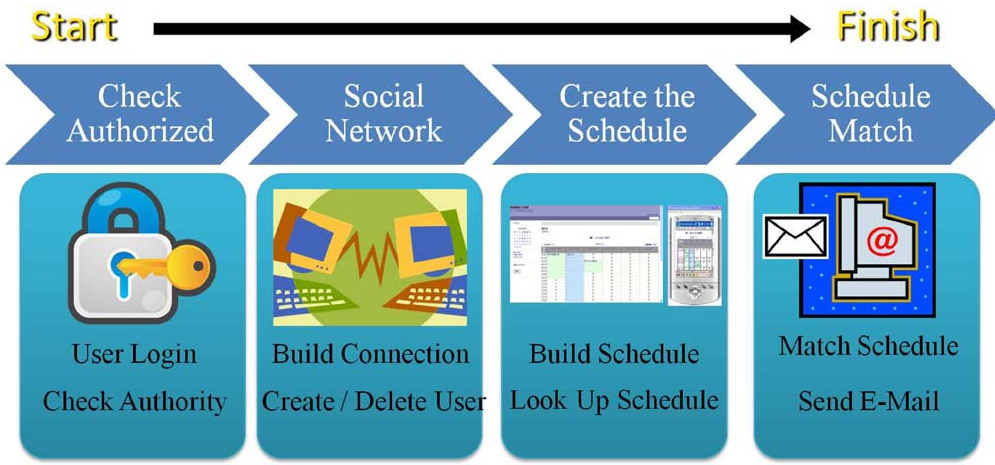 The Figure above illustrates the modular architecture, showing the interaction between the parent/volunteer clients and the backend database/management servers.
Experiments & Results
The system was rigorously tested in collaboration with the Angel Heart Family Social Welfare Foundation (AHFSWF). The research involved two major survey phases: an initial prototype stage (2007) and a post-training refined stage (2009).
Quantitative Improvements
- User Satisfaction: The overall satisfaction score jumped from 3.58 to 4.26 (out of 5).
- Impact of Training: A significant finding was the role of education. The training course for parents and volunteers scored 4.32, proving that technical solutions for marginalized groups must be accompanied by human-centric onboarding.
- Comparison with Baselines: Unlike existing tools like VolunteerMatch, MSNSM provides specialized support for CDD-specific records and integrated Location-Based Services.
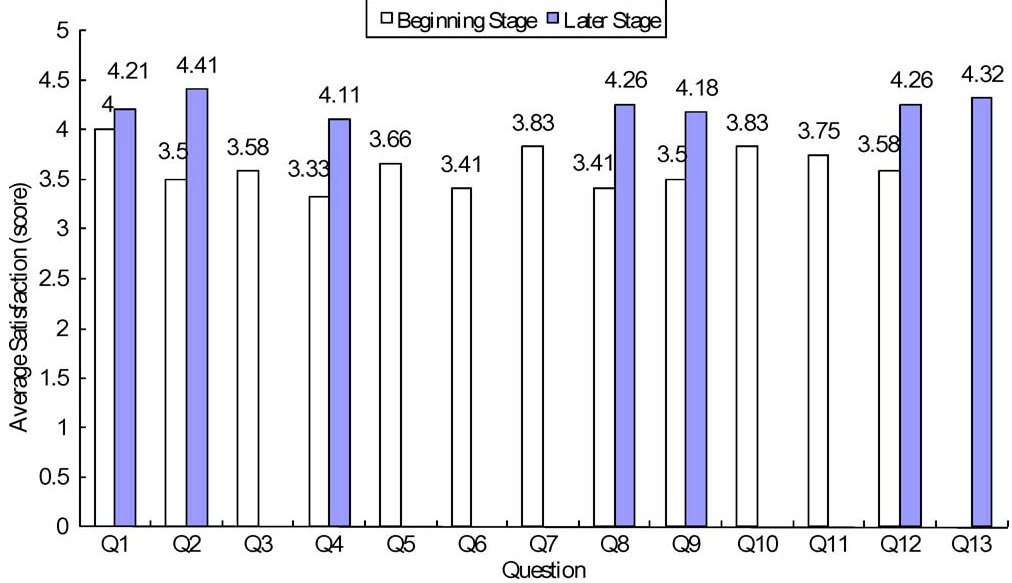 Comparative results showing the increase in satisfaction across various metrics after system refinement and training.
Critical Analysis & Conclusion
The MSNSM system represents a shift from "general-purpose" technology to "socially-aware" technology. Its greatest strength lies in its Trust Protocol—the use of an AAA (Authentication, Authorization, and Accounting) server ensures that the sensitive data of vulnerable families is protected while still being accessible to verified helpers.
Limitations & Future Work
- Privacy vs. Utility: While the LBS module is powerful, it relies heavily on persistent GPS tracking, which raises privacy concerns that the authors addressed via administrator-only access.
- Automation: Future iterations could benefit from automated AI-driven matching to replace the manual oversight currently required by foundation staff.
In conclusion, the paper serves as a blueprint for how mobile technology can be leveraged to build resilient, supportive communities for the "disadvantaged minorities" of our digital age.