
MSNP: Decoding the Future of Proximity-Based Decentralized Social Networks
Overview mobile social networking in proximity (MSNP): applications, characterstics and challenges
This paper provides a comprehensive overview of Mobile Social Networking in Proximity (MSNP), a paradigm that utilizes wireless Peer-to-Peer (P2P) technologies (e.g., WiFi Direct, Bluetooth) to enable spontaneous social interactions. It distinguishes MSNP from traditional centralized mobile social networks and identifies it as a convergence of MSN, Mobile P2P, and Opportunistic Networks (ON).
TL;DR
Mobile Social Networking in Proximity (MSNP) is an emerging paradigm that reconnects virtual social interactions with physical space. Unlike Facebook or Instagram, which rely on centralized "Big Brother" servers and constant 5G/LTE, MSNP uses Peer-to-Peer (P2P) and Opportunistic Networking (ON) to allow users to share content and interact directly via WiFi or Bluetooth only when they are nearby. This paper explores the transition from "online-always" to "spontaneous-local" social connectivity.
The Problem: The "Big Brother" and Connectivity Tax
The authors argue that current Mobile Social Networks (MSNs) suffer from two fundamental flaws:
- Centralization & Privacy: User data (location, profiles, messages) is stored by single entities, leading to surveillance concerns and data monetization without user consent.
- Infrastructure Dependency: Even if two users are in the same room, their data must travel to a remote server and back, wasting bandwidth and requiring expensive data plans. This makes social networking impossible in underground subways, disaster zones, or crowded stadiums where cellular towers are congested.
Methodology: The Convergence of Three Fields
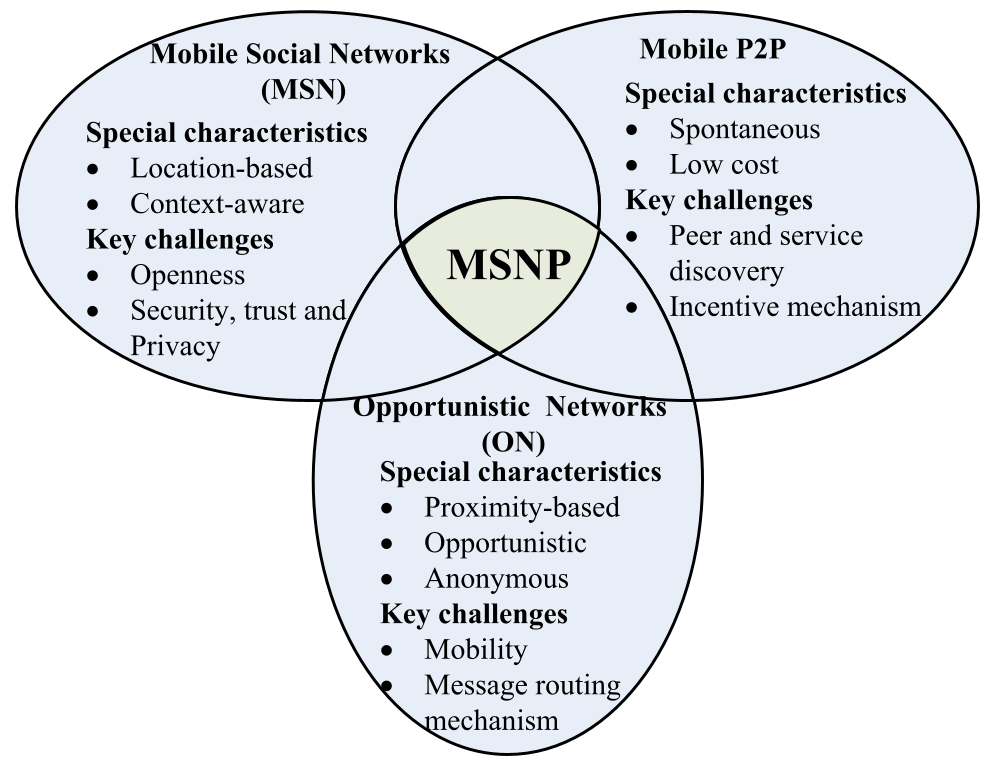
MSNP is not a single technology but a strategic intersection of three domains:
- Mobile Social Networks (MSN): The "social" layer (profiles, friends, interests).
- Mobile P2P: The "connection" layer (direct device-to-device interaction without APs).
- Opportunistic Networks (ON): The "mobility" layer (using the physical movement of people to carry and forward data packets—the store-carry-forward model).
Key Architectural Insight
As shown in the architecture diagram below, MSNP utilizes geo-proximity as a "natural filter." Instead of searching a global database, your phone discovers only what is physically relevant now.
Technical Characteristics
MSNP is defined by five "Spiritual Pillars":
- Spontaneity: Interactions are created in real-time with zero prior planning (e.g., meeting a stranger at a bar with a shared interest).
- Anonymity: Users begin as anonymous entities, gradually revealing information as trust is established through physical interaction.
- Context-Awareness: The system senses the environment (ambient noise, lighting, social cues) to enhance the relevance of connections.
- Low Cost: It utilizes off-the-shelf hardware (Bluetooth/WiFi Direct) and bypasses cellular roaming or data fees.
- Location-Centricity: Content is "anchored" to a physical spot.
The "Hard" Challenges
While promising, MSNP faces significant technical hurdles that the paper identifies as future research frontiers:
- Naming & Messaging: In a network without IP addresses or centralized DNS, how do you uniquely identify and reach a "moving" user?
- The Incentive Dilemma: Why would a user allow their phone's battery to be drained to "carry" a message for a stranger? The paper suggests reputation-based or social-incentive mechanisms.
- Security & Trust: Without a central authority to verify IDs (like "Blue Checks" on X), MSNP platforms must rely on localized public-key encryption and face-to-face verification.
Critical Analysis & Conclusion
This paper serves as a foundational roadmap for MSNP. Its primary value lies in its advocacy for Openness. The authors argue that for MSNP to succeed, it must resist the "walled garden" approach of current social giants. Projects like Stanford's Musubi or Qualcomm's AllJoyn are cited as early pioneers of this "crowd-sourced" communication channel.
The Takeaway: MSNP isn't just an app; it's a shift toward the "Edge." By pushing social interaction to the network's periphery, we can create a more resilient, private, and physically grounded digital society.