
MSNS: Empowering Supported Employment Through Mobile Social Networks and GPS Integration
Potential of mobile social networks as assistive technology: a case study in supported employment for people with severe mental illness
The paper introduces a "Mobile Social Network Service" (MSNS) prototype designed as an assistive technology for individuals with severe mental illness. It utilizes a GPS-enabled PDA architecture to facilitate a virtual community of caregivers and clients, specifically aiming to support "Supported Employment" programs through real-time location tracking and automated alarm systems.
TL;DR
This paper explores the potential of Mobile Social Network Services (MSNS) as a lifeline for individuals with severe mental illness participating in supported employment. By integrating GPS tracking with a dynamic caregiver alert system, the authors built a prototype that ensures safe transit to the workplace, reduces caregiver anxiety, and mitigates the risks of getting lost or being chronically late.
Background Positioning
Published in the proceedings of ASSETS '08, this work is an early and crucial exploration of "ubiquitous computing" for cognitive accessibility. It sits at the intersection of Social Services and Assistive Technology, moving beyond simple tracking to create a collaborative human-tech ecosystem.
Problem & Motivation: The Anxiety of Independence
For many individuals with mental illness, the path to a "mainstream" job is fraught with navigational hazards.
- The "Lost" Phenomenon: Simple route changes or similar-looking surroundings can trigger panic episodes.
- The Attendance Gap: Procrastination and memory deficits frequently lead to late arrivals, jeopardizing employment.
- The Caregiver Burden: Job coaches spend weeks physically escorting trainees, a non-scalable approach that limits the number of people they can help.
The authors' insight was to move away from isolated devices toward a Mobile Social Network, where the system acts as a bridge between the individual's location and a network of available caregivers.
Methodology: Spatio-Temporal Safeguards
The system architecture revolves around an Asus P535 GPS-PDA and a central server.
1. Dynamic Rescue Mechanism
When a user presses a "HELP" button, the system doesn't just call a single person. It searches for "matched" caregivers within a 1km radius (Distance d). If those nearby are occupied, the system dynamically doubles the search radius. This ensures that the most immediate help is mobilized.
2. The Active Alarm Service
Unlike standard alarms, this service is spatio-temporally aware.
- It triggers if the user is at home when they should be on the road.
- It triggers if the user exits the workplace unexpectedly.
- It provides a "reassurance loop" by notifying the coach upon successful arrival.
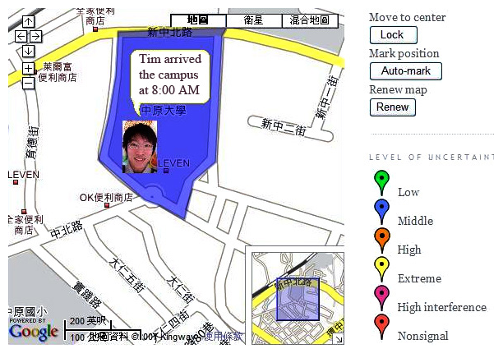 Figure 1. (a) Matching nearby caregivers to a lost person. (b) Monitoring zone alerts for workplace arrivals/departures.
Experiments & Results: Beyond "No News is Good News"
The researchers conducted field observations and "acting-out" sessions to simulate distress scenarios.
Key Findings:
- Proactive Management: In one case, the system detected a trainee was stuck in rain-induced traffic. This allowed the job coach to call the employer before the trainee was late, preserving the employer's trust.
- Caregiver UI Preference: While the web console was great for setup (regions/times), job coaches required SMS and mobile-first notifications because they are "nomadic"—constantly moving between prospective employers and trainee sites.
- The Simplicity Principle: The patient-side UI was stripped of complexity to ensure usability during a panic attack.
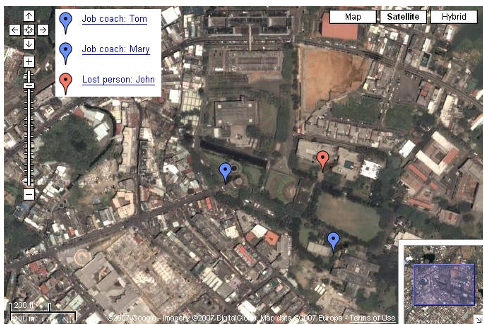 Visualizing the monitoring interface used by caregivers to track transit progress.
Critical Analysis & Conclusion
Takeaway
The true value of this work isn't just the GPS tracking—it's the social coordination. By treating caregivers as a mobile network rather than static observers, the system creates a resilient safety net.
Limitations
- GPS Indoor Dead Zones: As noted in the case study, failing to get a GPS signal indoors (at home) was used as a trigger, which might lead to false positives in high-density urban areas.
- Privacy vs. Safety: The paper focuses on safety, but the continuous tracking of individuals with mental illness raises significant ethical/privacy questions that would require more modern scrutiny.
Future Outlook
This 2008 study laid the groundwork for modern "Geofencing" and "mHealth" applications. Future iterations of this logic now reside in our smartphones, but the core lesson remains: for assistive tech to work, it must empower the caregiver's workflow as much as the user's interface.