
Designing Social Synergy: Rethinking Mobile Services for Large-Scale Exhibitions
Mobile Social Service Design for Large-Scale Exhibition
This paper presents a user-centered design study conducted by Nokia Research Center on mobile social services for large-scale exhibitions. It identifies five socio-technical factors—knowledge requirements, time costs, exhibitor needs, network maintenance, and environmental coordination—to improve visitor engagement through context-aware mobile technology.
TL;DR
Exhibitions are more than just trade shows; they are temporary, high-density social ecosystems. This research by Nokia identifies why most social apps fail in these settings—they focus too much on "socializing" and not enough on the "exhibition context." By analyzing visitor clusters and connection types, the authors propose a context-aware framework that prioritizes exhibit knowledge and low-friction companion tracking.
The "Museum vs. Exhibition" Motivation
While technologies for museum guidance have matured (e.g., ArtLinks, Imprints), the authors argue that large-scale exhibitions are a different beast. Unlike the quiet contemplation of a museum, an exhibition is loud, crowded, and business-focused. The primary pain point is that visitors feel "time-poor." They are there to see products, not necessarily to meet strangers, leading to a natural resistance toward traditional social networking features on-site.
Methodology: Mapping the Social Web
The researchers categorized social interactions into three critical links:
- Visitor-to-Exhibitor: The primary goal. Exhibitors want "potential customers," but currently lack tools to filter them in a crowd.
- Visitor-to-Companion: Surprisingly, 79% of visits are social. The study identified three group types who struggle to stay connected amidst the "flood of people."
- Visitor-to-Stranger: Mostly passive (observing popular booths). Direct interaction with strangers is often viewed as a distraction.
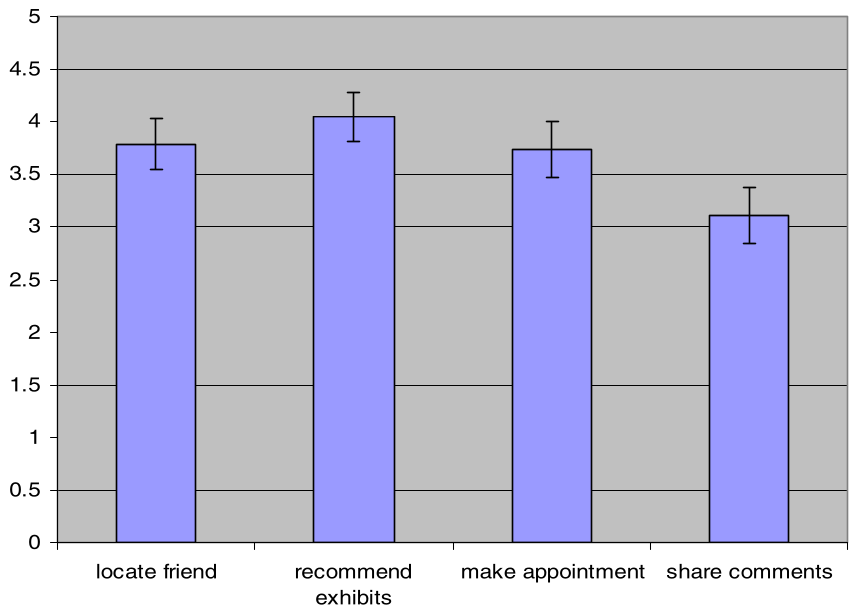 Fig 1 & 2: Quantitative analysis shows a clear preference for companion-based services (Locate, Recommend) vs. stranger-based services (Chat).
The Core Insight: The Five Pillars of Design
To overcome the barrier of adoption, the authors propose that any mobile social service must follow these five design implications:
1. The Knowledge Mandate
Social interaction must be a byproduct of seeking exhibit information. If a user asks "Who is looking at this car?", it should be because they want another perspective on the car, not just a profile to chat with.
2. Time-Critical Context Awareness
Input cost is the enemy. The authors advocate for Context-Aware UIs—using location and activity history to provide "Social Navigation" without requiring the user to type.
3. Bridging Physical & Digital
Exhibitions are physical. Visitors love brochures and posters. Mobile services should focus on a Multi-channel approach where the phone complements physical signage instead of replacing it.
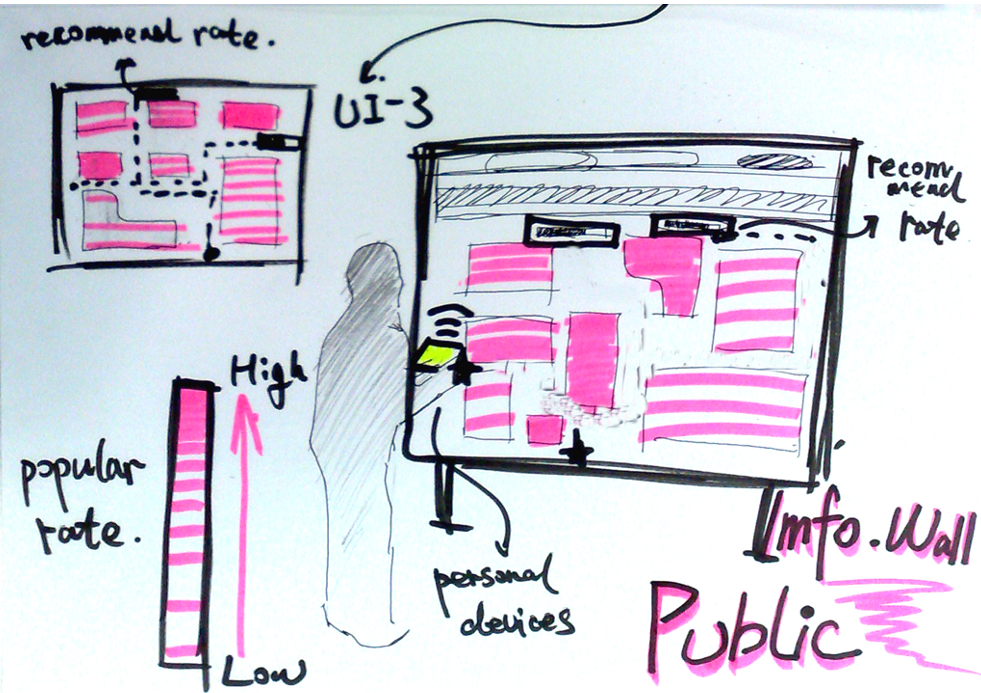 Fig 3: A conceptual mockup of using Public Displays to visualize booth popularity and crowd status, enabling indirect social navigation.
Critical Analysis & Conclusion
The paper’s greatest contribution is the realistic assessment of "Sociality" in commercial spaces. It admits that "unfamiliar visitor" interaction is an "uncertain demand."
Limitations: The study relies on 2007-era metrics and user behaviors (referencing business card exchanges and printed brochures). In a modern 2026 context, while the social psychology remains the same, the "physical artifacts" have largely shifted to QR codes and digital wallets. However, the core takeaway remains valid: Efficiency trumps sociality in a high-stakes, time-limited environment.
Future Outlook: The next frontier lies in integrating AR (Augmented Reality) to visualize the "traces" of companions and popular routes in real-time, removing the friction of a 2D map entirely.