
Mobile Social Software: Leveraging Trust in the Developing World
Mobile Social Software for the Developing World
This paper explores the design and utility of Mobile Social Software (MoSoSo) in the digitally emergent societies of Central Asia (Kazakhstan, Kyrgyzstan, Tajikistan, Uzbekistan). It posits that high reliance on traditional social networks for survival and information seeking makes these regions prime candidates for mobile services that systematize ad-hoc social processes.
TL;DR
In the West, we view social media as a space for leisure; in the developing world, social networks are a survival mechanism. This paper by Kolko et al. argues that in nations with low trust in state media and limited internet access, Mobile Social Software (MoSoSo) should not just be about "chatting"—it should be a functional tool that systematizes the informal, high-trust networks people already use to find jobs, healthcare, and news.
Contextualizing the Study
The researchers look at Central Asia (Kazakhstan, Kyrgyzstan, Tajikistan, and Uzbekistan), a region characterized as "information-poor" but "technology-adapting." Here, the "Desktop Web" is a luxury, but the mobile phone is a necessity. The paper identifies a crucial mismatch: Western SNS (like Facebook) assumes a reliable infrastructure and a desire for "social browsing," whereas Central Asian users need "social searching" within small circles of trusted peers.
Problem & Motivation: The Trust Deficit
Why do people in Central Asia rely so heavily on family and neighbors?
- State Control: Local governments often regulate news, leading to "positive-only" narratives that residents view with skepticism.
- Infrastructure Decay: Post-Soviet landline infrastructure is failing, making rural areas isolated from traditional telecommunications.
- Low Tech Access: While Internet Cafes exist, they are inconvenient and expensive.
The authors' insight is that trust is the bottleneck. In a society where official news is muddied, the "informational ecology" is built on personal connections.
Methodology: Mapping Information Ecology
The project (CAICT) utilized a massive 4,000-person survey to map technology usage against trust. They didn't just ask what devices people have, but who they ask when they need help with a health issue or a commercial purchase.
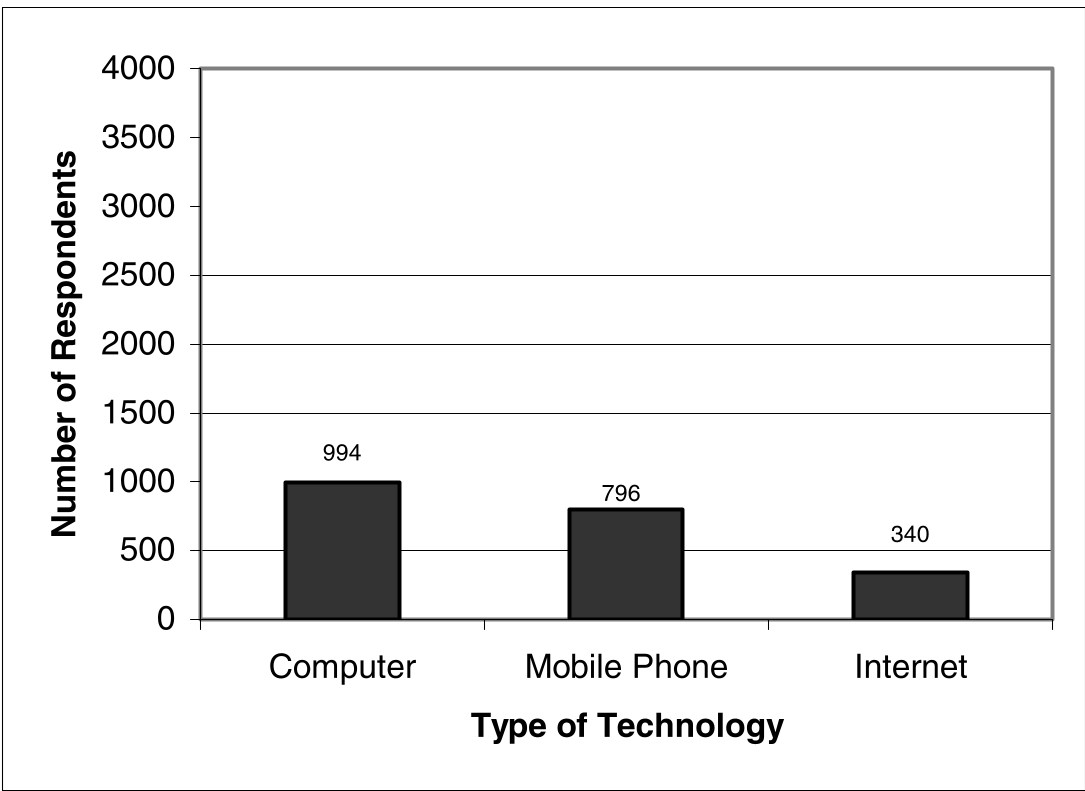 Fig 1: Mobile phone usage consistently outstrips Internet usage across all four surveyed nations, indicating the mobile device as the primary potential hub for social software.
Key Results: Trust vs. Frequency
The results reveal a fascinating divergence. While Television is the most frequently used source for news (due to sheer availability), it is viewed as significantly less trustworthy than personal social networks.
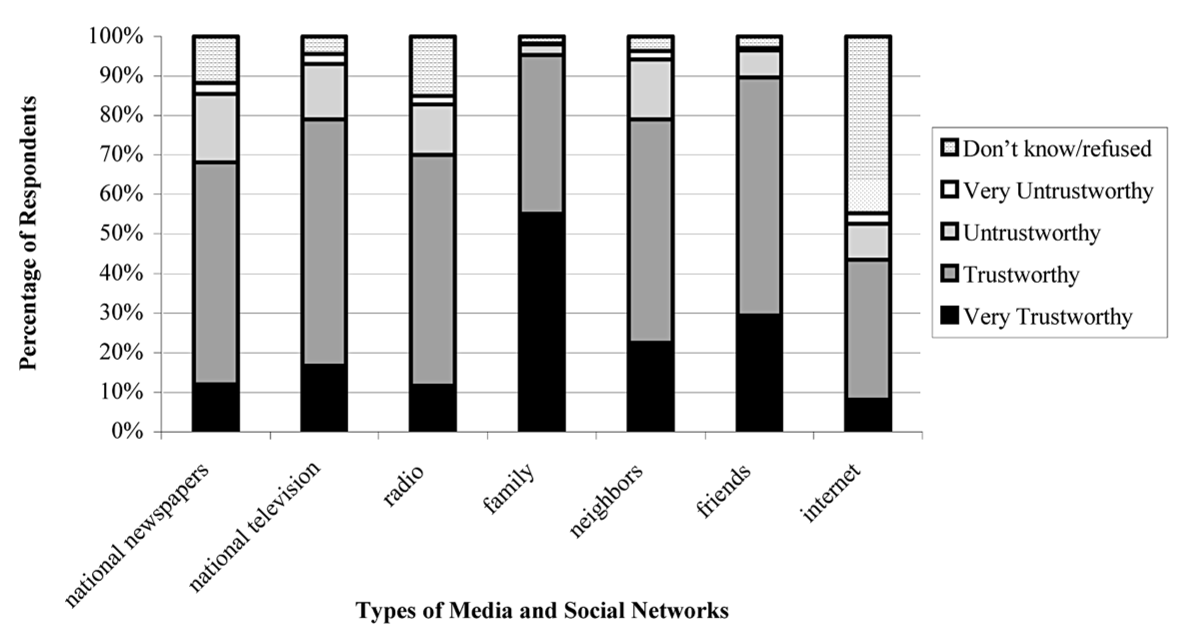 Fig 2: Trust levels by source. Note that "Family" and "Friends" consistently rank as "Very Trustworthy," whereas "TV" and "Newspapers" see much higher levels of skepticism.
Domain-Specific Seeking
The research found that social networks are not monolithic. People consult family for health issues and commercial purchases, but might rely on friends/neighbors for local news or finding officials. This suggests that MoSoSo must allow for "concentric circles" of privacy and trust, rather than a "public by default" approach.
Deep Insight: Beyond the Mobile Web
One of the paper's most critical takeaways for modern developers is the distinction between Mobile Social Software and the Mobile Web.
- In 2006 (and still in many developing regions today), data costs make web browsing prohibitive.
- SMS-based innovation is presented as the optimal path. Systematizing social referrals via text message can provide the same utility as a LinkedIn or a Yelp, but within the constraints of the local environment.
Conclusion & Future Outlook
Kolko et al. move the needle from Technology Determinism (build it and they will come) to Design Ethnography (see how they survive, then build tools to help).
Takeaways for Designers:
- Functional over Social: Don't build for "likes"; build for "leads" (jobs, goods, health).
- Prioritize Trust: Software should mirror the offline "web of connections."
- Constraint is the Mother of Invention: Low-bandwidth solutions (SMS, USSD) are not "low-tech"—they are "appropriate-tech."
The paper serves as a vital reminder that for much of the world, software isn't just an app on a screen—it's a digital extension of a community's survival strategy.