
MoViE: Redefining Mobile Video as a Collaborative Learning Tool
Mobile Social Video Sharing Tool for Learning Applications
This paper introduces MoViE (Mobile Video Experience), a mobile social media service specifically optimized for video story creation and sharing in educational contexts. The system leverages a dedicated Symbian S60 client to automate contextual metadata collection and provides a unique "remixing" capability for collaborative learning.
TL;DR
The MoViE (Mobile Video Experience) system is a pioneering framework designed to transform mobile phones from simple recording devices into active learning tools. By automating the "boring" parts of video sharing—tagging and metadata entry—and introducing mobile-native remixing, it enables organizations to document and learn from real-world experiences in real-time.
Contextualizing "Life Publishing" in Learning
In the late 2000s, the "Net Generation" began a shift toward life publishing—the act of documenting one's life occasions on the internet. While YouTube and Flickr popularized this, they remained tethered to desktop interfaces. The authors of MoViE recognized a critical gap: video is a powerful learning medium, but the friction of uploading, tagging, and organizing videos on mobile devices was too high for professional or educational use.
Their goal was to move beyond the "fun" aspect of mobile imaging and toward a structured "video memory" that allows teams to identify failures and improve processes incrementally.
Methodology: The Context-Aware Mobile Client
The soul of MoViE lies in its Symbian S60 client application. Unlike standard mobile browsers of the era, this client was built to bridge the gap between hardware sensors and semantic metadata.
The Tagging Workflow
- Capture: Users shoot video clips directly within the app.
- Context Extraction: The client silently collects GSM cell IDs and GPS coordinates.
- Cloud Enrichment: The server queries the Yahoo and Google APIs (notably Yahoo’s TagMap) to translate coordinates into meaningful labels like "Pori Jazz Festival" or "Sunny Weather."
- Remixing: Users can create new narratives by merging existing clips, adjusting cues, and establishing logical order—all on a mobile interface.
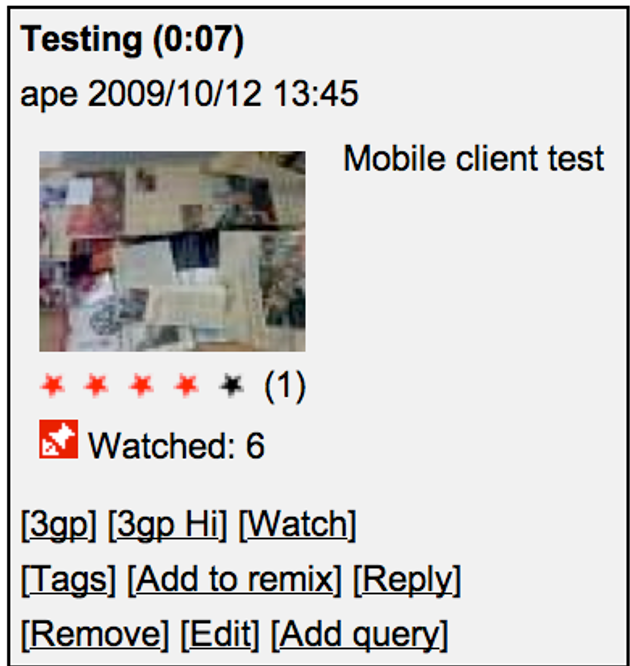 Figure 1: The MoViE interface for entering titles and descriptions after an automated upload.
Field Pilot: Learning from the Pori Jazz Festival
The system was stress-tested by the staff of the Pori Jazz Festival. The "Learning Task" was specific: capture unsuccessful events to ensure they wouldn't happen the following year.
Performance & Insights
- Volume: 8 users generated 113 videos, proving that video capture is faster than text-based note-taking in high-pressure environments.
- The "Cognitive Load" Barrier: Even with automated suggestions, users found manual tagging "requires too much attention." This feedback is a seminal insight in mobile HCI, suggesting that for field-learning applications, UI interactions must involve as few taps as possible.
- Value of Geo-Tagging: Participants identified geo-tags as the most critical feature for retrospective exploration, allowing them to visualize where specific organizational bottlenecks occurred.
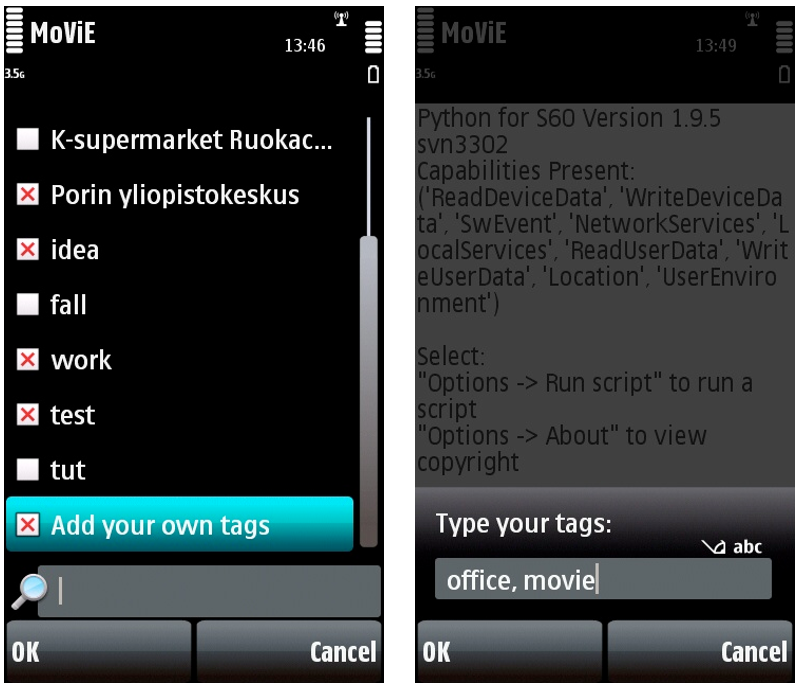 Figure 2: The MoViE web service integration, showing video content alongside automatically gathered location and weather metadata.
Critical Analysis & Conclusion
MoViE was ahead of its time in advocating for automated context-awareness in learning. Its primary contribution is the shift in perspective: seeing mobile video not as a final product (like a movie), but as a dynamic data point enriched by its environment.
Limitations
- Hardware Constraints: Developed for the Symbian S60 platform, the system was limited by the processing power of 2009-era mobile devices.
- Interaction Friction: Despite automated tags, the pilot showed that any manual entry is a hurdle during professional task execution.
Future Outlook
This work paved the way for modern pervasive documentation. Today’s AI-driven video tagging (using computer vision instead of just GPS) is the natural evolution of the MoViE philosophy. For researchers today, MoViE serves as a reminder that the success of a mobile social tool depends less on its video quality and more on how seamlessly it integrates into the user's natural workflow.