
Mobile vs. Web: Decoding the "Mobile Effect" on Social Network Dynamics
Exploring mobile users and their effects in online social networks: A Twitter case study
This paper presents a comparative study of Mobile Users (MSN) vs. Web Users (WSN) on Twitter to evaluate "mobile effects" on social networks. By analyzing 140 million tweets, it defines distinct behavioral and structural patterns between these groups and assesses their impact on information diffusion.
TL;DR
Is the mobile revolution making social networks more connected or more fragmented? This Twitter case study reveals a fascinating paradox: while mobile users are more "active" (freqent, short bursts of content), they are significantly less likely to propagate information (retweet). This results in a Mobile Social Network (MSN) that is faster in pace but narrower in reach compared to the traditional Web Social Network (WSN).
The Shift in User Intuition
The transition from sitting at a desk (Web) to carrying a networked device in your pocket (Mobile) isn't just a change in hardware; it's a change in social psychology. The authors hypothesized that mobile users would be "more rapid," yet the actual impact on the structure of the social graph remained a black box until this comprehensive data analysis.
Methodology: Building Two Parallel Worlds
To study this, the researchers categorized users based on their primary posting platform (e.g., "via iPhone" vs. "via web").
- MSN (Mobile Social Network): Nodes are users who primarily tweet via mobile.
- WSN (Web Social Network): Nodes are users who stick to the desktop interface.
By separating these graphs, they could measure metrics like Clustering Coefficients and Path Lengths to see how the "social fabric" differs between the two.
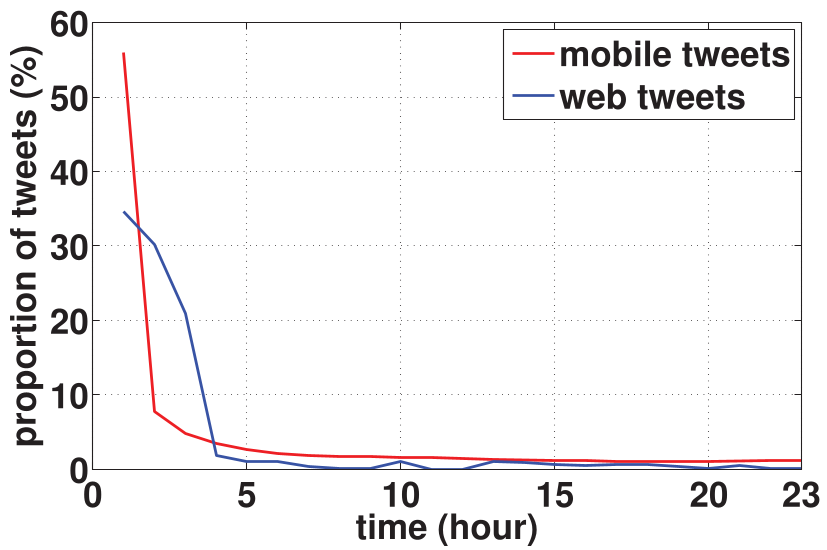 Fig 1: Notice how web users (dashed) peak during work hours and drop at lunch, while mobile users (solid) remain stable, even peaking when most are away from PCs.
Key Findings: Shorter, Faster, but Less Social?
The study highlights three major behavioral shifts:
- The "Short-Attention" Span: Mobile tweets are significantly shorter (mostly under 70 characters) and sent at much shorter intervals. Over 50% of mobile users tweet again within an hour.
- The Retweet Gap: This is the most striking finding. Web users retweet significantly more. Retweeting requires a "decision-making" moment that seems more aligned with desktop browsing than "on-the-go" mobile usage.
- Graph Topology: The MSN has a shorter Average Path Length (4.12 vs 4.38). While you are "closer" to others in the mobile network, the Clustering Coefficient is lower, meaning mobile users form fewer tight-knit communities compared to web users.
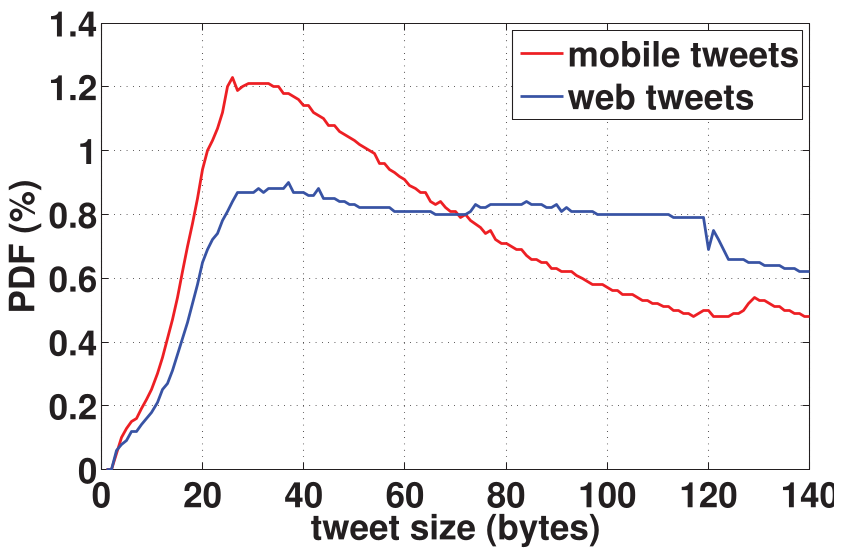 Fig 2: Mobile tweets (solid line) dominate the "short-form" spectrum, likely due to small screens and input constraints.
Information Diffusion: The SI Model Simulation
To see these effects in action, the authors ran a Susceptible-Infected (SI) model to simulate how a "viral" message spreads.
- Web Probability: 2.5% chance to forward.
- Mobile Probability: 0.5% chance to forward.
The result? The scope of information diffusion is much smaller in the MSN. Even though mobile users have more "high-degree" nodes (influencers with many followers), their reluctance to retweet acts as a bottleneck for virality.
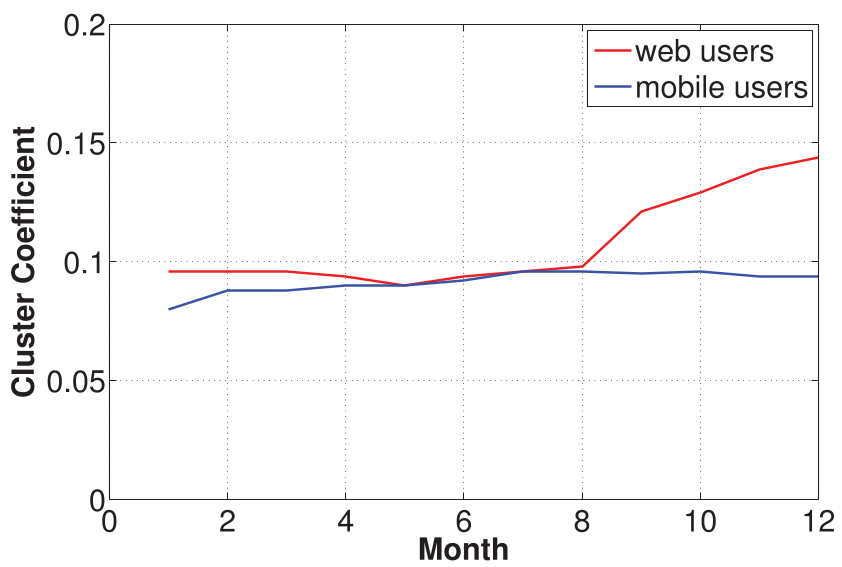 Fig 3: The WSN consistently maintains a higher clustering coefficient, suggesting more robust and interconnected social sub-groups.
Critical Insight & Conclusion
The "Mobile Effect" is a double-edged sword. It drives ubiquity (users are always online) but sacrifices depth (less re-sharing and weaker clustering).
For researchers and marketers, this suggests that "Mobile-First" strategies shouldn't just focus on frequency—they must solve the "Retweet Gap." If mobile users are less likely to forward content naturally, the UI/UX must make social propagation even more frictionless to compensate for the "mobile distraction" factor.
Limitations
The study uses a dataset from 2006-2010. While foundational, the "Retweet" interface has since been optimized for mobile (one-tap retweets), which might narrow the gap found in this study. However, the core insight—that mobile usage reduces the cognitive depth of social interaction—remains a highly relevant Inductive Bias for modern social algorithmic design.