
MobiTribe: Reclaiming Data Privacy in Social Networking through Device-Centric P2P Sharing
MobiTribe: Enabling device centric social networking on smart mobile devices
MobiTribe is a device-centric social networking architecture that enables decentralized content sharing directly between mobile devices. By integrating with existing platforms like Facebook, it provides a privacy-preserving P2P distribution system that leverages low-cost networks and predictive pre-fetching to minimize battery and communication overhead.
TL;DR
MobiTribe is an innovative architecture that turns smartphones into decentralized content hosting nodes. By integrating with Facebook as a metadata layer while handling actual data transfers via Peer-to-Peer (P2P) protocols, it addresses the "privacy vs. convenience" trade-off. It smartly utilizes low-cost network windows and battery-aware replication to ensure content is available without draining user resources.
The Privacy Trap of Centralized Social Media
Current social media giants operate on a simple but extractive model: free service in exchange for total data ownership. While decentralized alternatives like Diaspora have emerged, they struggle with a massive adoption hurdle—users don't want to host their own "always-on" servers.
The core challenge is: How do we decentralize social networking on devices that are frequently offline, battery-constrained, and bandwidth-limited?
Methodology: The "Private Storage Tribe"
MobiTribe’s architecture rests on the insight that while one smartphone is unreliable, a tribe of devices with complementary connectivity patterns can provide "Cloud-like" availability.
1. The Content Management Server (CMS)
Unlike a traditional server that hosts files, the CMS in MobiTribe acts only as a Tracker and Indexer. It monitors the connectivity status of devices and decides where content should be replicated.
2. Predictive Pre-fetching & Replication
The system doesn't just copy data everywhere. It uses a bipartite b-matching algorithm to identify "intended consumers" and replicates content to them when they are on low-cost networks (e.g., home WiFi). This turns prospective viewers into local seeders before they even click "play."
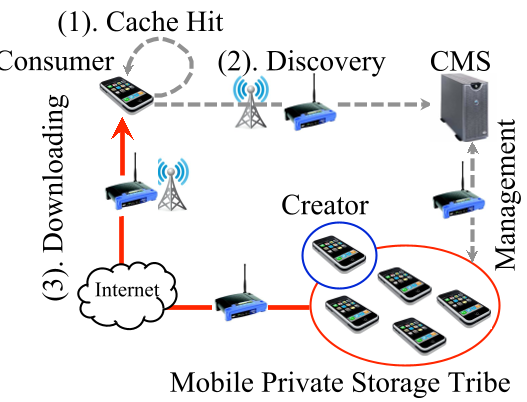 Figure 1: The dual-path architecture showing (a) Content Registration via the CMS and (b) P2P Content Access.
Implementation: A "Parasitic" Privacy Layer
The beauty of the MobiTribe prototype is its integration with Facebook.
- User Experience: A user posts a photo via the MobiTribe app.
- Behind the Scenes: The app generates a torrent file, registers it with the CMS, and posts a link to the Facebook feed.
- The Shift: When a friend clicks the link, the data is pulled directly from the creator’s phone or a "tribe" member's phone via a P2P protocol, bypassing Facebook's data-mining storage servers entirely.
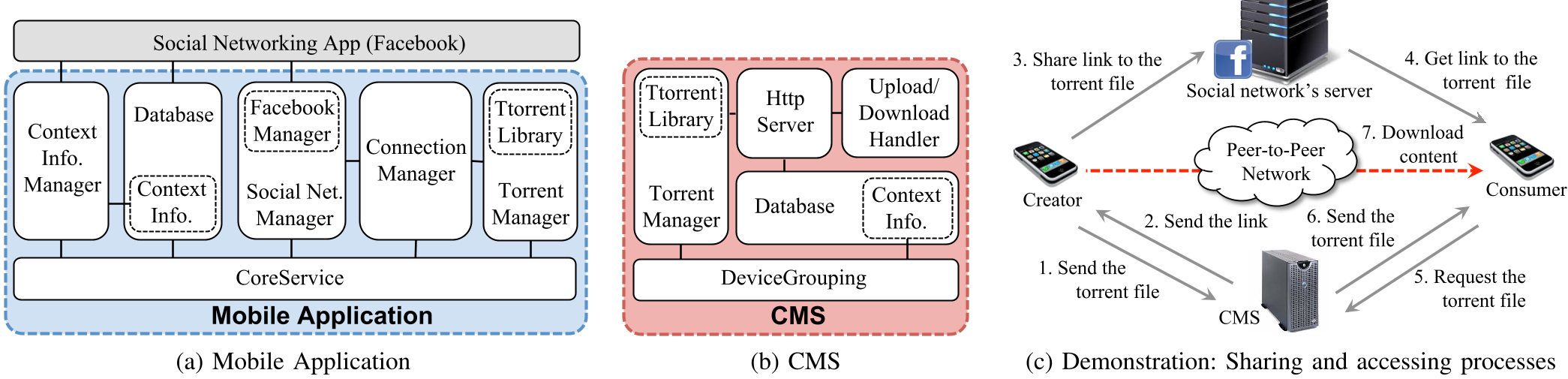 Figure 2: Modular implementation including the Android middleware and the Java-based CMS.
Experimental Validation
The demonstration setup featured three Android smartphones. Key findings included:
- Availability: With only two replicas, the system achieved high availability by picking devices with "complementary" connectivity (e.g., one user at home while the other is commuting).
- Scalability: As more users download a piece of content, they automatically act as "seeders," making the network stronger and faster as demand increases—a classic benefit of P2P systems.
- Resource Efficiency: By delaying uploads until WiFi is available, MobiTribe significantly reduced cellular data costs for the creator.
Critical Insight & Future Outlook
MobiTribe represents a pragmatic step toward decentralized web 3.0 ideals. Rather than asking users to abandon current social networks, it "intercepts" the data flow at the device level.
Limitations: The reliance on a centralized CMS for tracking is still a minor point of failure. Future iterations could decentralize the tracker itself using Distributed Hash Tables (DHT). Furthermore, the current model assumes a degree of trust within the "tribe," which could be further hardened using encryption.
Summary: MobiTribe proves that our smartphones are no longer just windows into the cloud—they are the cloud themselves. By coordinating these edge devices, we can enjoy the social graph of a giant like Facebook without surrendering our digital sovereignty.