
MobiTrust: Engineering Social Trust in Decentralized Mobile Networks
MobiTrust: Trust Management System in Mobile Social Computing
This paper introduces MobiTrust, a decentralized trust management system designed for spontaneous Mobile Social Networks (MSNs). It uniquely combines user profile similarity, reputation, and friendship history into a unified trust metric to facilitate secure peer-to-peer interactions without central authorities.
TL;DR
Establishing trust in spontaneous mobile social networks (MSNs)—like those formed at conferences or in temporary outdoor events—is notoriously difficult due to the lack of central authority. MobiTrust solves this by synthesizing semantic interest similarity, distributed reputation, and friendship history into a robust trust value. The model successfully filters out malicious "polluting" nodes even in highly dense and dynamic environments.
Background: The Trust Gap in Spontaneous Networks
As social networking shifts from centralized platforms like Facebook to spontaneous, infrastructure-less mobile environments (e.g., Jambo Networks), we face a "stranger danger" problem. Without a server to verify identities or history, how do you know if a peer's service claim is legitimate? Previous MANET protocols focus on packet delivery, but they ignore the human element—the social features that govern interaction.
Methodology: The Three Pillars of MobiTrust
The authors define trust as a weighted combination of three distinct social factors:
- Semantic Profile Similarity (): Humans naturally trust those with similar interests. MobiTrust goes beyond simple keyword matching, using an ontology-based distance that considers the depth of nodes in a hierarchy. If two users share a niche interest (located deep in the ontology), their similarity score is higher than sharing a generic root interest.
- Reputation (): This combines local observations with "global" reputation gossiped across the network. To prevent collusion, signatures and public/private key pairs are used for verification.
- Friends of Friends (): Utilizing the transitive property of trust, the system checks for common signed certificates of shared past contacts.
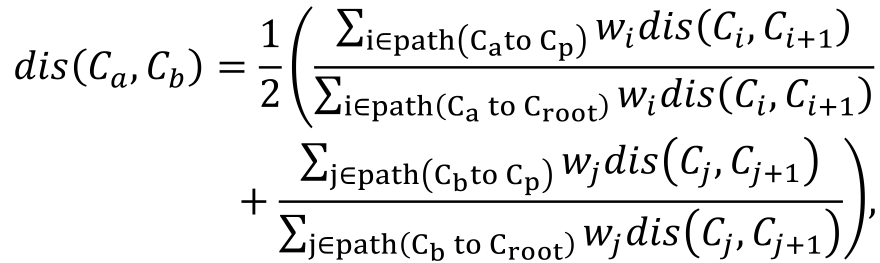 The semantic distance formula used to calculate profile similarity.
Privacy-Preserving Interaction
A key innovation is the use of Private Set Intersection (PSI). Users want to find similar peers without broadcasting their entire private profile. By using homomorphic encryption, MobiTrust allows users to find common interests without revealing non-overlapping profile parts to strangers.
Experimental Validation
Using a random waypoint mobility model, the authors tested the system against "bad nodes" that provide bogus services.
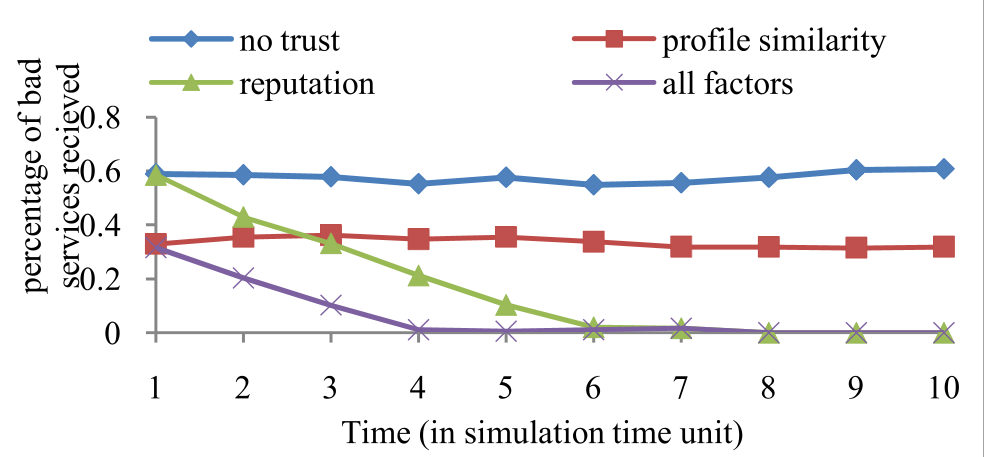
Critical Findings:
- The Cold-Start Solution: In the early stages of a network, Reputation () is useless because there is no history. Profile similarity () serves as the primary defense during this phase.
- Resilience to Hostility: Even when 50% of the network is malicious, MobiTrust keeps the "false match" rate significantly lower than the trust-free baseline, which approaches 40-50% error rates.
- Scalability: As the network grows from 200 to 2,000 nodes, the system maintains stable performance, proving its viability for large-scale public events.
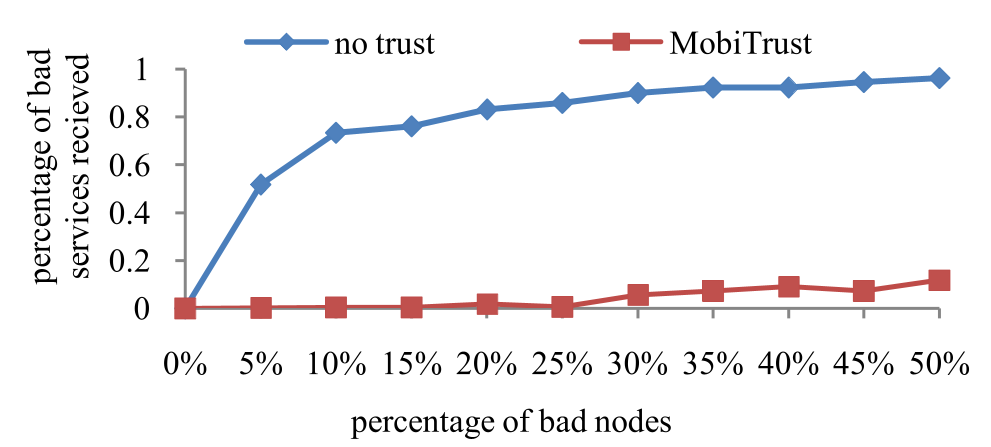 Performance remains robust even as the percentage of 'bad nodes' in the network increases.
Conclusion and Deep Insight
MobiTrust demonstrates that decentralized trust is not a binary state but a multifaceted social construct.
Key Takeaways for Developers & Researchers:
- Weighted Trust is Mandatory: Relying solely on reputation in mobile environments leads to failure in new networks. Semantic matching is the necessary "bootloader" for trust.
- Trade-offs (FP vs FN): High trust thresholds reduce malicious interactions (False Negatives) but may isolate honest nodes with less history (False Positives).
- Future Path: While MobiTrust handles mobile dynamics well, the next frontier is defending against sophisticated Sybil attacks where one malicious actor generates thousands of fake profiles with high similarity scores.
The model’s balance between social intuition and cryptographic privacy provides a strong foundation for the next generation of Edge Computing and Peer-to-Peer social applications.