
Beyond Technology: The MOC Approach to Revolutionizing Knowledge Transfer
MOC Approach and Its Integration with Social Network and ICT: The Role to Improve Knowledge Transfer
This paper proposes the Motivation-Opportunity-Competency (MOC) approach as a strategic HRM framework to enhance organizational knowledge transfer. It integrates MOC with Social Networks and Information and Communication Technology (ICT) to build human capital and improve knowledge acquisition capabilities.
TL;DR
In the modern knowledge economy, simply having a database isn't enough. This paper argues that effective Knowledge Transfer requires a sophisticated blend of Human Resource Management (the MOC Approach), Social Networks, and ICT. By focusing on employee Motivation, Opportunity, and Competency, organizations can transform individual expertise into a sustainable competitive advantage.
Perspective Shift: Knowledge as a Capability, Not an Object
For years, organizations treated knowledge like inventory—something to be stored in a "data warehouse." However, this paper posits a more dynamic view. Knowledge is a process and a capability.
The core challenge isn't just "accessing" information; it's the speed of acquisition. In a rapidly changing market, "Collaborative Agility Capital"—the ability to learn and transfer knowledge quickly—is the new gold standard.
The Pain Points of Traditional KM
Why do most Knowledge Management (KM) systems fail?
- The "Willingness" Gap: Individuals may possess knowledge but lack the motivation to share it.
- Structural Silos: Even if employees want to share, they may lack the social "opportunity" or interaction channels.
- Generic HRM: Standard HR practices (hiring/payroll) aren't optimized for the specific nuances of internal knowledge flow.
The Core Methodology: The MOC Framework
The author proposes the MOC Approach as the engine of the HRM system:
- Motivation: Creating policies that encourage individuals to share their tacit knowledge.
- Opportunity: Designing organizational structures that facilitate interaction and social exchange.
- Competency: Enhancing the individual's ability to identify, absorb, and apply new information.
The Conceptual Architecture
The model integrates "Soft" and "Hard" approaches to bridge the gap between individual Human Capital and Organizational Knowledge.
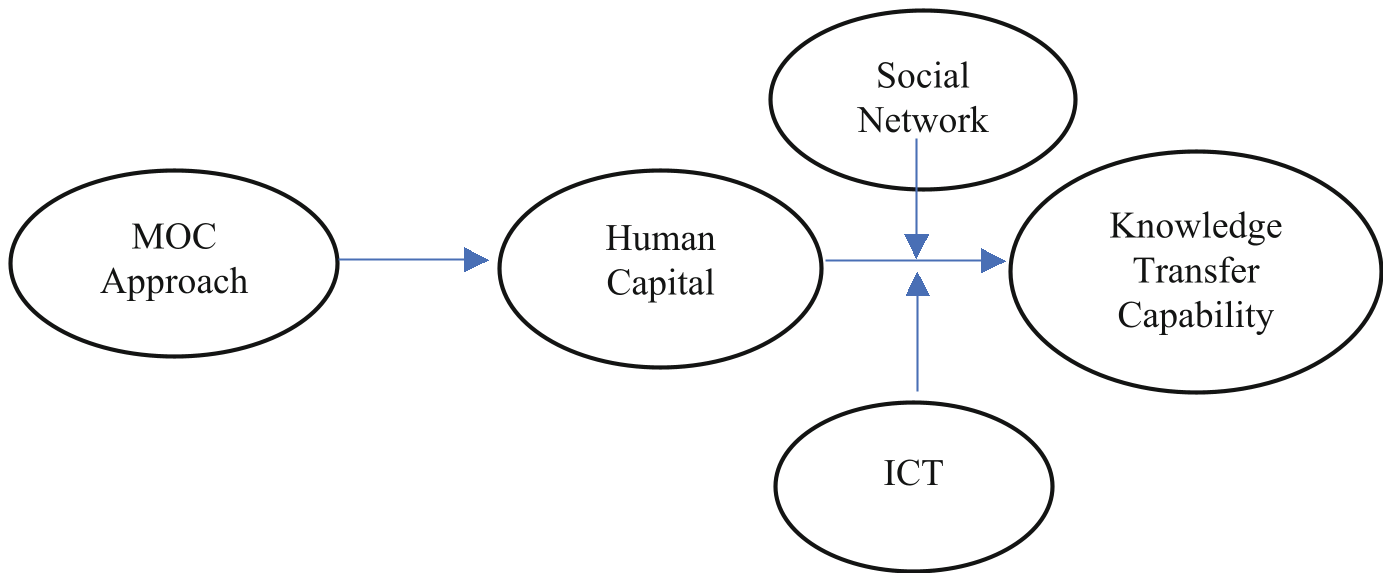 Figure 1: The proposed path from HRM-MOC policies to Knowledge Transfer Capability, moderated by Social Networks and ICT.
Soft vs. Hard: A Balancing Act
The paper emphasizes that Knowledge Transfer thrives on two pillars:
- Social Networks (The Soft Approach): Relational trust, reciprocity, and face-to-face interactions. This is where "tacit" knowledge—the stuff you can't easily write down—lives.
- ICT (The Hard Approach): Portals, emails, and databases. This facilitates the "codification strategy," turning personal insights into official documents that can be disseminated at scale.
The MOC approach acts as the catalyst that ensures these two pillars actually move the needle on Human Capital quality.
Critical Insight & Conclusion
The true value of this work lies in its holistic view. It suggests that Human Capital is not just a measure of what people know, but a measure of how much value they contribute back to the organization.
Key Takeaways for Leaders:
- Don't just buy software: An expensive KM portal (ICT) is useless without a culture that motivates sharing (Motivation) and a network that allows for discussion (Opportunity).
- Focus on Agility: In 2026 and beyond, the competitive winner is the firm that can transfer lessons learned from one project to the next with the least "friction."
Future Directions
While this paper provides a robust theoretical framework, the next step is empirical validation. Future research should focus on "knowledge workers" in high-tech sectors to measure exactly how much MOC-driven policies improve ROI compared to traditional management styles.