
Engineering Social Optimality: Influencing Decisions via Artificial Social Networks
A Model for Decision Making Under the Influence of an Artificial Social Network
This paper proposes a generalized framework for influencing population-level decision-making through an "Artificial Social Network." By identifying "best users" (socially optimal actors) and dynamically creating temporary network edges from them to the broader population, the model shifts the system equilibrium toward socially desirable states.
TL;DR
How do you nudge a population toward better decisions without coercion? This paper introduces a framework that uses "Artificial Social Networks" to create influential nodes—exemplary users who act as "social anchors." By dynamically rewiring the network to connect average users with these high performers, the system moves the entire population's behavior toward a socially optimal state, successfully reducing isolation (modularity) and improving collective utility.
Problem & Motivation: The Rationality Paradox
In many societal systems—from smart grids to public health—individual "rational" agents acting to maximize their own utility often create outcomes that are disastrous for the collective. This is a classic coordination failure.
The authors argue that while we understand how opinions spread naturally (cascading behavior), we lack a robust mechanism for a central authority to influence this process via modern IT. The challenge is two-fold:
- Homophily: People naturally cluster with those similar to themselves, creating "echo chambers" or high modularity.
- Trait Inertia: Certain traits are fixed (nonmalleable), while others (malleable) change only under sustained social pressure.
The authors suggest that by "promoting" the best users, we can bridge these clusters and steer the malleable traits of the masses.
Methodology: Dynamic Rewiring and Opinion Propagation
The researchers treat the population as a directed, weighted graph. The process follows a clear algorithmic loop:
- Homophily-based Initialization: Agents are connected based on a "similarity score" (norm of the difference of characteristic vectors).
- Identification of "Best Users": A social utility function evaluates actions. The users contributing most to the social good are labeled "Best."
- Temporary Edge Creation: The system creates temporary edges from these Best Users back to the general population. The probability of these edges depends on (an agent's social consciousness).
- DeGroot Update: The malleable traits () are updated using a weighted average:
Where represents the influence of the neighbors, including the newly promoted "Best Users."
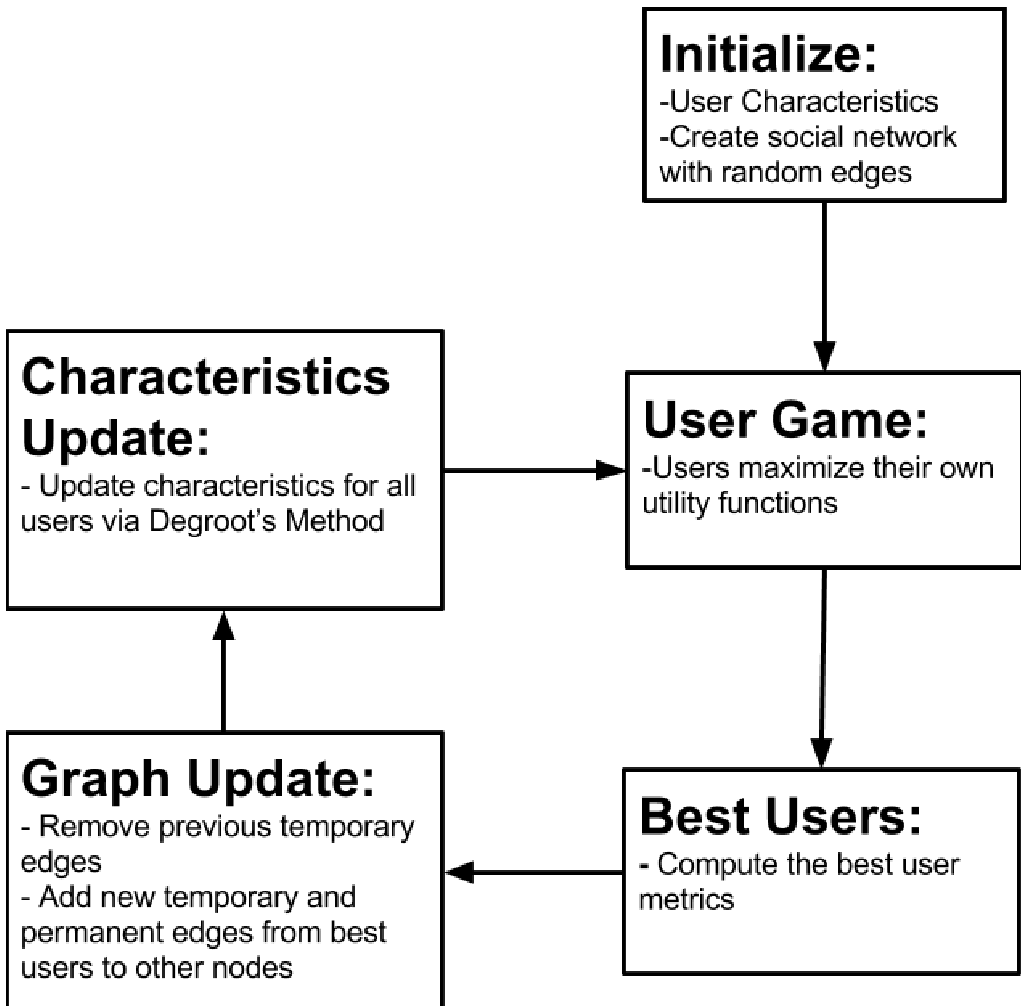 Fig 1: Abstract representation of the dynamic influence process.
Experiments: Breaking the "Clusters"
The authors tested the model across several cases, focusing on how different decision functions (additive vs. multiplicative) affect influence.
Key Result 1: Modularity Reduction
A critical finding is that the introduction of "Best Users" effectively breaks down communities. High modularity means a network is divided into dense, disconnected clusters. By inserting artificial edges from "Best Users" to many different communities, the modularity drops significantly, allowing influence to flow more freely across the entire population.
Key Result 2: Diminishing Returns of Influence
While adding more "Best Users" (M) increases social utility, the effect saturates. As shown in the simulation results, moving from 1 to 5 influencers provides a massive boost, but further increases yield marginal gains.
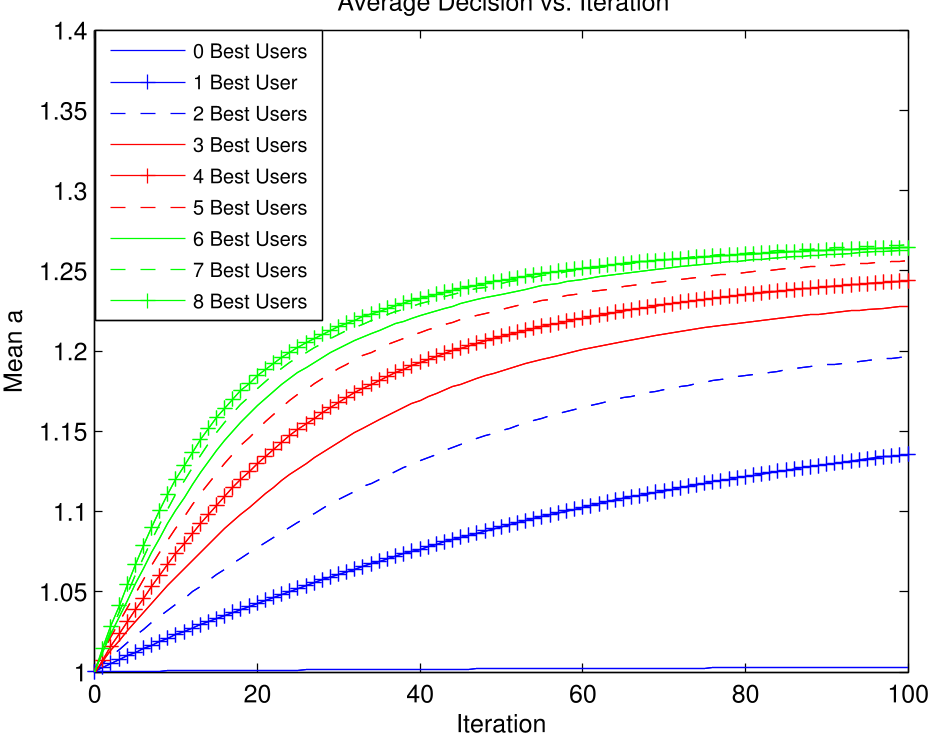 Fig 2: Social utility values increasing as the number of best users (M) increases.
Key Result 3: Robustness to Edge Weight
How much do people "weigh" an artificial link compared to a real friend? The authors found that even if the artificial links () are significantly weaker than organic ones, they still drive the equilibrium toward the optimum, provided .
Critical Analysis & Conclusion
This work provides a bridge between control theory and social psychology.
Takeaways:
- Strategic Interventions Work: A central authority does not need to change everyone's mind; it only needs to highlight and connect the "right" people.
- The Math Matters: If the decision function is multiplicative (where a low fixed trait "caps" potential), the influence of best users is hindered compared to additive scenarios.
Limitations & Future Work:
The current model assumes a relatively simple DeGroot update. In reality, "Influence Fatigue" or "Backfire Effects" (where users move away from authority-promoted models) might occur. Future research could investigate adversarial agents who actively resist the influence of the "Best Users," or apply this specifically to smart grid load balancing where the "best users" are those with the flattest consumption profiles.
Final Thought: In an era of algorithmic feeds, this paper offers a blueprint for how those feeds could be engineered for collective social benefit rather than just engagement.