
Engineering Emergence: A Systematic Approach to Collective Intelligence Model Design
On model design for simulation of collective intelligence
The paper proposes a systematic approach for the model design of Collective Intelligence (CI) systems, establishing CI as an umbrella term for self-organizing, adaptive, and multi-agent systems. It introduces a structured methodology comprising "modelling recipes" (Basic, Diversity, Adaptivity, etc.) and bridges the gap between conceptual system design and numerical simulation.
Executive Summary
TL;DR: This paper tackles the "wild growth" of Collective Intelligence (CI) research by providing a rigorous, step-by-step methodology for designing simulation models. It moves beyond haphazard experimentation, offering a "recipe-based" approach to define how local agent interactions lead to global emergent behaviors.
Context: This work occupies a unique position in the academic landscape—it acts as a bridge between the conceptual frameworks of Software Engineering (like RUP) and the numerical rigor of Complexity Science (like Boolean Networks). It is a foundational methodological guide for anyone looking to simulate "intelligence" that arises from the bottom up.
Motivation: The Gap Between Observation and Engineering
In the study of systems like ant colonies, traffic patterns, or social networks, we often witness Emergence—where the "whole is more than the sum of its parts." However, translating these observations into engineered systems has historically been a black art.
The author identifies a critical pain point: most researchers jump straight from "requirements" to "implementation," leaving the logical model—the specific rules governing agent behavior and environment feedback—vague and ill-defined.
Methodology: The Recipe for Complexity
The core contribution is a hierarchical workflow that guides a researcher from a natural language problem to a computer-ready simulation.
1. The Generic Model Phase
The author introduces several "Recipes" to add layers of complexity to a system:
- BASIC: Defines the fundamental Action-Observation loop.
- + Internal States: Adds memory and roles to agents.
- + Diversity: Allows for heterogeneous agents with different capabilities.
- + Non-determinism: Introduces stochasticity (realistic "noise").
- + Adaptivity: Implements learning mechanisms (e.g., Evolutionary Algorithms).
2. The Model Architecture
The paper emphasizes a clean separation between the Individual and the World. The environment is not just a container but a mapping function () that processes costs and benefits.
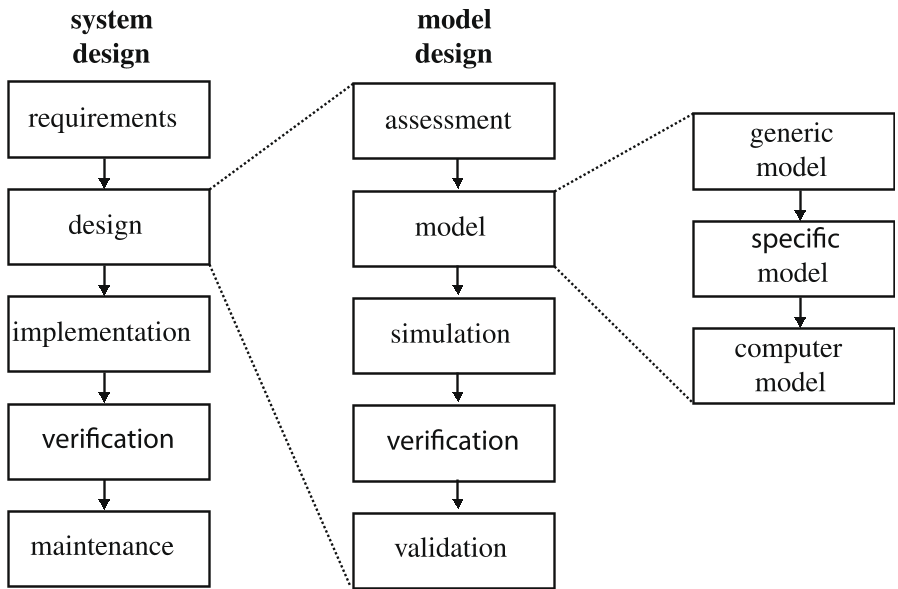 Figure 1: The systematic approach integrated into the generic system development cycle.
Case Study: From Human Languages to Robot Swarms
To prove the framework's versatility, the author applies it to two vastly different scenarios:
Case A: The Chinese Whispering Room (CWR)
A social-computational model where participants (humans or machines) attempt to learn a lingua franca through iterative translation. This case study demonstrates how "Internal States" (dictionaries and history) are vital for semantic interoperability.
Case B: Braitenberg Collectivae
A swarm of simple robots inspired by Braitenberg's "Vehicles." By adding communication (sharing visited locations), the author shows how these nearly "zero-intelligence" agents can achieve high-level area surveillance.
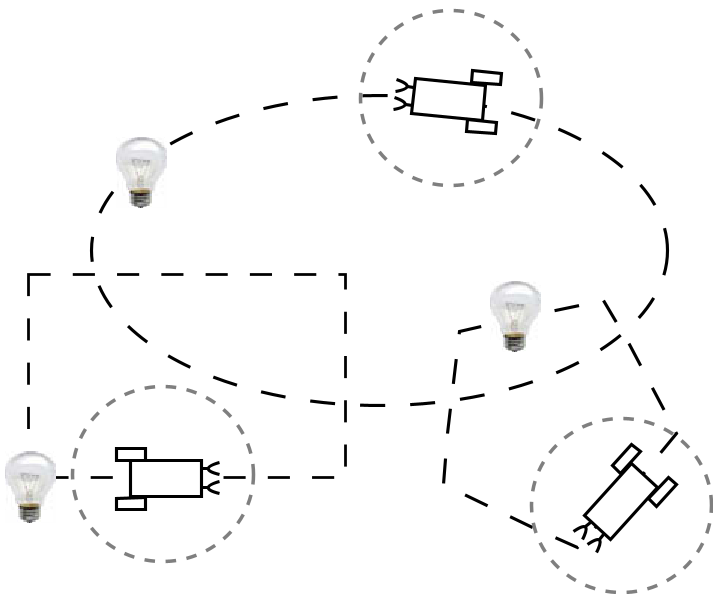 Figure 2: The Braitenberg Collectivae scenario where robots collaborate to cover space.
Critical Insight & Conclusion
The real value of this paper lies in its taxonomy of CI properties. By distinguishing between Enabling Properties (Adaptivity, Interaction, Rules) and Defining Properties (Global-Local dynamics, Emergence, Robustness), it gives researchers a precise vocabulary to evaluate their work.
Takeaway: As we move toward the era of the Social and Semantic Web, engineering "ecosystems of participation" requires more than just code; it requires a systematic understanding of local-to-global dynamics. While the paper acknowledges a lack of automated "validation" tools, it provides the essential blueprints needed to start building the next generation of self-organizing systems.
Limitations: The framework remains largely manual and conceptual. The "Global to Local Compiler" remains a holy grail—a tool that could automatically generate agent rules based on a desired global outcome.