
Model Driven Crowdsourcing: Solving the Integration Nightmare in Collaborative Development
Towards model driven crowdsourcing: First experiments, methodology and transformation
This paper introduces a Model Driven Crowdsourcing (MDC) framework that leverages Model Driven Engineering (MDE) to decompose software tasks in collaborative environments. It specifically proposes a "Parameterized Transformation" technique to seamlessly integrate independent business logic and context-aware modules developed by a distributed crowd.
TL;DR
Integrating software components from a distributed "crowd" is notoriously difficult. This paper proposes a Model Driven Crowdsourcing (MDC) approach that uses High-Level Abstraction (MDE) and a novel Parameterized Transformation technique to bridge the gap between business logic and context-aware requirements, allowing independent teams to work on the same system without stepping on each other's toes.
The Problem: The "Assembly" Pain Point in Crowdsourcing
Crowdsourcing is great for productivity but a nightmare for integration. When different teams develop independent modules, they often suffer from:
- Lack of Semantic Alignment: Team A calls a variable
User_Id, Team B calls itUserId. Standard compilers and transformation engines fail to see they are the same. - Cross-cutting Concerns: Context-aware logic (like GPS location or device type) often gets hard-coded into the business logic, making the code brittle and non-reusable.
- Architectural Drift: Without a shared high-level blueprint, the "assembled" software becomes a Frankenstein's monster of incompatible parts.
The Insight: Separation of Concerns via MDE
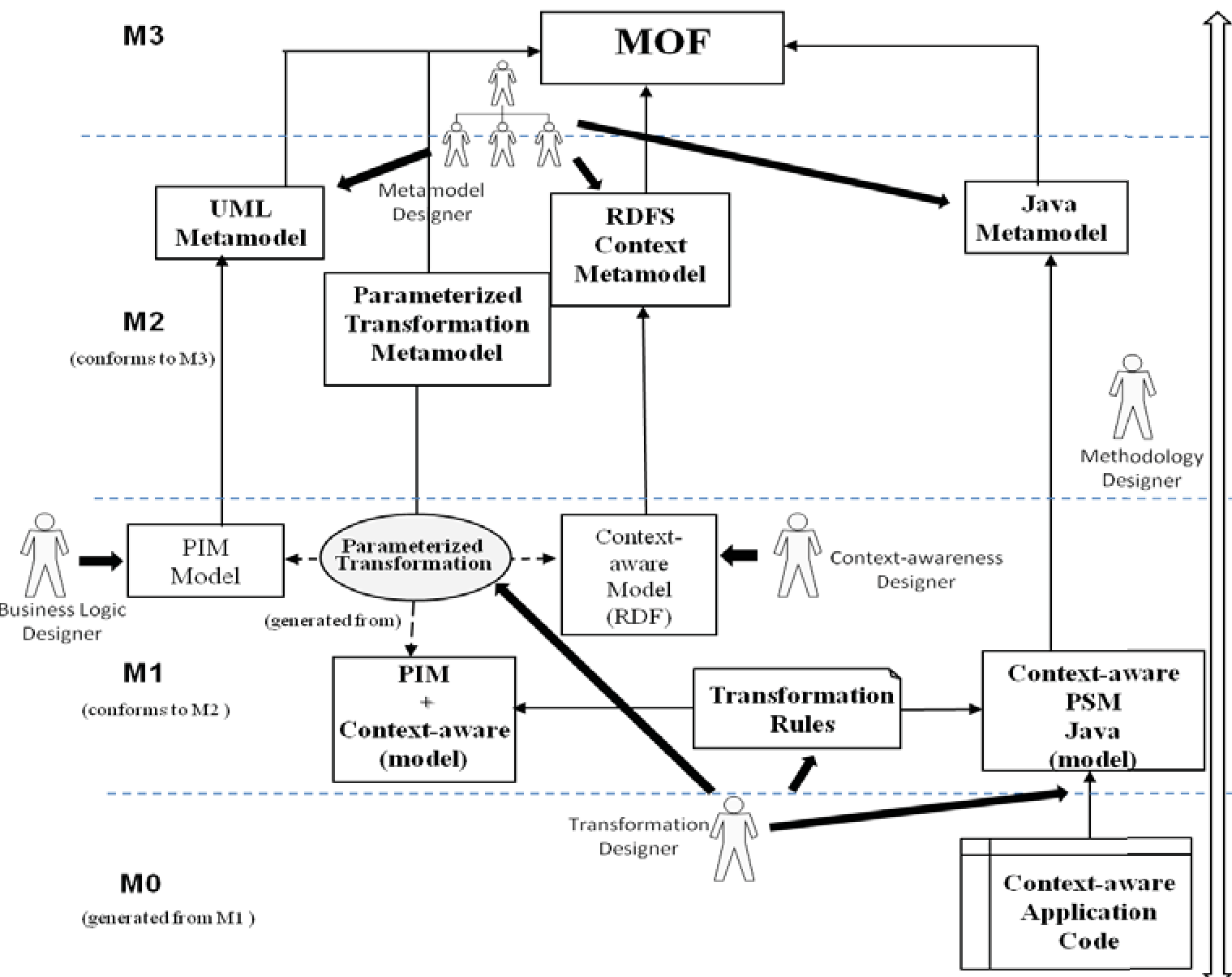
The author's core argument is that we shouldn't crowdsource code; we should crowdsource Models. By moving the collaboration to a higher level of abstraction (the M2 and M1 layers of the Model Driven Architecture), we can define strict interfaces (metamodels) that ensure different parts of the crowd stay aligned.
The Proposed Architecture
The paper classifies crowdsourcing participants into specialized roles:
- Methodology Designer: Defines the rules of the "game."
- Metamodel Designer: Creates the domain languages (Business vs. Context).
- Transformation Designer: The "glue" expert who writes the rules to merge models.
Methodology: The Parameterized Transformation
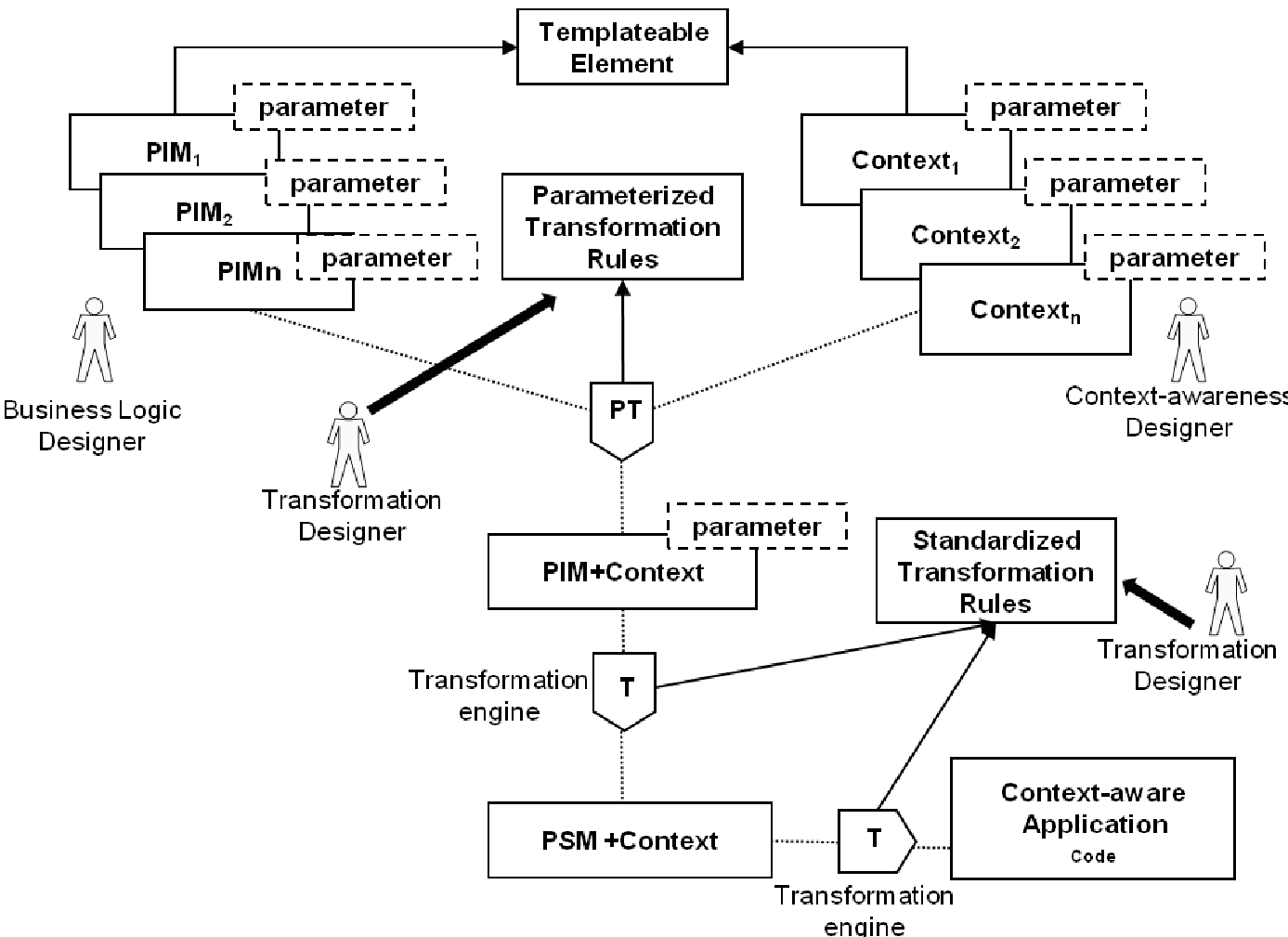
The "secret sauce" of this paper is the Parameterized Transformation. Instead of a static 1-to-1 mapping, the transformation engine treats the Business Logic (PIM) as a template.
- Tagging: Business logic designers mark certain elements with a
#symbol, indicating they are "parameterable." - Matching: The engine uses a similarity function and RDF ontologies to find the best match in the Context Model, even if names don't match exactly.
- Injection: The transformation engine injects the context-aware properties into the PIM to create a Contextual PIM, which is then converted into platform-specific code (PSM).
Mathematical Logic for Semantic Matching
To handle the "crowd" environment where naming is inconsistent, the author defines a matching operation based on the intersection of element signatures and a similarity index:
This ensures that even if workers use different terminology, the system can still bind the correct context to the correct business logic.
Experiments: Context-Aware Ubiquitous Apps
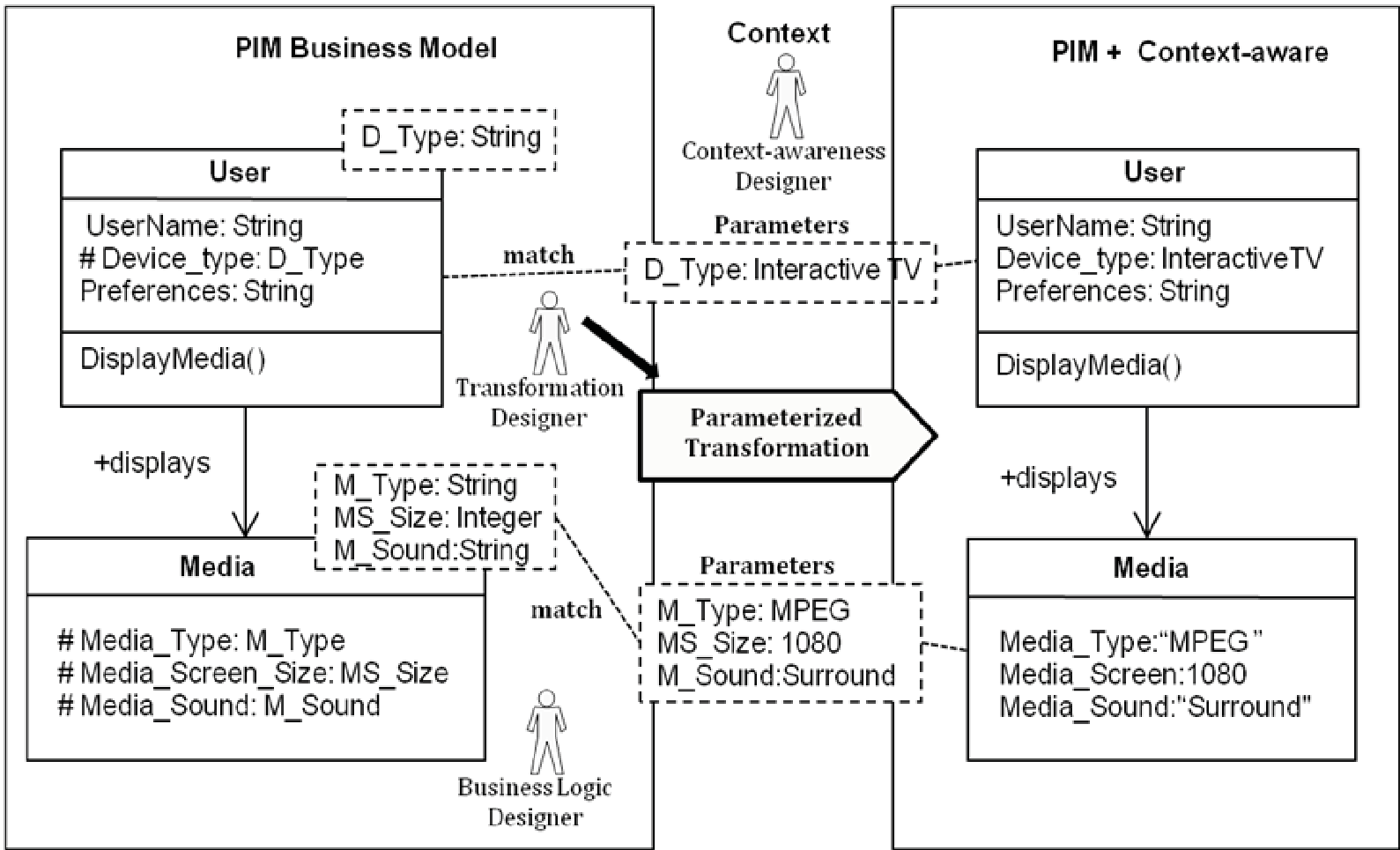
The paper validates this approach using an interactive media example. A Business Logic Designer models a general User viewing Media, while a Context-awareness Designer models the specific constraints of an Interactive TV using MPEG format. Through the parameterized transformation, these two independent models are merged to generate a specific application without either designer knowing the details of the other's work.
Critical Insight & Conclusion
This work shifts the focus of crowdsourcing from "outsourcing tasks" to "outsourcing expertise." By using MDE, organizations can allow domain experts (e.g., security specialists, UI designers) to contribute refined model fragments that are mathematically guaranteed to fit the core business logic.
Limitations: While the semantic matching (using RDF/OCL) is clever, the paper assumes a high degree of maturity in MDE tools, which are notoriously steep in their learning curves. For the "crowd" to truly participate, the modeling interfaces would need to be significantly more user-friendly than the current Eclipse/ATL ecosystem.
Future Outlook: As we move toward "AI-driven Crowdsourcing," the structural constraints of MDE could serve as the perfect "ground truth" for LLMs to generate valid, integrable code components from high-level model specifications.