
Beyond the Ego: A Theoretical Model for Personal Branding in Social Networks
A Model to Explore Personal Brand in Social Networks
This paper introduces a theoretical framework to evaluate personal branding within social networks by integrating Social Transparency Theory. It defines personal brand through three dimensions—Competency, Standards, and Relationship Commitment—and proposes how Identity, Content, and Interaction transparency act as key drivers of these dimensions.
TL;DR
Building a personal brand has long been treated as a "black art" based on anecdotal advice. This paper brings academic rigor to the field by proposing a model where Social Transparency—how much you reveal about who you are, what you produce, and how you interact—is the primary driver of your perceived Competency, Standards, and Relationship Commitment.
Problem: The Lack of Foundation in Personal Branding
Most "personal branding" advice is problematic. It often suggests "hacking" your image through manipulation and aesthetic choices ("Style"). However, the authors argue that in the digital age, this approach is:
- Ambiguous: It doesn't tell you what specific behaviors lead to growth.
- Unmeasurable: There is no framework to evaluate the ROI of your time spent on social media.
- Experiential: It is based on individual success stories (like Oprah) that may not apply to the average professional.
The core insight of this study is that personal branding in social networks is not just about what you post, but about how transparent the process is.
Methodology: The Three Pillars of Digital Brand
The authors redefine the traditional personal brand model by McNally and Speak, tailoring it for social networks:
- Competency: Your ability to satisfy the needs or desires of your network.
- Standards: How you do things; the unique image created by your core values and actions.
- Relationship Commitment: Moving beyond "Style," this measures your perceived ability and effort in maintaining social bonds.
To drive these three pillars, they introduce Social Transparency Theory as the engine:
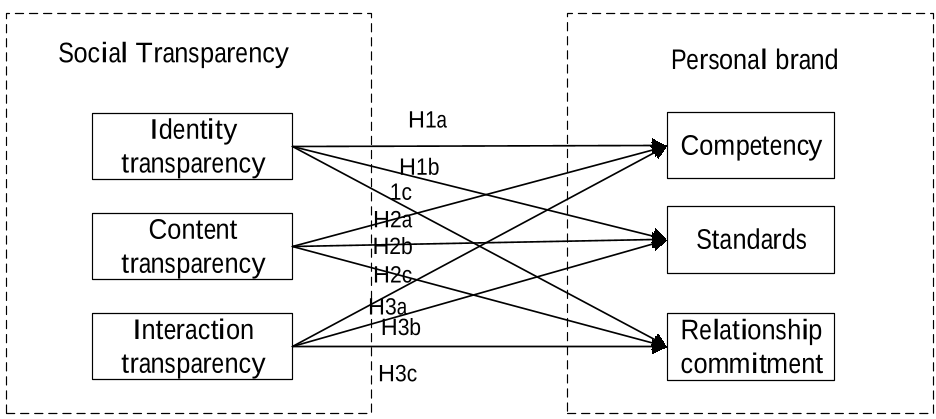
The Transparency Trinity
- Identity Transparency: Disclosing real names, hobbies, and education. The logic? More disclosure equals higher perceived credibility (H1a).
- Content Transparency: Showing the "provenance" or history of your posts. If people see how you created an idea (edit history, sources), they perceive you as an expert (H2a).
- Interaction Transparency: Making your interactions with others visible. Seeing how you talk to "third parties" helps others judge your role in a group (Leader vs. Follower) (H3b).
The Intuition: Why Transparency Works
The paper argues that in a virtual world, we cannot rely on physical cues. Therefore, we use "transparency" as a proxy for Accountability. When an individual reveals their background and the history of their ideas, they reduce "social loafing" and increase "trustworthiness."
For example, a blogger who shares the raw data and drafts of their research (Content Transparency) is branded as more competent than one who simply posts a polished summary without context.
Critical Analysis & Conclusion
Takeaway
The value of this paper lies in shifting the focus from Presentation to Provenance. It suggests that the most effective way to build a brand isn't by being "perfect," but by being "transparent."
Limitations
As a short paper, its primary limitation is the lack of empirical data. The model is theoretical and assumes that more transparency is always better. In reality, there is a "Privacy-Transparency Paradox" where over-disclosure might lead to negative brand perceptions or safety risks.
Future Outlook
As AI-generated content floods social networks, Content Transparency (verifying the origin of information) will likely become the most critical component of a personal brand. This model provides the groundwork for future researchers to measure exactly how much "proof of work" a creator needs to show to be considered an authority.