
Beyond Binary Ties: A Generative Model for Anthropologically Consistent Social Graphs
A Model to Represent Human Social Relationships in Social Network Graphs
The paper presents a generative model for synthetic human social network graphs that incorporates anthropological theories of ego networks. By integrating "triadic closure," "bridge" formation, and geographical constraints, the model reproduces both microscopic tie-strength properties and macroscopic small-world characteristics of real-world networks.
TL;DR
Human social networks are more than just nodes and lines; they are nested hierarchies shaped by cognitive limits and physical distance. This paper introduces a generative model that builds synthetic social graphs by combining Dunbar’s ego-network layers with global structural properties like triadic closure and geographical power-laws. The result is a weighted graph that mirrors real-world Facebook data in both its "small-world" nature and its internal relationship intensities.
Background: The Limits of Sociality
In the digital age, we often assume our social reach is infinite. However, anthropology suggests otherwise. Robin Dunbar’s research indicates that humans have a limited "cognitive budget" for relationships, resulting in a hierarchical structure:
- Support Clique (~5 people): High-intensity, high-contact.
- Sympathy Group (~15 people): Close friends.
- Active Network (~150 people): The "Dunbar Number" limit for stable social relationships.
Existing models (like Watts-Strogatz or Barabási-Albert) often ignore these internal weights or the cognitive costs of maintaining "edges," leading to synthetic networks that look like social networks but don't act like them in simulations of information spread or emotional closeness.
Methodology: Bridging Ego and Global Structures
The authors propose a dual-level approach:
1. The Single-Ego Model (Local)
Each node (ego) starts with a finite time budget. The algorithm populates the ego’s layers—from the support clique outwards—until the budget is exhausted. Relationship strength is converted into a "time cost," ensuring that an ego cannot have an infinite number of strong ties.
2. The Multi-Ego Model (Global)
To connect these individual ego networks into a global graph, the model uses two primary strategies:
- Triadic Closure: With probability , a node connects to a "friend of a friend" (closing a triangle), which increases the clustering coefficient.
- Bridging: With probability , a node creates a "bridge" to a random node, representing "weak ties" that connect distant parts of the network and reduce the average path length (the "Small World" effect).
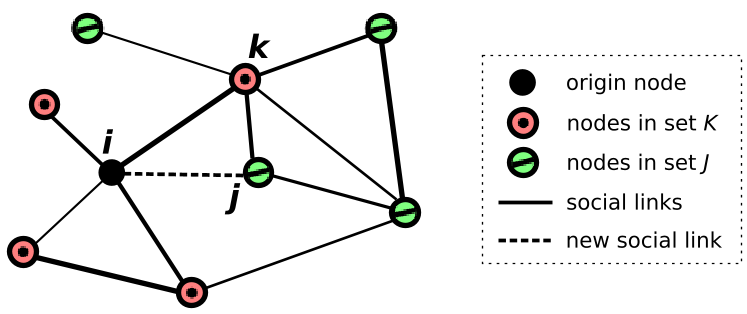 Figure 1: Comparison between Triadic Closure (left) and Bridging (right) mechanisms.
3. Geographical Constraints
Humans are more likely to befriend those nearby. The model incorporates a power-law decay for tie probability relative to distance, mirroring empirical observations in mobile call data.
Experimental Results & Validation
The researchers validated their model against a massive Facebook regional dataset (90k+ nodes, 1.2M+ links). By tuning the triadic closure probability () and the minimum distance threshold (), they achieved a near-perfect match for the Clustering Coefficient and Jaccard Similarity.
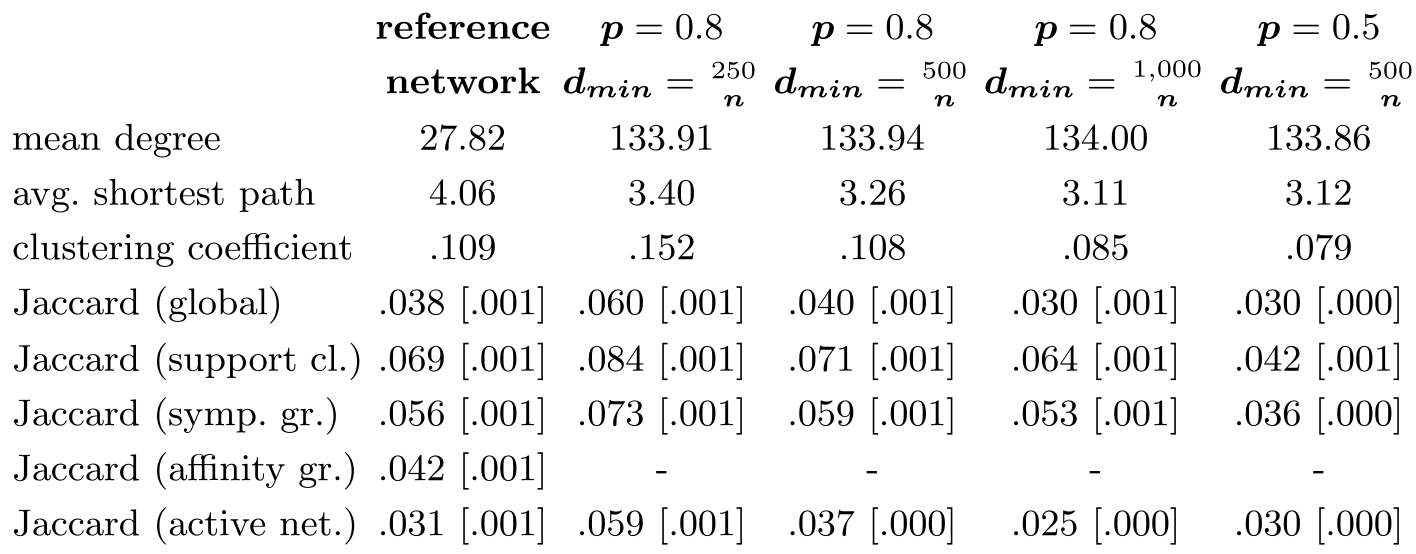 Table 1: Comparison of the reference network vs. generated networks under different parameters.
One of the most striking findings was the Jaccard Index analysis. In human networks, your strong friends (inner circle) share more mutual friends with you than your acquaintances do. As shown in the graph below, the model successfully captures this "Micro-Macro" correlation, where the similarity between ego networks drops as we move from the support clique to the active network.
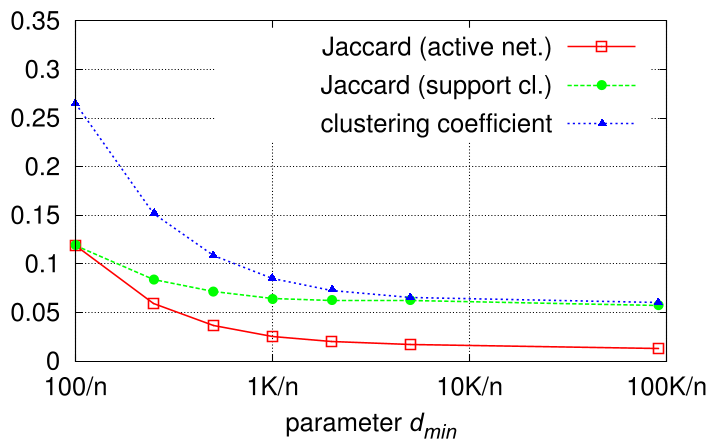 Figure 2: Impact of distance constraints and triadic closure probability on network similarity.
Critical Insight: Why This Matters
This work moves us away from "flat" network science toward socially-aware modeling.
- Inductive Bias: By baking anthropology (Dunbar layers) and physics (geography) into the generative process, the model achieves SOTA realism without needing massive amounts of training data.
- Practical Application: For those building decentralized social platforms or peer-to-peer (P2P) systems, this model provides a "test-bed" to see how protocols perform in a world where real human limits exist.
Conclusion
Conti et al. have provided a robust framework that proves a simple truth: the complexity of global social networks can be largely explained by local rules of cognitive capacity and a preference for closing triangles. While the model currently excludes the "affinity group" layer due to sparse literature, its modular design allows for future refinements as our understanding of digital sociology evolves.