
Beyond Homogeneity: Inferring Trust in Multi-Relational Social Networks
Towards a Model for Inferring Trust in Heterogeneous Social Networks
This paper introduces a novel framework for inferring trust in heterogeneous social networks by leveraging multiple types of relations (e.g., friendship, shared education) rather than relying on a single homogeneous link. The authors propose a Genetic Algorithm-based "Relation Extraction" method and a modified Dijkstra-based path-finding algorithm that integrates trust values and path lengths to outperform the state-of-the-art TidalTrust.
TL;DR
Trust isn't built on a single thread; it's a tapestry woven from various social relations. This paper moves away from traditional "homogeneous" trust models to a heterogeneous framework. By using a Genetic Algorithm for relation extraction and a modified Dijkstra's search for trust propagation, the authors significantly reduce prediction errors and computational complexity compared to the classic TidalTrust model.
Contextualizing Trust in the Social Matrix
In the digital age, trust and reputation are the primary currencies used to mitigate uncertainty. Most existing literature treats social networks as simple graphs where one type of link represents one concept. But in reality, your trust in a colleague might be a function of your shared university background, common interests in music, or professional overlap.
The authors argue that "Relation Extraction" is the key: taking these heterogeneous base relations and finding the specific combination that best approximates the "Hidden Trust Relation" requested by a user query.
Methodology: The Two-Pillar Approach
1. Relation Extraction via Genetic Algorithms (GA)
The goal is to find a linear combination of weight matrices that best estimates a target matrix (the provided query). While traditional regression is limited by query size and high complexity (), the GA approach offers:
- Scalability: complexity makes it suitable for networks with thousands of base relations.
- Interpretability: By constraining the solution to non-zero coefficients, the model identifies the most impactful factors (e.g., "Nationality" matters for trust, but "Gender" might not).
(Note: Refer to Section 3.1 & 3.2 for the optimization of Frobenius norms in relation extraction.)
2. The Trust Propagation Algorithm
Once the relations are extracted, the network may still have gaps where no direct link exists. The authors improve upon the Tidal algorithm by modifying Dijkstra’s path discovery. Instead of just looking for the shortest path, they define the path cost as:
This formula creates a sophisticated balance: it penalizes long paths (due to the product of weights ) but favors paths with high-intensity trust clusters.
Experimental Performance
The authors validated their claims using a FOAF (Friend Of A Friend) network with 27 specialized communities (e.g., Java developers).
Key Benchmarks:
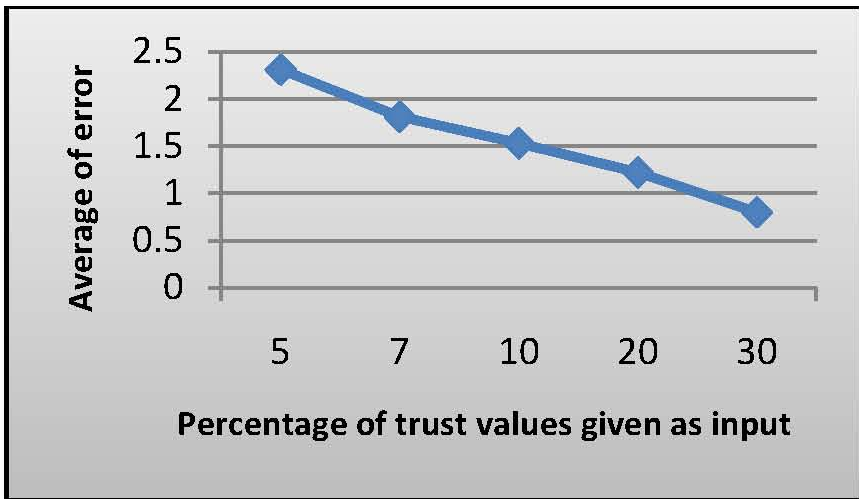
- Error Rate: With only 10% of trust data known, the proposed model achieved an average error of 1.53, vs 1.92 for Tidal Trust.
- Scalability: The GA crossover and mutation operators allow the system to handle 2200+ relations far more efficiently than standard regression.
Deep Insights & Future Outlook
This work highlights a critical shift in social computing: Heterogeneity is a feature, not a bug. By allowing the "User Query" to guide which relations matter, the model moves toward a personalized trust metric.
Limitations & Future Work: While a linear combination of matrices is a strong start, the authors acknowledge that logical operators (e.g., Trust = (NOT same gender) AND (same education)) might provide better fit for specific tasks like matrimonial suggestions or high-stakes financial communities. The next frontier involves Multi-objective Trust, where trust values differ based on the specific action being assessed (e.g., trusting someone for a coding review vs. a financial loan).
Takeaway
If you're building recommendation engines or decentralized reputation systems, the lesson here is clear: don't look at links in isolation. The intersection of diverse social behaviors holds the most accurate signal for trust.