
Turning Social Networks into Markets: An Economic Incentive for Opportunistic Forwarding
Using the Model of Markets with Intermediaries as an Incentive Scheme for Opportunistic Social Networks
This paper introduces an economic-inspired incentive scheme for Opportunistic Social Networks (OSNs) based on the "Model of Markets with Intermediaries." By treating message forwarding as a trade involving virtual or real currency, the authors propose the Ranger Algorithm for broker selection to optimize message dissemination performance.
TL;DR
To solve the "selfish node" problem in Opportunistic Social Networks (OSNs), this paper introduces a market-based incentive scheme where users act as traders (brokers) earning virtual currency for forwarding messages. By utilizing a new broker selection method called the Ranger Algorithm, the system significantly improves offline social activity organizing efficiency without relying on cellular data or centralized servers.
Problem & Motivation: The Reality of Social Selfishness
Opportunistic Social Networks (OSNs) leverage short-range communication (like Bluetooth) to spread information. While theoretically powerful for organizing campus events or offline meetups, they face a critical bottleneck: User Selfishness.
In the real world, nodes (phones) have limited resources. Users are often unwilling to drain their battery or occupy memory for strangers. Prior works attempted to use "Reputation Systems" (monitoring neighbors) or "Virtual Currency" (tamper-resistant hardware), but these solutions often introduced high overhead or hardware constraints. This paper asks: Can we make message forwarding a profitable game for the user?
Methodology: The Market with Intermediaries
The authors treat message dissemination as a three-player market:
- Sellers (Senders): Holders of the message who value it at a certain price.
- Buyers (Receivers): Users interested in the content who are willing to "buy" the message.
- Traders (Brokers): The core of the system. They "buy" at a bid price from the sender and "sell" at an ask price to the buyer, pocketing the difference as profit.
The Ranger Algorithm
Not all traders are equal. To ensure the market is "richly connected," the authors propose the Ranger Algorithm to find the most efficient intermediaries. A "Ranger" is defined by four metrics:
- Cross-community interaction: Meeting people outside their immediate circle.
- High mobility: High total number of unique encounters.
- High probability: Reliable future meeting potential.
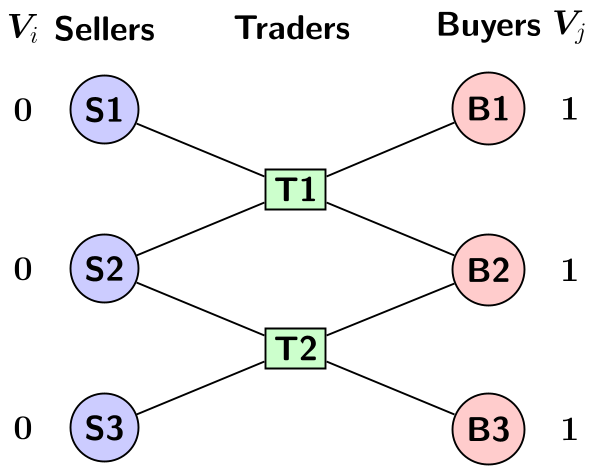 Figure 1: The mapping of Sellers, Buyers, and Traders in the market model.
Experiments & SOTA Comparison
The authors validated their model using the MIT Reality Mining Dataset, focusing on 83 users over 12 weeks. They compared the Ranger Algorithm against common baselines:
- Popularity-based: Nodes with the most total contacts.
- Social-tie-based: Nodes that are friends with the targets.
- Random: Baseline selection.
Key Findings
The "Ranger" approach consistently produced higher connectivity (B-T and S-T connections). This richness in connectivity is the bedrock of a healthy market—the more connections a trader has, the higher the social welfare and the more likely the message reaches the destination.
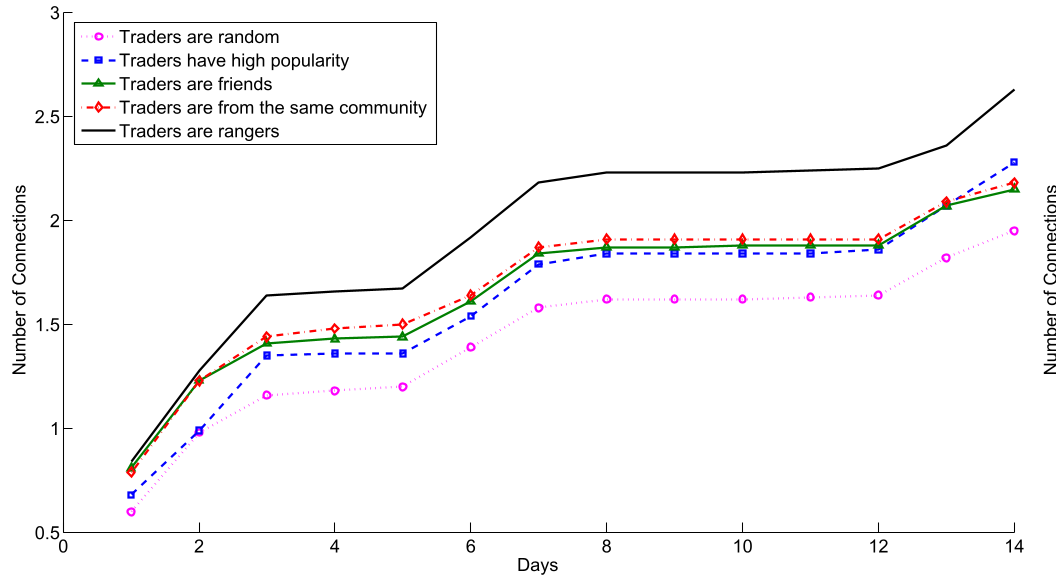 Figure 2: Performance comparison showing Rangers generating the most robust connections.
Critical Analysis & Conclusion
Takeaway
The genius of this work lies in its incentive alignment. Instead of punishing nodes for being selfish (reputation systems), it rewards them for being active "brokers" of information. By using Rangers, the network optimizes for "boundary spanners"—people who bridge different social communities.
Limitations
- Two-Stage Limitation: The current model assumes a simple Sender-Broker-Receiver chain. Real OSNs often require multi-hop paths where the pricing logic becomes exponentially more complex.
- Currency Stability: The paper mentions virtual currency but doesn't detail how to prevent inflation or forge transactions in a decentralized environment.
Future Outlook
As edge computing and decentralization become more prominent, market-based mechanisms like this could become the standard for "Zero-Trust" networking where cooperation cannot be assumed by default.