
Predicting Customer Value: The Convergence of Product R&D and Marketing Strategy
A model for predicting customer value from perspectives of product attractiveness and marketing strategy
This paper introduces a multi-modular CRM framework that integrates System Dynamics and Markov Chain models to predict Customer Lifetime Value (CLV). By combining product attractiveness and marketing strategy parameters, the model forecasts long-term financial returns and optimizes customer acquisition and retention strategies.
TL;DR
This study bridges the gap between engineering-led product development and marketing-led customer management by proposing a simulation-based model. By utilizing System Dynamics and Markov Chains, the researchers provide a tool that predicts how product design, quality, and marketing spend coalesce into long-term financial returns. It shifts CRM from a reactive database task to a proactive strategic simulation.
The Missing Link: Why Product Design is a CRM Variable
Most Customer Relationship Management (CRM) tools are essentially glorified ledgers—focused on "what" the customer bought and "when." However, they often ignore the "Why." The authors argue that customer retention is not just a result of good emails or loyalty points, but a direct consequence of Product Attractiveness (Design, Quality, Price).
The core friction in existing literature is the siloed nature of departments: Marketing focuses on "Adoption from Advertising," while R&D focuses on "Performance Metrics." This paper integrates these into a single feedback system, recognizing that the "Experience" after the first purchase determines whether a customer migrates from a "First-Time" state to an "Active" state.
Methodology: A Three-Module Architecture
The researchers utilize iThink, a software based on System Dynamics, to model the flow of customers through three distinct modules:
- Customer Purchasing Behavior Model: This treats the customer base as a "stock" that flows through segments (Potential → First-Time → Active) based on "rates" influenced by marketing effectiveness and product scores.
- Markov Chain Model: The results from the simulation are fed into a transition matrix. This calculates the probability of a customer staying active or churning, eventually leading to a discounted Customer Lifetime Value (CLV).
- Financial Returns Model: This module translates the CRM metrics into a bottom-line Gross Profit figure, enabling executives to see the direct ROI of tweaking a product’s design or an advertising budget.
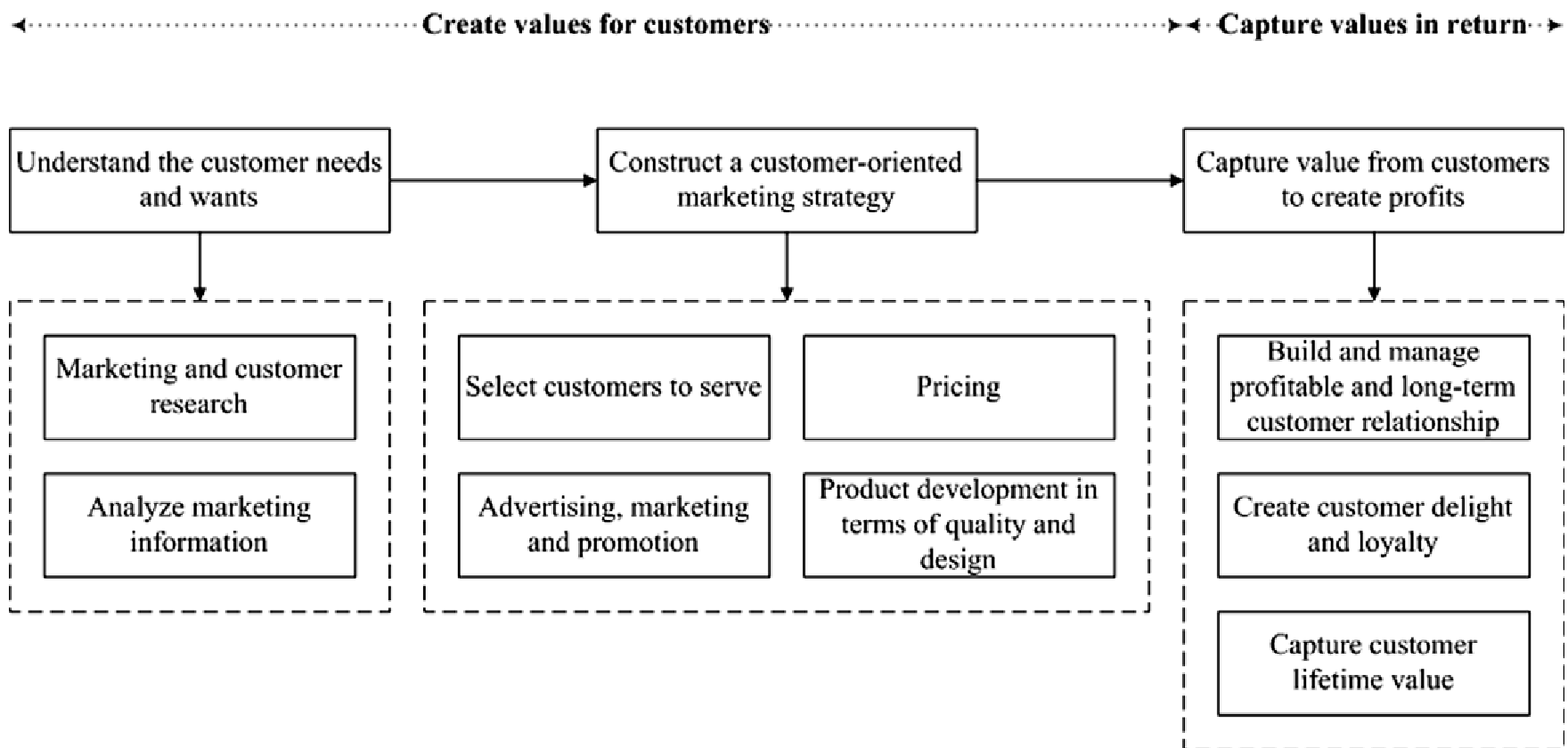 The interaction between value creation (Product/Marketing) and value capture (CLV/Profit).
Strategic Insights from the Case Study
The model was tested using data from a $3.2 billion turnover firm in Hong Kong. The simulation yielded non-obvious strategic insights:
- The 3-Quarter Peak: First-time customers are most active in the first nine months. After this, the efficacy of mass advertising drops significantly.
- Retention over Acquisition: The transition matrix confirmed that the CLV of an "Active" customer (~572).
- Strategic Pivot: The results suggested the firm should pivot from "Mass Advertising" to "Membership/Face-to-Face Marketing" specifically during the second and third years post-launch to maximize the "Active Customer" stock.
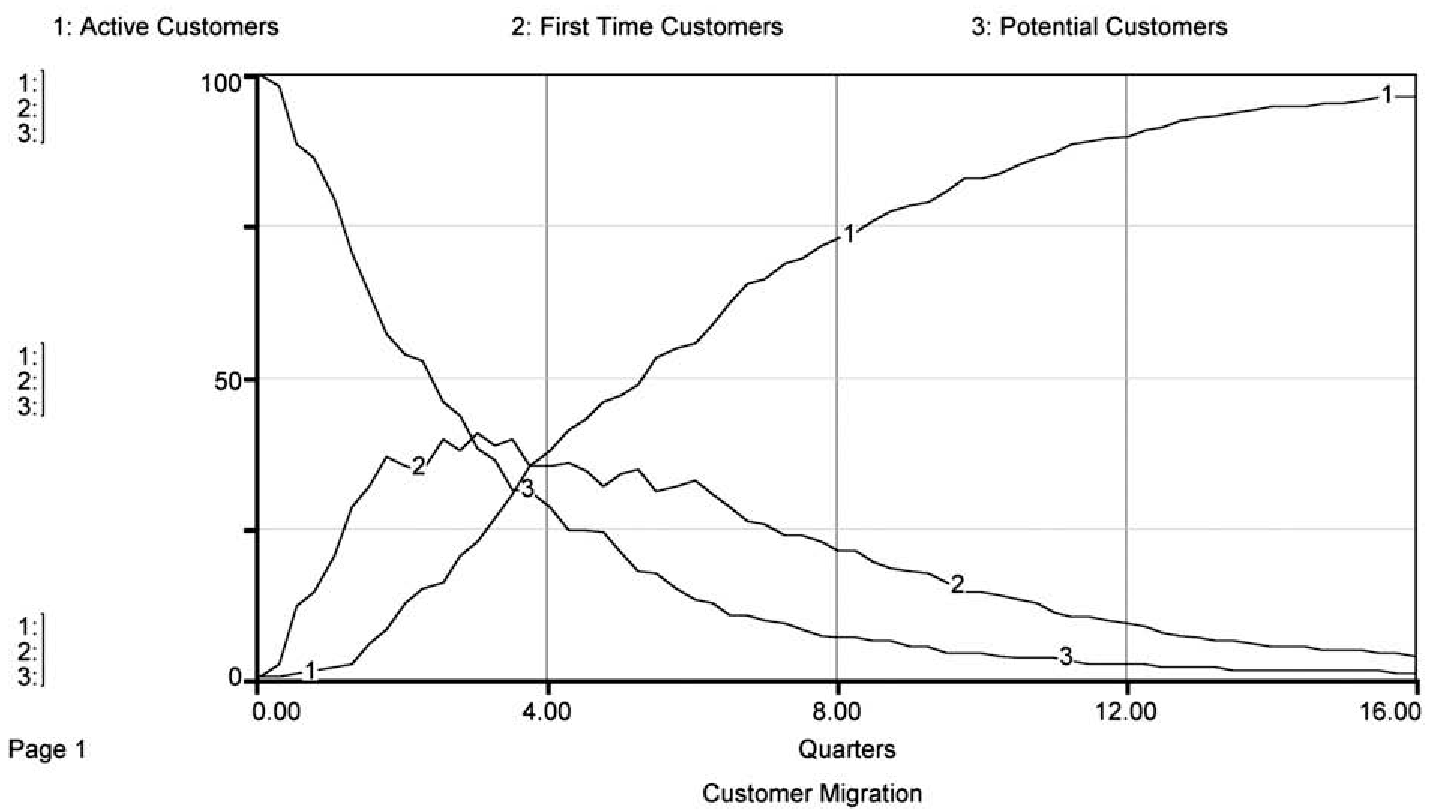 Visualizing Customer Migration: The flow from Potential to Active segments over 16 quarters.
Critical Analysis & The Future of CRM
The main contribution of this paper is the Visual Interface Layer, which allows non-technical managers to use sliders to adjust "Design Importance" or "Marketing Effectiveness" and see immediate impacts on 6-year profit projections.
Limitations
- External Factors: The model assumes a degree of environmental stability and does not fully account for aggressive competitor price wars or black swan technological shifts.
- Data Sensitivity: The accuracy of the Markov transition probabilities relies heavily on the quality of the initial customer surveys.
Future Outlook
The next step for this research involves integrating Real-time Big Data into the System Dynamics model. Instead of static survey data, feeding live sentiment analysis from social media or usage telemetry from IoT-connected products could turn this into a "Digital Twin" of a firm's market presence.
Conclusion
By treating CRM as a dynamic system rather than a static database, this model proves that "Value" is a generated property. Firms that succeed in the future will be those that can simulate the delicate balance between the attractiveness of what they make and the effectiveness of how they sell it.