
Model Smoothing via VAT: Enhancing Robustness in Speech Emotion Estimation
Model Smoothing Using Virtual Adversarial Training for Speech Emotion Estimation
This paper introduces a robust speech emotion estimation model utilizing Virtual Adversarial Training (VAT) to address data scarcity and cross-corpus performance degradation. By applying local distributional smoothing to a DNN-based regression task, the method achieves improved generalization across different languages and recording environments.
TL;DR
Recognizing human emotions through speech is notoriously difficult when the AI encounters a speaker from a different culture or a recording from a new environment. This paper proposes a Virtual Adversarial Training (VAT) framework to smooth the model’s decision boundaries. By simulating "worst-case" perturbations during training, the model learns to be less sensitive to noise and domain shifts, resulting in superior performance in cross-lingual (English to Japanese) emotion estimation.
Problem & Motivation: The "In-the-Wild" Challenge
Deep learning has pushed the boundaries of speech emotion recognition, but it remains fragile. Most models are trained on specific corpora (like IEMOCAP), and when deployed in different environments—characterized by different languages, microphone quality, or cultural expressions—their accuracy plummets.
The authors identify two core bottlenecks:
- Data Scarcity: Creating high-quality labeled speech corpora is expensive and time-consuming.
- Domain Sensitivity: Prior work shows that models often overfit to the specific "manifold" of the training corpus, failing to generalize to the subtle nuances of different languages.
The research intuition here is: Can we make the model "smoother"? If a small change in input (acoustic noise or cultural variation) leads to a massive jump in the estimated emotion, the model is not robust. VAT is the chosen tool to enforce this smoothness.
Methodology: Adversarial Smoothing for Regression
The core of the paper is the application of Virtual Adversarial Training (VAT). Unlike standard Adversarial Training (AT), which requires labels to generate perturbations, VAT is "virtual"—it uses the model's own output distribution.
From Classification to Regression
Standard VAT was designed for classification (minimizing KL divergence between probability distributions). For emotion estimation (a regression task), the output is a continuous value (e.g., Valence 1.0 to 5.0).
The authors bridge this gap by defining a normal distribution centered at the model output with a variance of 1. They then seek a perturbation that maximizes the KL divergence between the original prediction and the perturbed prediction:
This perturbation is then added to the training loss as a regularization term, forcing the model to yield similar outputs for similar (but slightly perturbed) inputs.
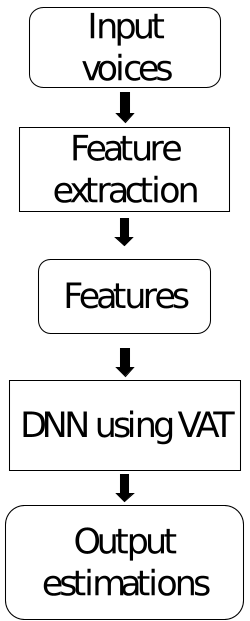 Fig 1. The overall system pipeline: from feature extraction (OpenSMILE) to the VAT-augmented DNN.
Experiments & Results
The authors utilized 384-dimensional acoustic features (MFCCs, Energy, F0, etc.) from the INTERSPEECH 2009 challenge.
1. Fine-tuning Hyperparameters
Through a single-corpus study on the IEMOCAP dataset, the authors found the "sweet spot" for two critical parameters:
- (Adversarial Weight): Set to 1.5. Too high a value disrupts the original learning objectives.
- (Perturbation Magnitude): Set to 1.5. If the noise is too large, it results in "excessive smoothing," which harms accuracy.
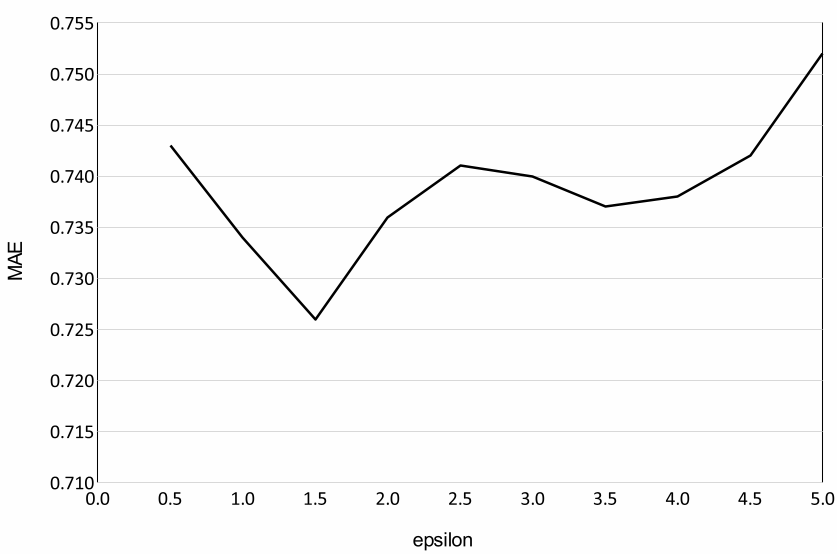 Fig 2. The impact of perturbation magnitude () on Mean Absolute Error (MAE).
2. Cross-Corpus Performance (The Real Test)
The model trained on English (IEMOCAP) was tested on Japanese (UU Database).
- Valence (Positive vs. Negative): VAT improved MAE from 0.7011 to 0.6964.
- Dominance (Submissive vs. Dominant): VAT improved MAE from 0.7243 to 0.7180.
- Activation (Passive vs. Excited): Performance was nearly identical, suggesting that activation cues might be more universal and less influenced by the "smoothing" of linguistic differences.
| Metric | DNN (Baseline) | DNN + VAT |
|---|---|---|
| Valence MAE | 0.7011 | 0.6964 |
| Dominance MAE | 0.7243 | 0.7180 |
Critical Analysis & Conclusion
Takeaway
The study demonstrates that VAT is a viable strategy for enhancing the robustness of speech-based regression models. By smoothing the output manifold, VAT effectively acts as a bridge between disparate datasets (English vs. Japanese), reducing the "culture gap" that often plagues emotion AI.
Limitations & Future Work
While the results are promising, the improvements are marginal in some dimensions (like Activation). The authors acknowledge that a simple 2-layer DNN might not capture the complex temporal dynamics of speech as well as an RNN or Transformer. Additionally, using a fixed variance of 1 for the KL-divergence normal distribution is a simplification; future work should explore dynamic variance to better reflect the model's confidence.
Overall, this research highlights the power of semi-supervised adversarial regularization in making AI more resilient to the unpredictable nature of human communication.