
Beyond Friendship: Decoding the Social Communication Network (SCN) of Modern Messengers
A Model for Social Communication Network in Mobile Instant Messaging Systems
This paper introduces the Social Communication Network (SCN) model, a metagraph-based framework designed to represent communication in Mobile Instant Messaging (MIM) systems like Telegram and WhatsApp. Unlike traditional social networks, the SCN captures interactions mediated by groups and channels, achieving high compatibility with real-world data through specialized generation algorithms for person-to-person, group, and channel contacts.
TL;DR
Mobile Instant Messaging (MIM) has outgrown the traditional "friendship graph" model. This paper proposes the Social Communication Network (SCN)—a metagraph-based framework that accounts for groups and channels as primary nodes. By redefining network metrics and introducing biologically-inspired generation algorithms, the authors create a model that mirrors real-world Telegram data with remarkable precision.
Background: The Graph That Failed
For decades, we’ve modeled social networks using simple graphs: nodes (people) connected by edges (friendships). However, if you are in a Telegram group with 500 strangers, you are communicating with them despite having no "friendship" edge. Traditional models like Barabási-Albert (BA) or Watts–Strogatz (WS) cannot represent this "set-to-set" communication. This paper argues that MIM is a hybrid—part social network, part broadcasting media.
Methodology: The Power of the Metagraph
The core innovation is the use of Metagraphs. Unlike a standard graph where an edge connects two points, a metagraph edge can connect a set of nodes to another set.
1. The Trinity of Contacts
The authors categorize all MIM interactions into three types:
- PP (Person-Person): Direct one-to-one messaging.
- GP (Group-Person): Multi-directional interactions within a closed set.
- CP (Channel-Person): One-to-many broadcasting (Admins to Subscribers).
2. Redefining Network Metrics
Because groups bridge strangers, the authors introduce:
- Codegree: A user's influence isn't just their contacts, but the sum of members in all groups/channels they reach.
- Communication Path: The "distance" between users is measured by how many groups or direct hops a message needs to traverse.
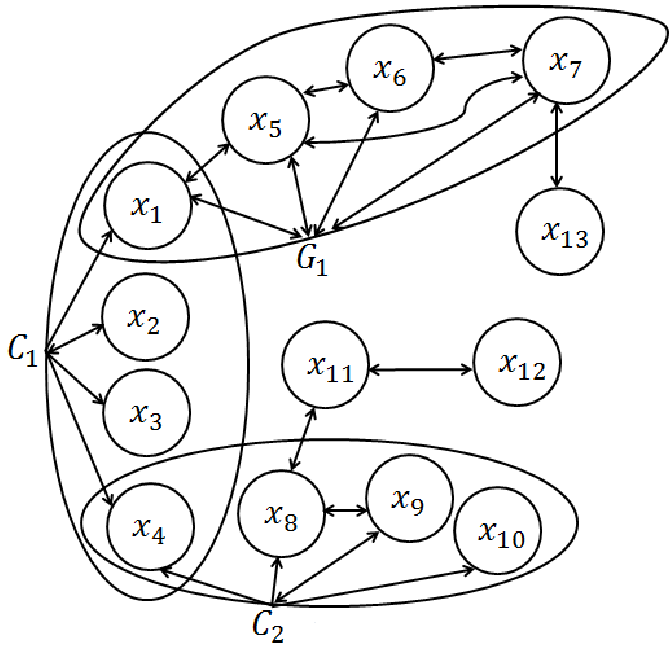 Figure: The SCN captures how user x2 can reach x13 through a channel and a group, even without a direct link.
The Generation Engine
To simulate a realistic SCN, the authors designed a three-headed algorithmic approach:
- Generate-PP: Builds "islands" of trees and then merges them, simulating how real-world communities form and eventually connect.
- Generate-GP: Uses a "friend-of-friend" invitation logic—the more friends you have in a group, the more likely you are to join.
- Generate-CP: Follows a "rich-get-richer" preferential attachment—large channels naturally attract more subscribers.
Experimental Results: Real-World Validation
The authors didn't just theorize; they built a Telegram Bot to crawl real interaction data. Comparing their synthetic SCN to reality, the results were striking:
- Degree Distribution: The power-law curves of the model matched Telegram's real data across multiple scales.
- Modularity: The model achieved modularity scores (approx. 0.95), proving it captures the "clumpy" nature of human groups.
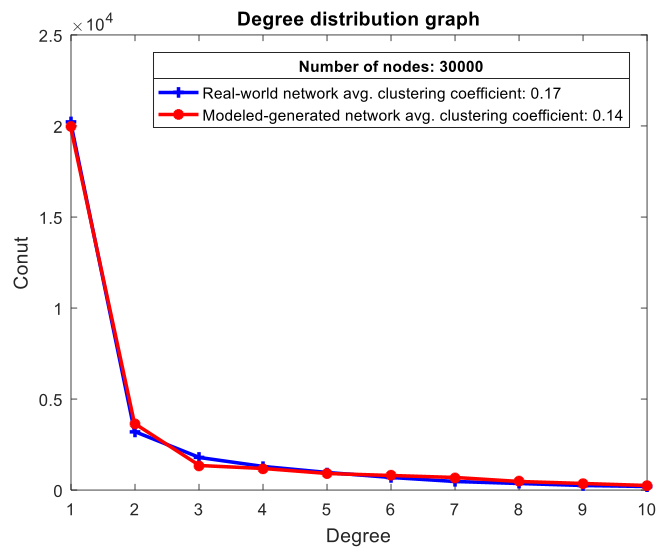 Figure: The model-generated degree distribution (right) closely tracks the real-world Telegram data (left).
Critical Insight: Why This Matters
The shift from "Networking" to "Communication" is pivotal. In a world where rumors and misinformation spread via encrypted groups (WhatsApp) and public channels (Telegram), we need the SCN model to predict Information Diffusion.
Takeaway: If you are analyzing a modern chat platform, stop looking for "friends." Look for the Communication Paths created by the groups they inhabit.
Future Outlook
While highly effective, the model currently struggles to capture private group data (due to privacy limitations in crawling). Future work aims to apply this SCN framework to Rumor Control—identifying which "Group-Betweenness" nodes to block to stop a viral lie in its tracks.