
Engineered Virality: A Deep Dive into Social Network Challenge Modeling
Modeling and Analyzing Engagement in Social Network Challenges
This paper presents a comprehensive model and analysis for managing "Social Network Challenges" designed to boost brand engagement through user-generated content. Utilizing the YourExpo2015 case study, the authors demonstrate how a structured interplay between managers, players, fans, and owners across multiple social platforms (Instagram and Facebook) can maximize participation and content creation.
TL;DR
Building a successful social media challenge isn't just about a catchy hashtag. This paper deconstructs the mechanics of YourExpo2015, proving that high-level engagement is a product of structured Staging, Social Amplification, and the strategic interplay between four specific actor roles. By shifting from simple "announcements" to "award-driven" interactions, the experiment mobilized hundreds of thousands of users over nine weeks.
Problem & Motivation: Beyond the Hashtag
Most brands treat social challenges as a "post and pray" endeavor. However, the authors argue that the lack of a formal model leads to wasted resources and low conversion from "fans" to "players." The core difficulty lies in the Inductive Bias of participants: users are hesitant to contribute original content without proof of visibility or social reward.
The authors' insight was to treat the challenge not as a single event, but as a Staged System. They recognized that for a challenge to thrive, it requires a "Manager" to set rules and an "Owner" (a high-visibility entity) to provide the initial momentum that a lone manager cannot achieve.
Methodology: The Framework of Interaction
The paper formalizes the "Content Production Challenge" through a model that balances hierarchy with social fluidity.
1. The Actor Model
The research identifies a four-tier architecture:
- Manager: The operational logic (setting rules, monitoring).
- Player: The engine of content (submitting media).
- Fan: The validation layer (voting and liking).
- Owner: The visibility catalyst (celebrities or official brand accounts).
2. Action Flow and Staging
Instead of a linear timeline, the authors propose a cyclical structure. By repeating challenges and sub-structuring them into phases (e.g., Weekly Hashtags), they built loyalty.
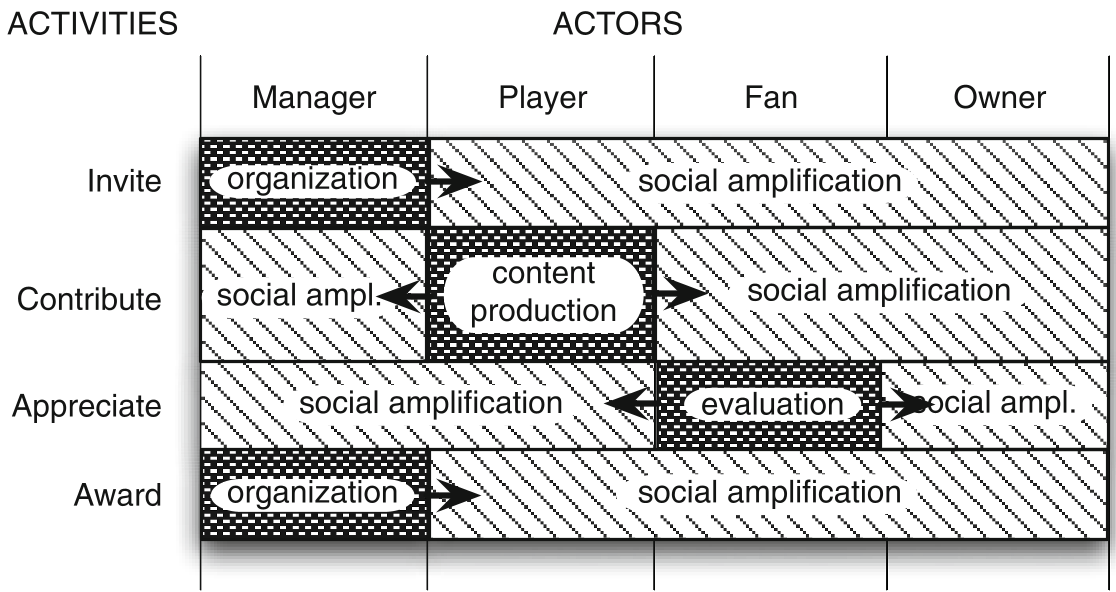
The methodology also emphasizes Cross-Social Network Fertilization. Players might post on Instagram, but the final voting and "Wall of Fame" recognition occurs on Facebook, forcing a multi-platform footprint that maximizes the brand's reach.
Experiments & Results: What Actually Drives Participation?
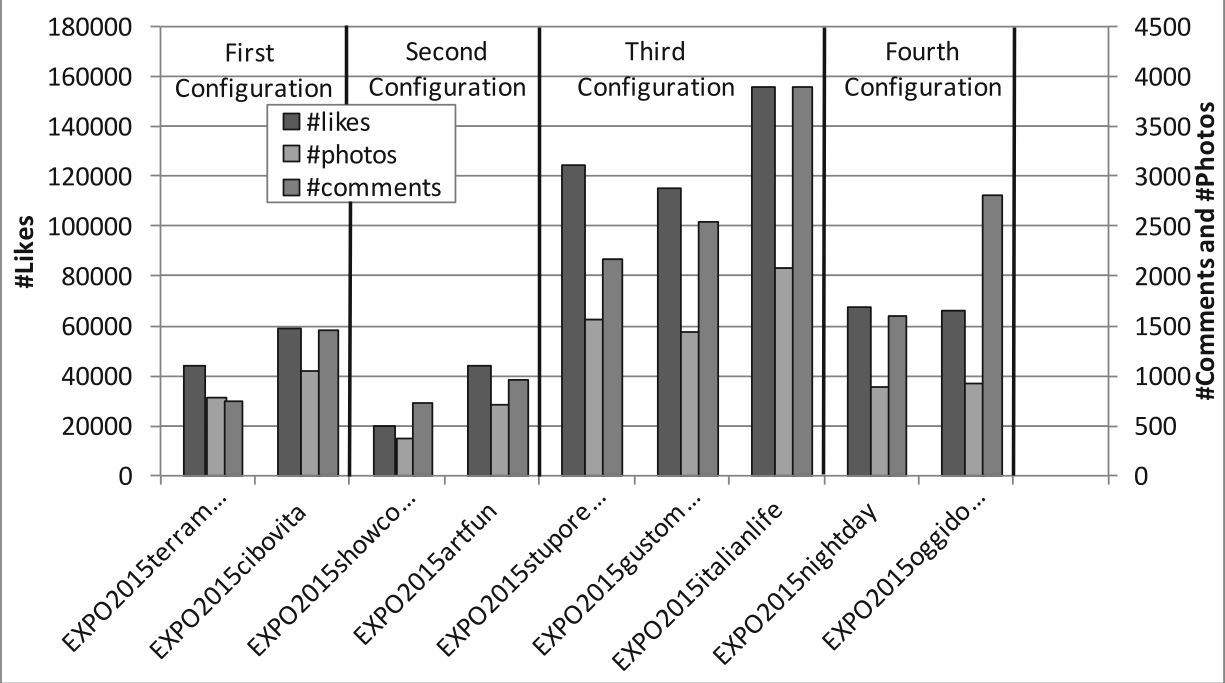
The researchers tested four configurations across the YourExpo2015 campaign.
The Power of Recognition
The data shows that "Award" actions (Finalists and Winners announcements) generated the highest peaks of engagement. Users are more likely to interact when they or their peers are publicly recognized.
- Insight: Mentioning four players together in a "Composite" post was more effective than individual mentions because it sparked interaction between the mentioned players.
The "Owner" Effect
As seen in the comparison of configurations, the involvement of the "Owner" (the official Expo 2015 account) was the single greatest predictor of success.
Temporal Dynamics (Daytime Influence)
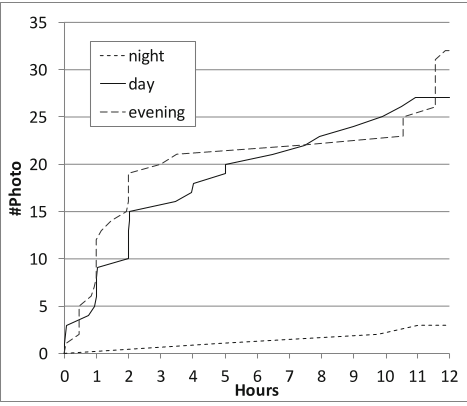
The study highlights that high-demand actions (like posting content) are highly sensitive to the time of day, whereas "low-effort" actions (likes) occur consistently across all waking hours. Managerial actions (like "follows") performed at night had almost zero immediate return compared to daytime pushes.
Deep Insight & Conclusion
Takeaways
- Gamification works, but Socialization works better: The strongest driver wasn't just the desire to win, but the formation of a social sub-network within the challenge.
- Managerial Reciprocity: Automated actions (likes/follows from the manager) are highly effective in the early stages of a user's lifecycle but have diminishing returns.
- Ownership Matters: You cannot "grow" a challenge from zero without a high-visibility catalyst (The Owner).
Limitations & Future Work
The study noted that while Instagram and Facebook were highly effective for visual content, Twitter failed to gain traction in this specific context because the challenge lacked the "real-time breaking news" element that Twitter users crave. Future research should investigate how these models adapt to short-form video algorithms (TikTok/Reels) where the "Manager" role is often replaced by an AI recommendation engine.
Final Thought
Engagement is not a lucky break; it’s an architecture. By treating social challenges as structured, multi-actor ecosystems, brands can move from being "broadcasters" to "community architects."