
Modeling Anomalous Attention: A Computational Approach to Detecting Cyberstalkers
Modeling anomalous attention over an online social network through read/post analytics
This paper introduces a formal behavioral model to detect anomalous attention (cyberstalking) in online social networks (OSNs). It proposes the "Anomaly Index," a metric derived from read/post analytics and network topology, achieving clear separation between benevolent users and stalkers in simulated environments.
TL;DR
Online social networks (OSNs) have a dark side: they provide tools for "stealthy and persistent pursuit"—otherwise known as cyberstalking. Unlike traditional security research focusing on bots or spam, this paper by Zhang and Liu introduces a formal mathematical framework to quantify Anomalous Attention. By analyzing what users read versus what they post, and passing this through a PageRank-style network analysis, the authors can distinguish between a friendly follower and an obsessive watcher with high precision.
1. The Challenge of "Invisible" Surveillance
Detecting a stalker in the physical world is intuitive: they are physically present. In the digital world, the "watcher" may never "like" a post or leave a comment. They simply consume.
Current detection methods are often limited to profiling—guessing who might be a stalker based on demographics. This paper argues that behavior is a much better signal. However, digital behavior is tricky because:
- Victim-Definition: What one person sees as "affectionate interest," another sees as "intimidation."
- Indirection: Stalkers may follow a target's friends to gather info about the target indirectly.
- Stealth: Reading logs are often invisible to the public, though accessible to network providers.
2. The Methodology: Measuring the "Attention Gap"
The authors propose two primary metrics to bridge the gap between simple activity and obsessive behavior.
Phase A: Message-based Attention (M-index)
First, they calculate the Jaccard similarity between Agent A's reading logs and Agent B's posts. If Agent A reads almost everything Agent B writes, the M-index is high.
Phase B: Link-based Attention (The PageRank Twist)
Because information diffuses through networks, a watcher might monitor a target's neighbor to find out about the target. The authors use a Transition Matrix where attention is distributed not just by direct reads, but by following edges in the social graph.
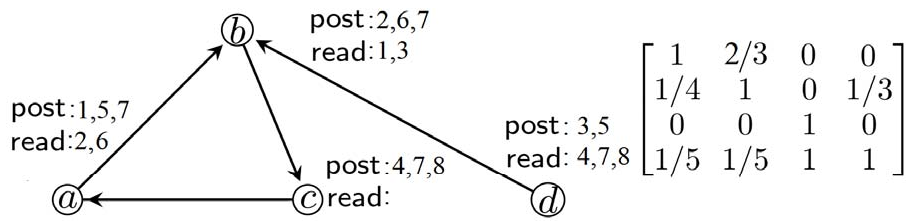 Fig 1: A network abstraction showing the relationship between message posting and social ties.
3. Defining the Anomaly Index
To move from "attention" to "anomalous attention," the model looks for three traits:
- Obsessive: The attention A pays to B is much higher than what B typically receives from the average user.
- Unreciprocated: A watches B, but B does not watch A back.
- Persistent: This unreciprocated attention lasts and accumulates over time.
The Anomaly Index () uses a diminishing effect where recent behavior carries more weight, but a history of stalking behavior builds a cumulative score that eventually diverges toward infinity for true watchers.
4. Experimental Evidence: Spotting the Watcher
The authors tested their model against three types of network structures: Erdős-Rényi (ER), Scale-Free (SF), and Watts-Strogatz (SW).
The results were striking. In all scenarios, the "Watcher" (the agent intentionally programmed to consume a target's info) was clearly identifiable. As shown in the simulation plots below, while benevolent users' indices remained low and fluctuating (the noise near the bottom), the watcher's index climbed steadily.
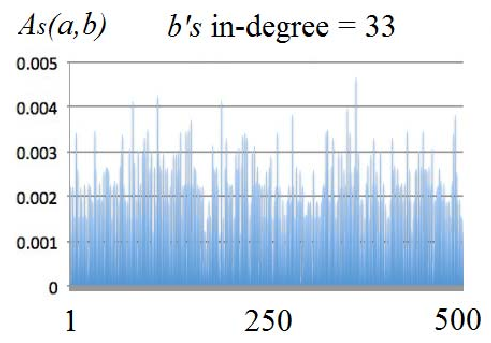 Fig 2: Anomaly index vs. Time. The blue/red lines represent ordinary users, while the diverging line represents the watcher.
Key Insights from Experiments:
- Scale-Free Influence: In SF graphs, "influencers" (high in-degree) naturally receive more attention, but the Relativized Attention metric successfully normalized this, ensuring popular people aren't wrongly flagged as victims unless the attention is uniquely unreciprocated.
- Network Density: While denser networks lower the overall anomaly index (due to higher global average attention), the gap between a stalker and a normal user remains significant.
5. Critical Analysis & Future Outlook
This paper provides a robust mathematical foundation for a problem that was previously relegated to the realm of psychology or sociology. By treating attention as a network flow problem, it opens the door for OSN providers to build automated "Safe Mode" triggers.
Limitations:
- Data Access: This model requires access to reading logs (clicks/views), which are high-volume and often siloed.
- Topic Neglect: The current model treats all messages as equal. Future iterations should incorporate NLP to see if the watcher is focusing on specific "high-risk" topics like location or personal routine.
Takeaway: The "Anomaly Index" is a powerful potential tool for digital safety. It proves that even when someone thinks they are invisible, their patterns of consumption leave a mathematical fingerprint.