
DuoNN: Bridging the Gap Between Machine Logic and Human Emotion
Modeling cognitive and emotional processes: A novel neural network architecture
The paper introduces the DuoNeural Network (DuoNN), a novel architecture featuring "DuoNeurons" that integrate cognitive and emotional processing at the structural level. Applied to face recognition tasks, DuoNN mimics the brain's dorsal and ventral streams to achieve superior recognition rates and faster convergence compared to existing emotional neural networks.
TL;DR
Researchers have long sought to replicate the human brain's ability to balance cold logic with emotional intuition. This paper introduces the DuoNeural Network (DuoNN), an architecture that literally embeds "emotions" into neurons. By splitting information into dorsal (cognitive/local) and ventral (emotional/global) streams, DuoNN achieves higher accuracy and significantly faster training than traditional neural networks in face recognition tasks.
Executive Summary
Modern AI often treats emotion as an afterthought—an external layer or a post-processing step. Adnan Khashman’s work challenges this by proposing that emotion and cognition are separate yet inseparable. DuoNN is more than just a mathematical tweak; it is a structural redesign of the hidden layer, utilizing a novel "DuoNeuron" to simulate the parallel processing pathways of the human visual cortex.
Problem & Motivation: The Silo of Logic
The fundamental "pain point" in classical neural networks is their lack of global context during local feature extraction. Humans don't just see pixels; we see patterns that trigger emotional weights—factors like "confidence" when a face is familiar or "anxiety" when data is ambiguous.
Prior works, such as the Emotional Back Propagation (EmBP) algorithm, introduced emotional coefficients to the learning rate, but the structure of the network remained standard. Khashman argues that for a machine to truly "perceive," it needs a functional mechanism that mirrors the brain's Ventral (what/emotion) and Dorsal (where/cognition) streams.
Methodology: The Architecture of Feeling
The heart of this work is the DuoNeuron. Unlike a standard sigmoid neuron, a DuoNeuron contains two sub-units:
- Dorsal Neuron (): Processes local segmented blocks of an image (Cognitive Stream).
- Ventral Neuron (): Processes the accumulated global average of the entire image (Emotional Stream).
The Emotional Engine
DuoNN updates its weights using two dynamic parameters:
- Anxiety (): Driven by the error signal. High error at the start leads to high anxiety, forcing the network to pay more attention to pattern averages.
- Confidence (): Developed as anxiety decreases. It acts as an "intelligent inertia," trusting previous weight changes as the model stabilizes.
Experiments: Superior Recognition
The model was tested against the ORL Database of Faces (400 images). The comparison was held against the then-SOTA emotional model, EmBP.
Key Results:
- Accuracy: DuoNN reached 92% on unseen test data, while EmBP lagged at 84.5%.
- Efficiency: DuoNN required only ~5,820 iterations to converge, making it 3.64 times faster than the baseline (21,183 iterations).
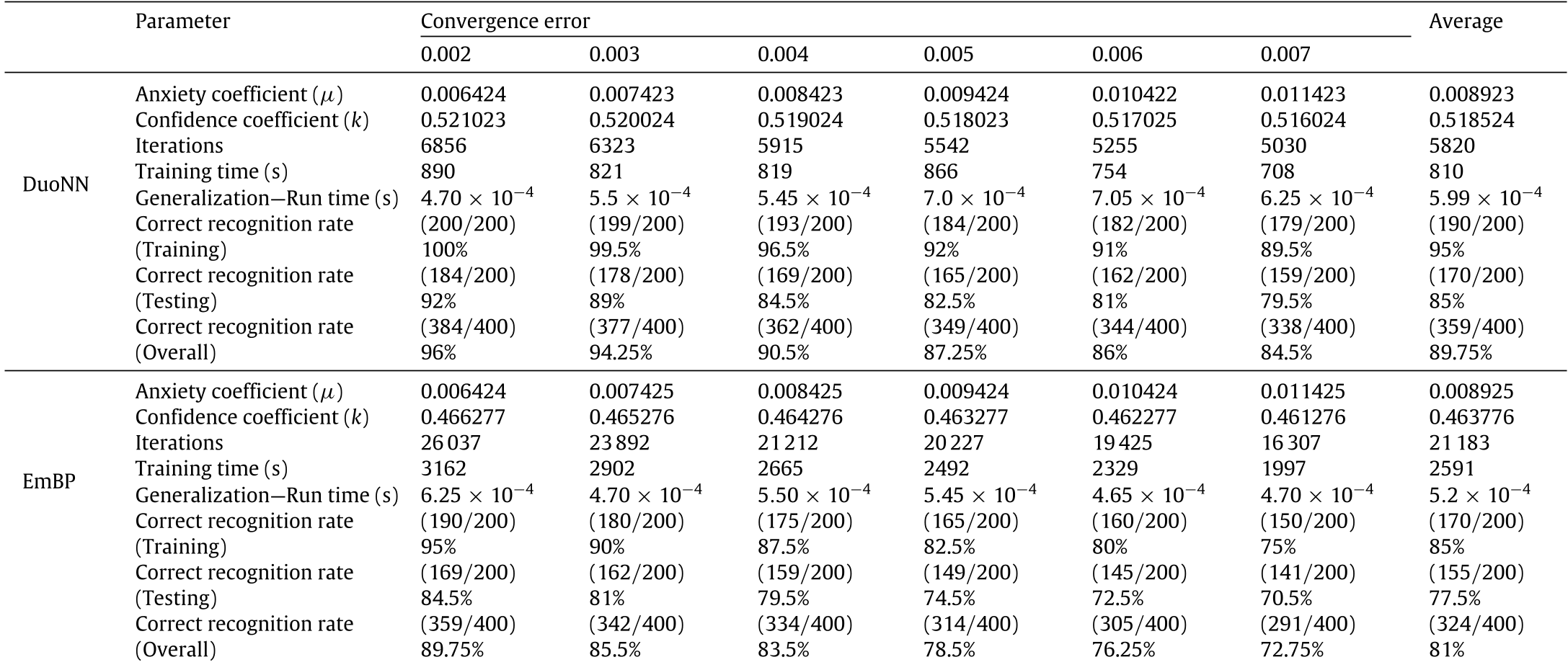
The results clearly show that the "Emotional Memory" provided by the ventral weights allows the network to find the global minimum of the cost function much more rapidly.
Deep Insight & Conclusion
The DuoNN framework proves that "emotion" in AI isn't just about sentiment analysis; it's about representation learning. By forcing the network to look at the "big picture" (ventral) alongside the "details" (dorsal), we provide it with an inductive bias that mirrors millions of years of biological evolution.
Future Outlook
While this paper uses face recognition as a playground, the implications for Autonomous Systems and Human-Robot Interaction are massive. A robot that experiences "anxiety" (uncertainty) in a novel environment and builds "confidence" as it learns could be the key to safer, more adaptive artificial intelligence.
Limitations: The current model uses simple pattern averaging for global features. Future iterations could benefit from more sophisticated global descriptors like Vision Transformers (ViT) or attention-based global pooling.